
I’ve been watching AI and crypto circle around each other for a while now, almost like two ideas that were always going to meet eventually. Not dramatically. More slowly than people expected. And I’m noticing something strange: the conversation has shifted. It used to be about what AI could do. Now it feels increasingly about who owns the value once AI starts doing more.
I keep wondering where all of this leads.
Because AI runs on data. Models improve because someone contributes information, time, feedback, computing power. Yet most of those contributions disappear into systems people never see. The outputs remain visible; the origins fade away.
That seems to be one of the questions sitting underneath OpenLedger.
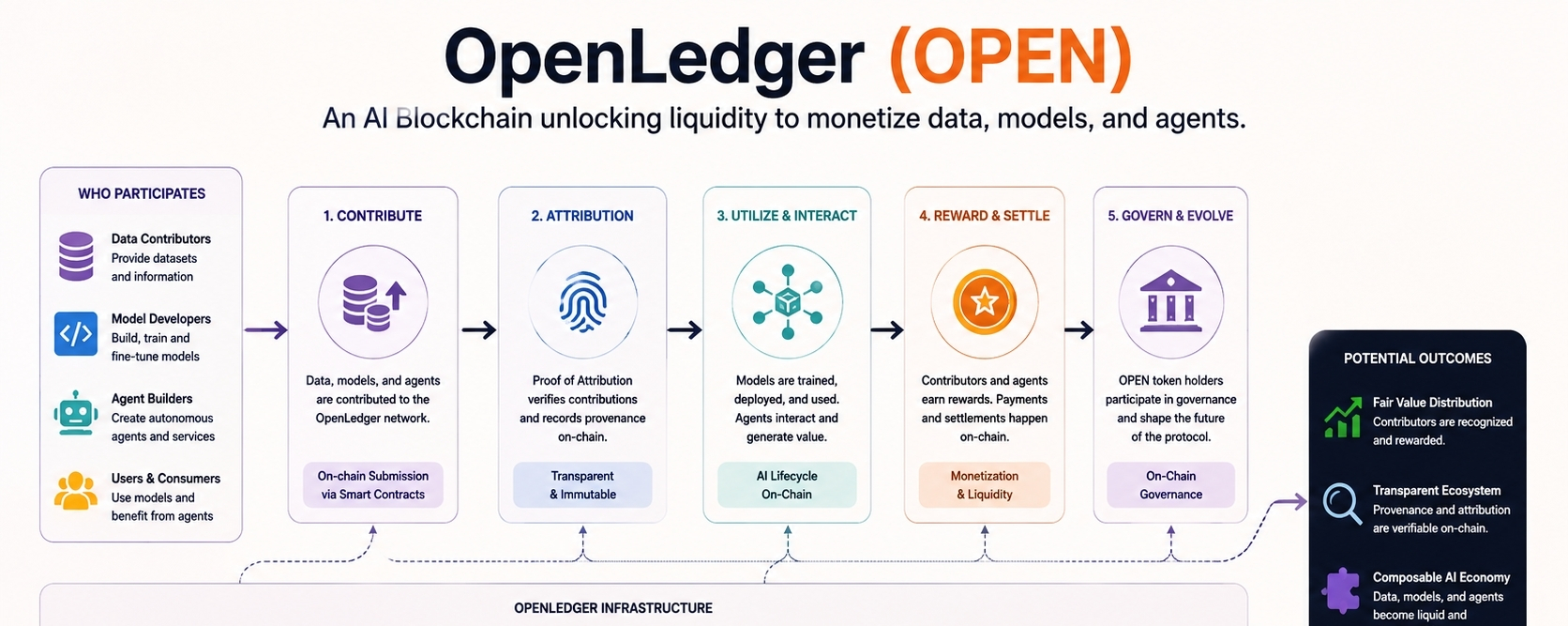
OpenLedger, or OPEN, positions itself as an AI-focused blockchain built around the idea that data, models, and autonomous agents shouldn’t exist in isolation from ownership or incentives. The vision is broader than simply hosting AI applications. It leans toward creating infrastructure where training, deployment, attribution, and interaction happen within an on-chain environment—where contributions become visible and potentially valuable.
On paper, it sounds practical.
Maybe even fair.
If data helps train a model, should the contributor benefit? If an AI agent creates value over time, should that activity be traceable? If models improve through collective participation, who deserves recognition?
These aren’t entirely technical questions. They feel human.
What makes OpenLedger interesting is that it doesn’t appear to build from scratch in complete separation from existing crypto ecosystems. Its Ethereum compatibility means wallets, smart contracts, and familiar developer tools can connect more naturally. Integration with Layer 2 environments suggests an attempt to reduce friction rather than create another isolated network with its own rules.
That approach feels sensible.
People rarely move toward entirely new systems overnight. They move through familiarity.
Still, I can’t help feeling cautious whenever efficiency becomes the central promise.
Because efficiency often sounds positive until you ask what gets removed in the process.
OpenLedger talks about unlocking liquidity around AI—around data, models, and agents. The phrase itself is interesting. Liquidity implies movement, accessibility, value flowing more freely. But once everything becomes liquid, everything also becomes measurable, tradable, and optimized.
Including intelligence.
Including contribution.
Possibly even trust.
And that’s where my uncertainty begins.
There’s an appealing side to the idea that AI ecosystems could become more transparent, where contributors aren’t invisible and where value isn’t captured entirely by centralized entities. Yet there’s another possibility too: creating new systems where every interaction gains an economic layer attached to it.
More ownership, perhaps.
But also more dependence.
I’m not sure which outcome feels more likely.
The growing conversation around autonomous agents makes this even harder to untangle. We’re moving toward a world where AI systems may not just answer questions but execute tasks, coordinate actions, and participate in digital economies. OpenLedger seems designed with that possibility in mind—a network where agents become active participants rather than passive tools.
That future sounds exciting for a moment.
Then slightly unsettling.
Because once agents generate value, questions around control become harder. Ownership becomes blurry. Attribution matters more. Incentives start shaping behavior in ways people don’t always anticipate.
Technology often promises decentralization while influence quietly recenters elsewhere.
History repeats itself enough to make caution reasonable.
Maybe OpenLedger becomes meaningful infrastructure for AI economies. Maybe transparent attribution and on-chain participation help build stronger systems around intelligence. Or maybe monetizing every layer of contribution introduces new complexities that won’t become obvious until much later.
I don’t know.
And I think uncertainty is the honest place to end.
For now, OpenLedger feels less like a finished answer and more like an experiment unfolding in public—an attempt to decide whether intelligence, ownership, and value can coexist differently than they have before.
I’ve been watching projects like this for a while.
Sometimes the most important ones aren’t the loudest.
They’re the ones that quietly raise questions people haven’t figured out how to answer yet.