
Most people do not realize how much of their life is already helping artificial intelligence grow. Every search, every conversation, every photo uploaded online, every review, every click, every correction, every reaction, and every piece of behavior quietly becomes part of a much larger machine learning system. AI did not suddenly appear from nowhere. It learned from people. It learned from years of human activity spread across the internet. In many ways, modern artificial intelligence is built from millions of invisible contributions made by ordinary users who never expected their digital lives to become economic fuel for intelligent systems.
But something strange is happening underneath this transformation. The people creating the raw value behind AI usually do not own the systems benefiting from it. Information flows upward into giant platforms, models become private infrastructure, and intelligence slowly concentrates inside a small number of companies with enormous computational power and control over data. Most users only see the surface layer, a chatbot answering questions, an image generator creating pictures, or an algorithm recommending content. Underneath that simple experience, an entirely new economic structure is forming around intelligence itself.
That is where OpenLedger begins to matter in a deeper way. The project is not interesting simply because it combines blockchain and AI. Hundreds of projects try to do that. What makes OpenLedger important is the larger question sitting underneath it. What happens if artificial intelligence becomes one of the most important layers of global infrastructure, but ownership over that intelligence remains concentrated inside closed systems forever? And what happens if there is another possible path where data, models, agents, and contributors can operate inside an open economic network instead of a fully centralized one?
OpenLedger appears to be built around the belief that intelligence itself may eventually need a decentralized coordination layer. Not because decentralization is fashionable, but because AI is becoming too economically important to exist only inside isolated corporate environments. The internet is slowly changing from a network where humans mostly exchange information into a network where machines, agents, algorithms, and automated systems increasingly interact with each other economically. Once that transition becomes large enough, questions about ownership, settlement, incentives, trust, and coordination become unavoidable.
For years, people accepted the internet tradeoff without thinking too deeply about it. Platforms offered convenience, entertainment, communication, and free services. In exchange, users provided data and attention. At first the arrangement seemed harmless because the systems were relatively simple. But AI changed the scale of the relationship completely. Information is no longer just helping platforms show advertisements more effectively. Information is now training systems capable of producing intelligence itself. That changes the meaning of contribution.
The uncomfortable reality is that modern AI systems depend heavily on collective human activity while most of the economic value flows toward centralized infrastructure owners. OpenLedger is part of a growing movement inside Web3 that questions whether this model becomes dangerous if AI eventually controls larger parts of digital life. The concern is not only financial. It is structural. Whoever controls intelligence infrastructure may eventually influence communication, labor markets, information flows, research systems, automation layers, financial coordination, and digital identity itself.
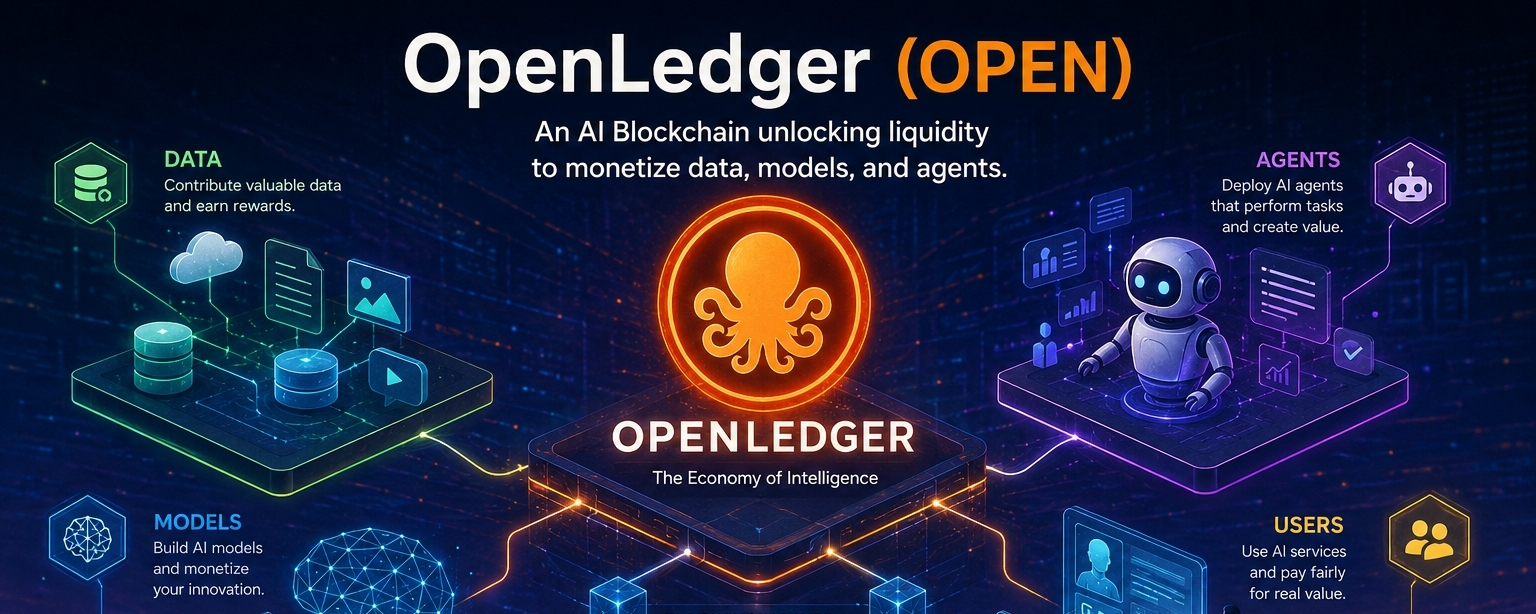
Instead of treating AI purely as software products, OpenLedger seems to treat intelligence as an economic network made from many participants interacting together. Data contributors provide information. Developers build models. Validators maintain reliability. Compute providers offer infrastructure. Autonomous agents perform tasks and interact with services. Users consume outputs and contribute activity back into the system. The blockchain layer acts as a coordination mechanism attempting to connect these relationships through transparent settlement and programmable incentives rather than centralized ownership alone.
This becomes easier to understand when thinking about how AI itself is evolving. Right now, most people still interact with AI manually by typing prompts into applications. But the industry is clearly moving toward autonomous systems capable of acting independently. AI agents may eventually manage workflows, purchase services, conduct research, analyze markets, interact with APIs, negotiate tasks, and communicate with other agents without constant human oversight. Once software becomes economically active on its own, entirely new coordination problems appear.
How do autonomous agents establish trust? How do they verify information? How do they pay for resources? How do they build reputation? How do they access reliable datasets? How do they interact economically across networks they do not control? Traditional centralized databases can store information, but they are not naturally designed for decentralized coordination between unrelated participants operating globally without trust. Blockchain systems were originally created to solve coordination problems exactly like this.
Bitcoin explored decentralized monetary settlement. Ethereum expanded that idea toward decentralized programmable coordination. Projects like OpenLedger are exploring whether intelligence itself can become part of decentralized economic infrastructure. That does not mean replacing AI companies entirely. It means creating open systems around intelligence before dependency on centralized platforms becomes too deeply embedded into the internet.
One of the more interesting aspects of OpenLedger is how it approaches the idea of data ownership. In traditional AI systems, data usually disappears into enormous training pipelines where attribution becomes almost impossible to track. Once models absorb the information, contributors lose visibility into how their participation generated value later. OpenLedger appears to be experimenting with ways to keep data economically connected to the network instead of allowing it to vanish permanently into closed systems.
That may sound technical, but emotionally it changes the relationship between people and digital infrastructure. Instead of users existing only as invisible fuel for increasingly intelligent systems, contributors potentially become economically connected participants inside the networks they help create. Whether this model fully succeeds remains uncertain, but the direction matters because it challenges the assumption that AI ownership must always remain centralized.
The OPEN token exists inside this broader coordination system. Like many blockchain networks, the token is designed to align incentives between independent participants. Decentralized systems cannot rely on corporate hierarchy to maintain behavior. Contributors need rewards for providing useful resources. Validators need incentives to maintain network integrity. Computational infrastructure requires compensation. Services need settlement layers. Tokens become the economic mechanism attempting to coordinate these moving parts together.
But token economies are fragile and often misunderstood. Crypto history is filled with projects where financial speculation became disconnected from actual utility. OpenLedger’s long term sustainability will depend heavily on whether the network creates real economic relationships around data, models, computation, and agents rather than existing primarily as a speculative market. Sustainable ecosystems usually require continuous activity, recurring demand, and meaningful dependency between participants. Without this, token incentives often weaken once market attention fades.
Reliability may become an even bigger challenge. AI systems already struggle with misinformation, hallucinations, manipulated outputs, and synthetic content. Decentralized environments make these problems harder because participants are independent and globally distributed. Poor quality datasets, dishonest contributors, spam agents, poisoned models, and fake reputation systems could slowly damage trust if the network lacks strong verification mechanisms.
This is one reason why OpenLedger’s real challenge may not be speed or scalability alone. The deeper challenge is whether decentralized systems can create trustworthy environments around intelligence production itself. Human societies build trust slowly through accountability, incentives, reputation, and consequences. Digital economies are not very different. If decentralized AI systems fail to establish reliability, users may naturally return toward centralized infrastructure because convenience and predictability become attractive during uncertainty.
At the same time, centralized systems carry their own risks. During stable periods, concentration often feels efficient because everything functions smoothly. But stress reveals dependency. Economic instability, censorship pressures, geopolitical fragmentation, monopolized infrastructure, and concentrated control expose how vulnerable people become when too much power sits inside too few systems. Open systems are slower, messier, and often less efficient, but they attempt to distribute coordination before dependency becomes irreversible.
That tension sits at the center of projects like OpenLedger. The project is not really trying to sell a fantasy about technology replacing humanity. It is responding to a deeper concern that intelligence itself may become one of the most concentrated resources in modern history if alternative coordination systems are never built. AI is slowly becoming infrastructure, and infrastructure shapes power over long periods of time.
The broader ecosystem around OpenLedger matters as well because no blockchain survives independently anymore. AI systems require storage, computation, identity layers, payment rails, interoperability systems, and developer environments. The future of decentralized AI will likely depend on networks integrating into wider Web3 infrastructure rather than existing as isolated chains competing for attention. Coordination between systems may become more important than competition between narratives.
There are also serious risks that cannot be ignored. Regulatory pressure around AI and crypto is increasing globally. Projects operating at the intersection of both industries may face uncertainty around data ownership, autonomous agents, digital assets, privacy rules, and financial compliance. There is also the risk that decentralized AI coordination simply proves less efficient than centralized alternatives in practice. Large technology companies possess enormous advantages in capital, infrastructure, talent, and execution speed. Open networks must prove that distributed ownership and resilience create enough long term value to justify slower coordination.
Another major risk involves sustainability during difficult market conditions. Many blockchain ecosystems grow rapidly during periods of strong incentives, but weaken once rewards decline. Temporary participation is not the same as durable utility. OpenLedger’s real test may come during periods when speculation disappears and only systems with genuine economic usefulness continue operating. If contributors remain active because the network provides real value, the system matures. If participation depends entirely on emissions and hype, long term reliability becomes difficult.
Still, the reason projects like OpenLedger continue attracting attention is because the underlying concern feels increasingly real. People can sense that the internet is changing again. AI is no longer just a productivity tool sitting on the edge of digital life. It is becoming part of the structure underneath digital economies themselves. Once intelligence becomes infrastructure, ownership stops being a philosophical discussion and becomes a practical question affecting power, economics, and participation across the internet.
Whether OpenLedger ultimately succeeds or fails may matter less than the direction it represents. The project reflects a growing realization that the future of AI may not only depend on who builds the smartest models. It may depend on who builds the most resilient systems for coordinating trust, ownership, incentives, and economic participation around intelligence itself. Under real world pressure, those structures matter far more than marketing narratives or temporary excitement.
The next era of the internet will likely be shaped by systems powerful enough to influence how people work, communicate, create, trade, and organize information. If intelligence becomes one of the foundational resources of modern civilization, then the question of who owns that intelligence may become one of the most important economic questions of the digital age.
