
There’s a certain pattern you start noticing after watching enough AI and crypto projects come and go. The language changes slightly every cycle, the branding becomes cleaner, the websites become more polished, but the structure underneath usually stays the same. First comes attention. Then comes the farming phase where everyone rushes in for rewards, points, whitelist campaigns, and speculative upside. After that, liquidity arrives, tokens unlock, early excitement fades, and the community quietly moves on to the next “revolutionary infrastructure layer” promising to reshape the internet.
That’s honestly where my mind went when I first came across OpenLedger.
Another AI blockchain. Another protocol talking about data ownership, decentralized intelligence, monetization, and network participation. Crypto has become extremely good at packaging familiar ideas into fresh narratives, and AI has become the easiest narrative of all. Right now, almost anything can raise attention if you attach “AI-powered” somewhere near the front page.
But OpenLedger felt a little different after sitting with it longer.
Not dramatically different. Not in the kind of way that instantly convinces you this is the future of technology. But different enough to make me stop treating it like another short-term attention machine.
The reason is simple: underneath the AI branding and blockchain language, OpenLedger seems to be focused on a problem that actually matters.
Most people using AI today don’t really think about where the intelligence comes from. They interact with a chatbot, image generator, or AI assistant and assume the system somehow created value on its own. But behind every model is an enormous ocean of human contribution — data, writing, conversations, images, behaviors, corrections, labeling, training material, feedback loops. Modern AI systems are built on top of human-generated information, yet the people contributing that information rarely capture any meaningful share of the value created afterward.
That imbalance has become one of the biggest unanswered questions in the AI industry.
OpenLedger appears to be trying to build an economic layer around that exact issue.
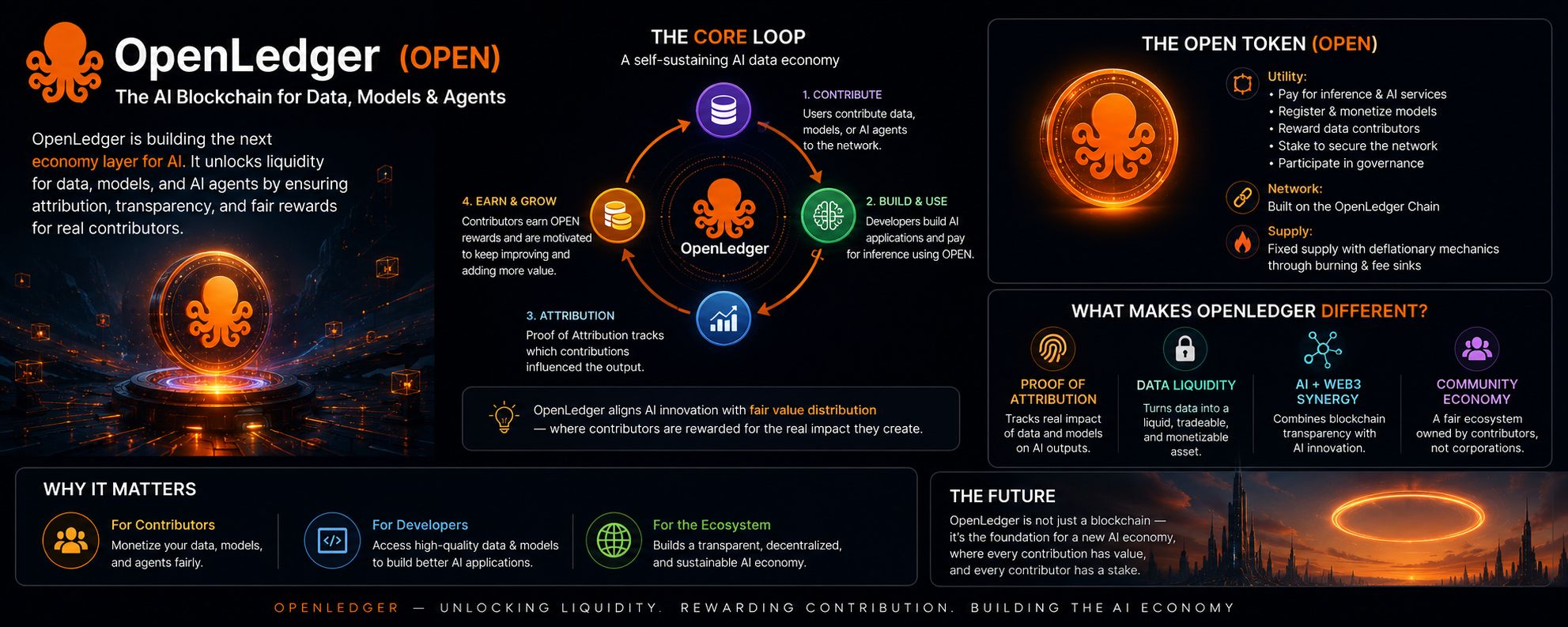
The idea, at least conceptually, is straightforward. Users contribute data, models, or AI-related assets into the network. Developers and applications use those resources to train or deploy AI systems. When those systems generate usage, requests, or inference activity, the protocol attempts to track which contributors helped produce the output. Rewards are then distributed back through a mechanism centered around attribution.
And honestly, that is a far more interesting direction than most AI-chain projects chasing speculative trends around AI agents endlessly talking to each other on social media.
OpenLedger is essentially asking whether data itself can become a productive on-chain asset instead of remaining invisible fuel extracted by centralized platforms.
That doesn’t automatically mean the model works.
In fact, the reason this project stands out is partly because the problem it’s trying to solve is genuinely difficult.
A lot of crypto projects become popular because the core idea is emotionally appealing while technically shallow. OpenLedger feels almost inverted. The concept is compelling precisely because the execution challenge is enormous.
Attribution inside AI systems is messy.
Very messy.
Once a model has been trained across massive datasets, identifying exactly which contributors influenced which outcomes becomes incredibly complicated. Data overlaps. Models evolve. Fine-tuning changes behavior. Outputs are probabilistic rather than deterministic. So when OpenLedger talks about rewarding contributors fairly through attribution systems, the natural question becomes: can this actually function accurately at scale?
That’s where skepticism still matters.
Because crypto history is filled with projects that identified real structural problems but underestimated how hard those problems were to solve in practice.
Still, there’s something refreshing about seeing a project aim at infrastructure instead of pure spectacle. The broader AI ecosystem right now is dominated by centralized players with almost complete control over data pipelines, training resources, and monetization. OpenLedger is trying to insert a programmable economic layer into that system where contributors are no longer passive participants but active stakeholders.
Whether blockchain is the ideal solution for that remains debatable. But at least the project isn’t inventing a fake problem just to justify a token.
And the token itself is interesting for that reason.
OPEN is not just positioned as another governance coin floating around without purpose. It sits directly inside the network’s economic loop. Developers use it for deploying models and paying for inference. Contributors receive it when their data or models create measurable value. Validators secure the network through staking. Governance and ecosystem participation also revolve around it.
At first glance, that “one token powers everything” structure sounds dangerously familiar because crypto projects love overloading utility narratives. Usually it’s marketing disguised as design. But the more you examine OpenLedger’s architecture, the more the token at least appears connected to actual network activity rather than existing solely for speculation.
That distinction matters.
The strongest crypto systems are usually the ones where the token naturally emerges from usage instead of being artificially forced into the ecosystem afterward.
But even if the structure makes sense on paper, the real test is user behavior.
And this is where things become complicated again.
Crypto users are extremely efficient at exploiting incentives. If emissions exist, people will optimize for extraction. If rewards exist, farming will appear almost immediately. It doesn’t matter how idealistic the project vision sounds. Human behavior inside tokenized systems eventually gravitates toward whatever produces the highest short-term return with the lowest effort.
OpenLedger already shows signs of facing that tension.
Early participation campaigns, reward systems, ecosystem incentives, and community farming mechanics are useful for bootstrapping activity, but they also attract the exact kind of temporary engagement that eventually weakens many crypto ecosystems. The danger is that speculative participation starts looking like genuine adoption until the rewards slow down.
That’s why the attribution layer becomes so important.
OpenLedger seems to understand that simply rewarding activity is not sustainable. The protocol is attempting to reward useful contribution instead. In theory, users earn value not because they clicked buttons every day, but because their data or models generated measurable utility for the network.
That is a much healthier direction than pure emissions farming.
The problem, again, is whether the system can reliably distinguish genuine contribution from manipulated participation.
Because if attribution becomes inaccurate or easy to game, the economic model starts breaking apart very quickly. Contributors lose trust. Developers lose confidence. Speculators dominate behavior. Eventually the network risks turning into another circular reward machine detached from meaningful usage.
And this is really the core tension surrounding OpenLedger.
The vision is intelligent.
The incentives are more thoughtful than average.
The target problem is real.
But the execution burden is massive.
At the same time, I think that difficulty is exactly why the project feels more credible than many AI-chain narratives floating around right now. The easiest crypto ideas are usually the least important. OpenLedger is stepping directly into one of the most unresolved economic questions in artificial intelligence: who deserves compensation when AI systems create value?
That question is only becoming bigger.
As AI models absorb more human-generated knowledge and become commercially dominant, pressure around ownership, contribution, attribution, and monetization will intensify. Centralized companies currently control most of that economic flow. OpenLedger is effectively experimenting with an alternative structure where value distribution becomes more transparent and programmable.
Maybe that works.
Maybe it becomes too complicated for mainstream adoption.
Maybe developers simply prefer centralized infrastructure because it’s faster and easier.
Maybe attribution systems never become accurate enough to justify the overhead.
Those are all realistic possibilities.
And honestly, the project does not need to become the dominant AI blockchain to matter. Sometimes experiments become valuable simply because they explore the right questions before the market fully understands why those questions matter.
What keeps pulling my attention back to OpenLedger is that it doesn’t feel entirely driven by the usual crypto psychology cycle. There’s still speculation, obviously. There’s still token volatility, hype phases, and community excitement attached to future upside. No crypto project escapes that environment. But beneath it, there appears to be an actual attempt to build an economic model around AI contribution rather than just financializing attention.
That’s a meaningful distinction.
Whether it succeeds is another story entirely.
Right now, OpenLedger feels less like a finished ecosystem and more like an early experiment trying to prove that AI contribution can become measurable, tradable, and rewardable inside an open network. If the mechanics work, the project could end up occupying a genuinely important corner of decentralized AI infrastructure. If they don’t, it risks falling into the same cycle that swallowed countless other ambitious protocols before it.
That uncertainty is still very real.
But for the first time in a while, this is one of those AI-chain projects where the skepticism doesn’t completely overpower the curiosity.
And in this market, that alone already makes it worth paying attention to.