
There was a period when every infrastructure meeting sounded the same. Someone would walk into the room with a benchmark chart, a latency graph, a triumphant TPS number glowing like a clean medical scan. The assumption sat underneath every conversation: faster systems were safer systems. Faster finality meant fewer problems. Faster execution meant maturity. Faster throughput meant inevitability.
Then the incident reports started arriving at 2:07 a.m.
Not consensus failures. Not catastrophic halts. Human failures. Wallet approvals signed too broadly. Delegated permissions left open after deployment windows closed. Session keys that outlived their purpose by weeks because nobody wanted to interrupt “user flow.” The chain was fast. The exploit was faster.
That is the uncomfortable territory where OpenLedger becomes interesting.
OPEN does not present itself as a civilization-ending revolution. It feels more like infrastructure designed by people who have already sat through audit reviews with legal teams, protocol engineers, treasury operators, and exhausted compliance leads arguing over whether a signer should retain privileges through the weekend. The architecture carries the tone of organizations that understand something uncomfortable about modern crypto systems: catastrophic losses rarely originate from block production speed. They emerge from authority leakage.
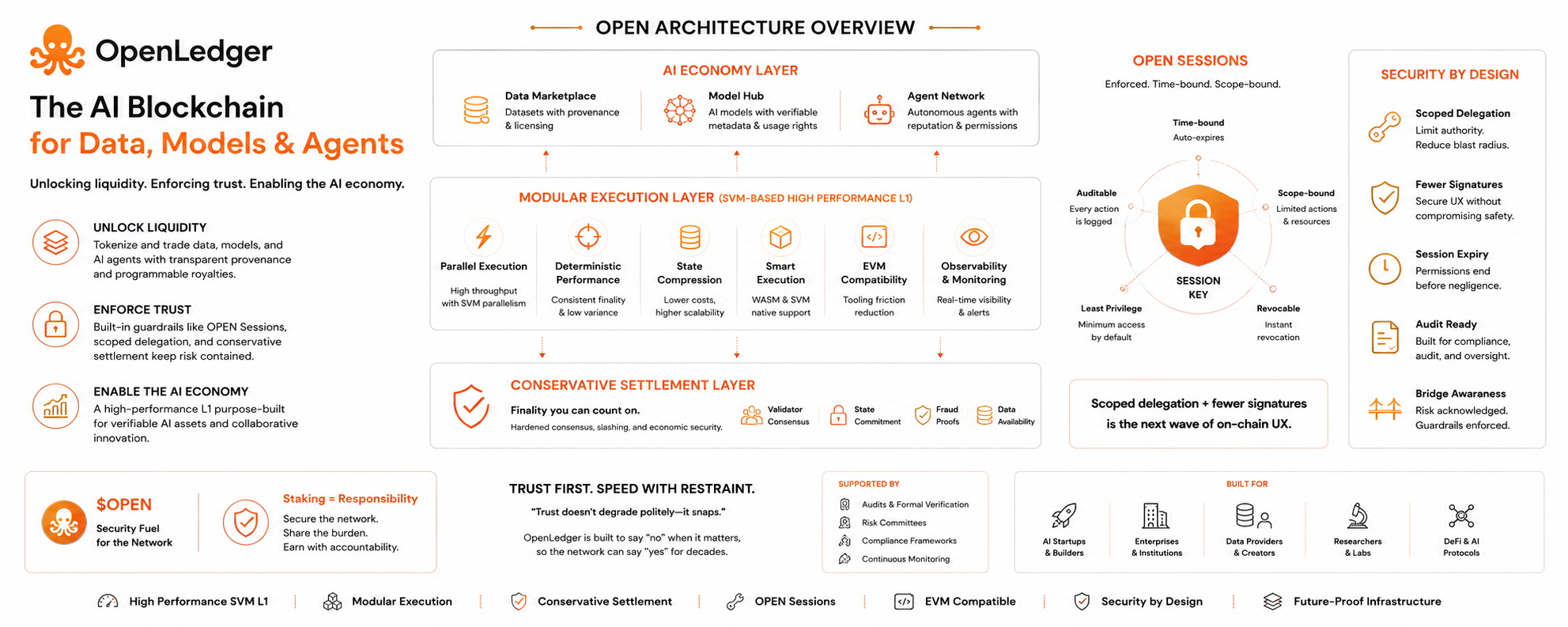
An SVM-based high-performance L1 is, on paper, an obvious answer to modern throughput demands. Parallel execution matters. Deterministic performance matters. Congestion costs matter. But OPEN’s more important design instinct is restraint. The network appears structured around the idea that execution environments should move quickly while settlement remains conservative enough to reject chaos rather than absorb it. Modular execution above a hardened settlement layer is not just a scaling strategy; it is operational philosophy. Separate velocity from accountability. Let systems breathe without allowing them to improvise trust.
Because trust, in production systems, behaves differently than people imagine.
“Trust doesn’t degrade politely—it snaps.”
The sentence sounds dramatic until you watch a bridge exploit unfold in real time. One compromised validator set. One leaked multisig approval. One overlooked dependency in a liquidity route that had already passed six internal reviews and three external audits. Then the dashboards turn red, phones begin vibrating across time zones, and every executive suddenly wants to know why a permissions model nobody discussed during growth meetings had unilateral authority over treasury movement.
Bridges remain one of the clearest examples of the industry misunderstanding its own risk profile. The obsession with throughput often distracts from the fact that the largest failures happen in translation layers, delegated authorities, and operational shortcuts. Slow blocks are annoying. Exposed keys are existential.
OPEN Sessions feels designed by people who accept that reality without romanticism. The concept is not glamorous: enforced, time-bound, scope-bound delegation. Temporary authority with explicit limitations. Session-based permissions that expire before negligence can become institutionalized. The design acknowledges that users and organizations will always delegate power; the only real question is whether the system forces that delegation to remain narrow, observable, and disposable.
“Scoped delegation + fewer signatures is the next wave of on-chain UX.”
That line matters because most conversations around user experience still reduce themselves to friction elimination. Fewer clicks. Fewer prompts. Faster approvals. But mature infrastructure treats friction selectively. Some friction prevents catastrophe. Some signatures exist only because architectures never learned how to express bounded trust cleanly. OPEN Sessions appears to argue that reducing signatures should not mean expanding exposure. It should mean shrinking the blast radius of every interaction.
The distinction changes the emotional texture of operating a network.
There is a particular kind of silence that exists during wallet approval debates inside serious organizations. Not public Twitter arguments. Internal calls. Treasury teams asking whether automated agents should receive broad execution rights during liquidity events. Security engineers warning that “temporary” permissions historically become permanent permissions. Product teams insisting that tighter controls reduce conversion. Compliance officers quietly asking who carries liability after compromise.
Those conversations shape infrastructure more than TPS leaderboards ever will.
Even OPEN’s EVM compatibility reads less like ideological alignment and more like operational concession. Tooling friction reduction matters because developers arrive carrying habits, libraries, monitoring systems, and deployment assumptions accumulated over years. Compatibility is not identity. It is translation infrastructure. The more important question is what the system permits once developers arrive.
And OPEN’s answer appears unusually direct: speed is acceptable only when authority remains constrained.
The native token exists inside that framework less as spectacle than as security fuel. Staking, in mature systems, is not passive yield theater. It is operational responsibility. Economic participation tied to validation discipline. The language around staking often becomes euphoric in this industry, but the mechanics are fundamentally administrative: secure the network, inherit the burden of keeping it honest, absorb consequences when that honesty fails.
That is why the most sophisticated infrastructure conversations eventually stop sounding technical and start sounding philosophical.
What should a system allow by default?
What should it refuse?
What permissions should expire automatically, even when users prefer convenience over discipline?
The industry spent years believing decentralization meant removing barriers. But institutional-grade systems increasingly discover that survival depends on intelligently designed constraints. Not every request deserves approval. Not every key deserves persistence. Not every transaction deserves authority simply because it can be executed quickly.
A fast ledger that cannot say “no” eventually becomes a machine for accelerating predictable failure.
OPEN’s more compelling argument is that performance and refusal can coexist. That an SVM-based chain can remain high-speed while still enforcing bounded permissions, constrained delegation, and conservative settlement assumptions beneath modular execution layers. Not safety through slowness. Safety through explicit limitation.
Because in the end, the systems that survive are rarely the ones that moved the fastest.
They are the ones that understood exactly when to stop.
