
Most conversations about artificial intelligence eventually circle back to the same familiar names: the companies building giant models, the race for faster chips, or the endless speculation about what machines may eventually replace. Yet beneath all of that sits a quieter question that rarely gets proper attention. Who actually creates the raw material that makes intelligent systems useful in the first place, and why do so few people benefit from it?
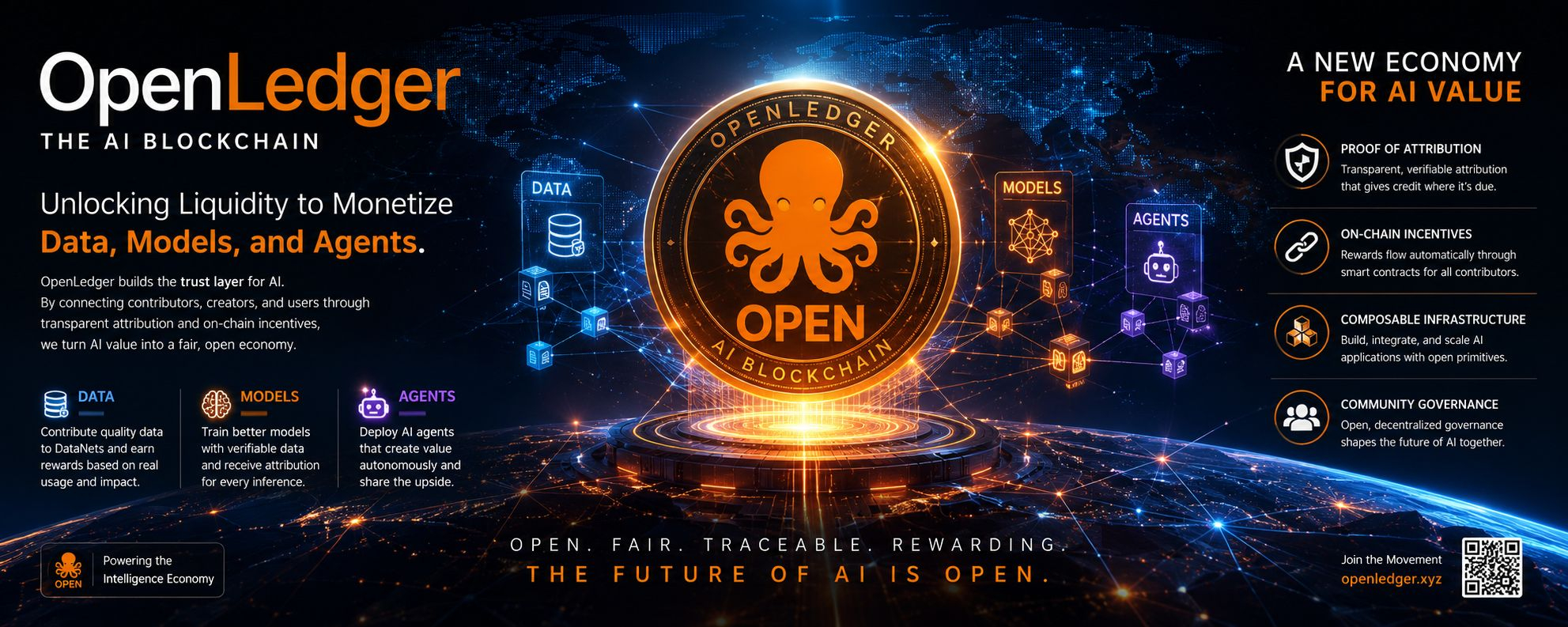
That overlooked space is where OpenLedger has decided to position itself. It describes itself as an AI blockchain designed to unlock liquidity around data, models, and agents, but the idea begins to make more sense when stripped of technical language. At its center sits a simple argument: the people and systems contributing value to AI should not disappear into the background once a model becomes profitable or useful. Data, expertise, refinement, and interaction all shape intelligence, yet the chain of contribution is often invisible.
The modern AI economy has a strange habit of consuming effort while quietly erasing its fingerprints. Massive models learn from oceans of information, much of it created by individuals, communities, specialists, and institutions whose role becomes difficult to trace once training is complete. The outcome may be impressive, but the path that produced it grows foggy. OpenLedger seems to be asking whether that fog is inevitable or merely convenient.
Instead of treating AI as a sealed product, the project approaches it more like an ecosystem with memory. It wants data, models, and autonomous agents to behave less like scattered digital assets and more like economic participants whose contributions can be identified and rewarded. There is an unusual practicality to that ambition. It does not begin with promises about replacing industries or reinventing civilization. It starts by looking at the plumbing.
The term “liquidity” appears often around OpenLedger, though here it carries a slightly different flavor than in traditional crypto conversations. Usually, liquidity points toward markets and financial movement. In OpenLedger’s framing, it stretches into something broader: turning otherwise trapped value into something measurable and exchangeable. Data that would normally sit unused or uncompensated becomes part of a marketplace. Models stop existing as isolated technical achievements and instead become assets with traceable economic relationships. Even AI agents, increasingly discussed as autonomous software workers, are treated as participants capable of generating and receiving value.
There is something quietly ambitious about that framing because it touches a problem many AI builders already recognize. High-quality data is expensive, difficult to source, and often painfully specialized. General information can teach a model broad behavior, but expertise lives elsewhere. Legal systems, medicine, finance, logistics, agriculture—each field carries nuance that generic datasets rarely capture. The people holding that knowledge usually have little reason to contribute it openly if there is no clear way to benefit.
OpenLedger’s response leans into attribution. Rather than viewing training data as something absorbed and forgotten, the system attempts to preserve a line between input and outcome. The concept is not entirely new in theory, but applying it meaningfully at scale is another matter. The project introduces what it calls Proof of Attribution, an effort to identify how datasets influence model outputs so contributors can receive compensation tied to actual use rather than abstract promises.
That distinction matters more than it first appears. Many platforms speak generously about rewarding participation, yet the rewards often feel detached from genuine contribution. OpenLedger appears to be aiming for something more grounded: if a dataset materially shapes a model’s usefulness, its contributor should not vanish from the economic equation. In principle, this nudges incentives toward quality instead of noise. People are given a reason to contribute something meaningful rather than simply something abundant.
Its structure revolves around something called DataNets, which can be understood as organized streams of domain-specific information rather than giant undifferentiated data pools. The logic here feels refreshingly realistic. Intelligence tends to improve when context becomes sharper. A healthcare-focused system trained on precise medical knowledge behaves differently from a broad model stretched across unrelated information. By separating knowledge into purposeful environments, OpenLedger seems to be betting that specialized intelligence will matter more in the next chapter of AI than endlessly scaling generic systems.
The project also gestures toward a future where models themselves become easier to create and distribute. Instead of assuming only enormous corporations can train useful AI, OpenLedger introduces infrastructure aimed at helping communities, developers, or businesses build models tied to their own expertise. This feels like an important shift in tone. Much of today’s AI conversation quietly assumes centralization—that only the biggest players possess enough resources to matter. OpenLedger seems to push against that assumption, suggesting intelligence can emerge from many smaller but deeply informed sources.
Of course, none of this becomes meaningful simply because the language sounds thoughtful. Systems like this succeed or fail through execution. Attribution sounds attractive until reality enters the room. Models evolve, data overlaps, and causality becomes difficult to untangle. If ten sources shape one outcome, how should rewards be distributed? What happens when knowledge changes over time? Can attribution remain fair once systems become deeply interconnected? These are not minor technical details hiding in the margins. They are the whole challenge.
Yet there is value in paying attention to projects willing to wrestle with difficult questions rather than avoid them. Too much of the blockchain world still drifts toward abstraction, speaking endlessly about future transformation while remaining detached from practical use. OpenLedger, for all its complexity, appears anchored in a tangible friction point. AI increasingly depends on collective contribution, but collective contribution rarely translates into collective ownership.
The OPEN token sits inside this structure as more than a symbolic badge. It functions across staking, governance, fees, and incentives tied to network participation. That does not automatically guarantee usefulness—tokens are easy to create and harder to justify—but within OpenLedger’s design, the token appears woven into how value circulates rather than merely existing for speculation. Whether that structure matures into something sustainable depends less on market excitement and more on whether people actually build, contribute, and stay.
There is also a cultural undercurrent to the project that feels worth noticing. For years, technology has moved in a direction where systems become more powerful while the people shaping them become less visible. OpenLedger quietly argues for the opposite. It imagines intelligence with receipts. A model response is not just an answer appearing from nowhere but something connected to histories of contribution, expertise, and participation.
Perhaps that is why OpenLedger feels slightly different from many AI-blockchain narratives. It is not trying to convince people that decentralization alone solves everything, nor does it rely entirely on dramatic predictions about artificial intelligence taking over every profession. Instead, it spends more time asking an uncomfortable but necessary question: if intelligence increasingly becomes the world’s most valuable resource, who gets remembered when value is created?
There is no certainty that OpenLedger will fully solve the puzzle it has set for itself. In truth, few projects attempting something this structurally difficult ever move without friction. But there is something worthwhile in the attempt. The future of AI may depend less on who builds the biggest model and more on who builds systems that people trust enough to contribute to.
And trust rarely grows from spectacle. More often, it grows from fairness people can actually see.
