
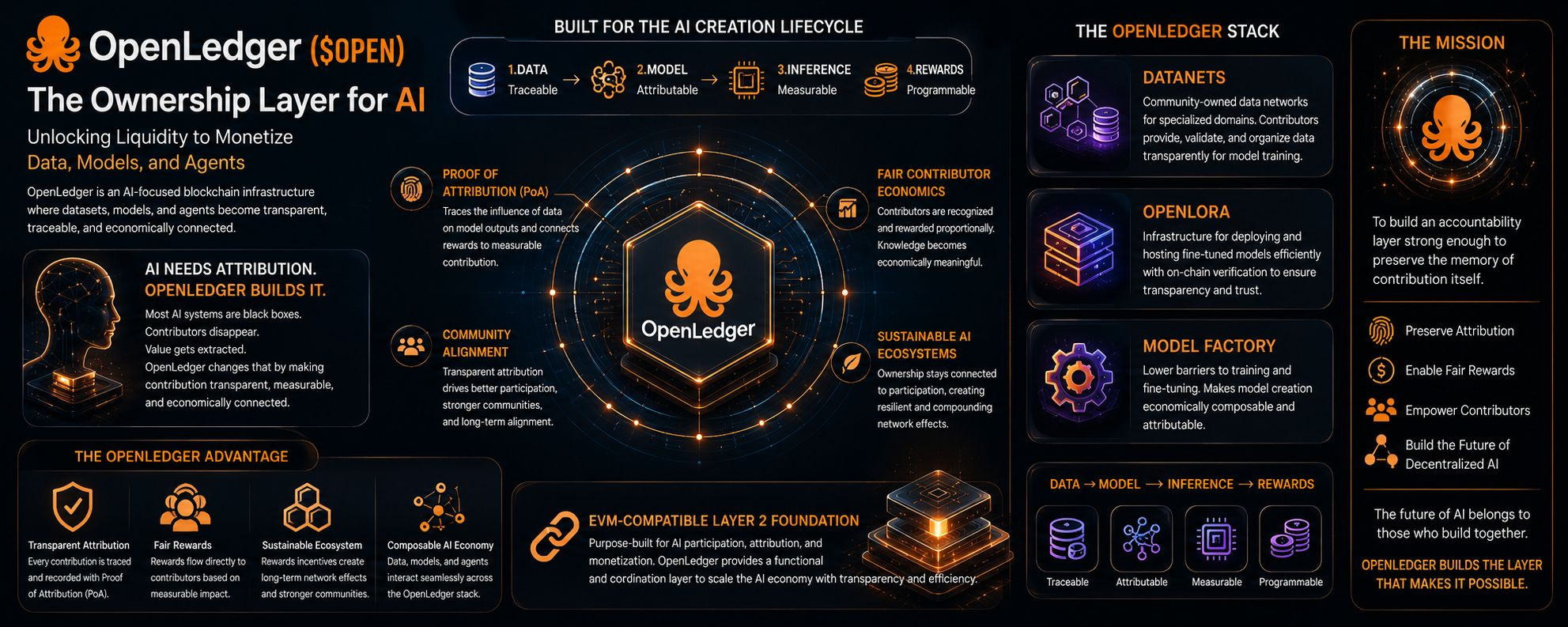
OpenLedger ($OPEN) is one of the few AI projects I’ve studied recently that doesn’t feel obsessed with visibility. The longer I spent exploring its architecture and underlying philosophy, the more it started to resemble something quieter and potentially far more important: an ownership layer for AI.
That distinction matters more than most people realize
A large portion of today’s AI economy operates through invisible extraction. Data is collected, models are trained, outputs are monetized, and somewhere along the process the contributors disappear. The people who shaped the intelligence itself rarely remain connected to the value being created. Attribution fades. Ownership dissolves. Economic participation becomes concentrated around whoever controls the infrastructure.
What makes OpenLedger interesting is that it approaches this problem from the opposite direction.
Instead of treating attribution as an afterthought, it places attribution at the center of the system design. The entire structure feels built around a simple but powerful idea: AI systems should be able to identify where intelligence came from, who contributed to it, and how value should flow back to those participants over time.
That changes the conversation entirely.
OpenLedger positions itself as an AI-focused blockchain infrastructure where datasets, models, and agents become transparent, traceable, and economically connected. Rather than functioning like a general-purpose chain trying to absorb AI as another narrative, it appears designed specifically around the lifecycle of AI creation itself.
The part that stayed with me most was Proof of Attribution (PoA).
Most AI systems today operate like black boxes. You might see an output, but you rarely understand which datasets, contributors, or refinements influenced the result. OpenLedger attempts to make that relationship measurable. Its PoA mechanism is designed to trace the influence of data on model outputs and connect rewards directly to measurable contribution.
That may sound technical on the surface, but the behavioral implications are much bigger than the mechanism itself.
When contributors know their participation can be recognized transparently and rewarded proportionally, the quality of participation changes. People become less disposable inside the AI pipeline. Specialized knowledge becomes economically meaningful again. High-quality datasets stop being treated as invisible fuel and start functioning more like productive assets.
I think this is where OpenLedger starts to feel structurally different from many AI narratives currently circulating through crypto.
Most projects focus heavily on compute, model performance, or speculative AI agents. OpenLedger seems more concerned with incentive alignment and provenance — the economic and accountability layer underneath intelligence systems. From what I see, the project is asking a deeper question: how do you build AI ecosystems where contributors remain permanently connected to the value they help create?
That question becomes even more important when looking at Datanets.
The idea behind Datanets appears relatively straightforward, but strategically it feels significant. Instead of relying on opaque centralized datasets, OpenLedger enables community-owned data networks designed around specialized domains. Contributors can provide, validate, and organize data transparently for model training.
This creates an entirely different relationship between data and AI development.
Specialized AI models require specialized data. But specialized data is difficult to sustain if contributors have no visibility, no attribution, and no long-term participation in the economic upside. Datanets seem designed to solve exactly that tension by turning data contribution into an ongoing economic relationship rather than a one-time extraction event.
The same pattern extends into OpenLoRA and Model Factory.
OpenLedger doesn’t appear focused solely on making models accessible. It also seems focused on making model creation economically composable and attributable. Model Factory lowers the barriers around training and fine-tuning, while OpenLoRA provides infrastructure for deploying and hosting fine-tuned models efficiently with on-chain verification mechanisms attached to them.
What I found interesting is that these components are not presented as isolated products. They function more like connected layers of a broader AI economy:
Data becomes traceable. Model creation becomes attributable. Inference becomes measurable. Rewards become programmable.
That continuity is important because fragmented systems rarely sustain long-term ecosystems. Infrastructure tends to survive when incentives remain coherent across the full stack.
Another detail I kept returning to was the project’s EVM-compatible Layer 2 foundation.
Not because “Layer 2” itself is exciting, but because it signals something more pragmatic underneath the design philosophy. OpenLedger doesn’t feel like it is trying to reinvent every component of blockchain architecture for spectacle. The approach appears more focused on building a functional settlement and coordination layer specifically optimized for AI participation, attribution, and monetization.
That practical orientation matters.
In crypto, infrastructure projects often outlast trend-driven narratives precisely because they solve coordination problems that continue existing regardless of market cycles. AI hype will likely evolve through multiple phases over the coming years. Models will improve. Interfaces will change. Narratives will rotate. But ownership, attribution, provenance, and contributor incentives are structural problems. They do not disappear simply because the market becomes distracted by the next trend.
That’s why OpenLedger feels less like a temporary AI narrative and more like an attempt to redesign the economic logic underneath AI systems themselves.
And honestly, that may end up being the more durable opportunity.
Because the future AI economy probably does not belong entirely to whoever builds the largest models. It may increasingly belong to whoever builds systems where contributors, datasets, developers, and communities remain aligned over long periods of time.
OpenLedger seems to understand that alignment is not just a technical issue. It is behavioral infrastructure.
When attribution becomes transparent, people contribute differently. When rewards become measurable, ecosystems become more sustainable. When ownership remains connected to participation, the network becomes harder to extract from and easier to grow collaboratively.
After spending time studying the project, that is ultimately what stayed with me.
Not the token. Not the market narrative. Not the short-term speculation.
But the possibility that AI may eventually require an accountability layer strong enough to preserve memory of contribution itself — and that OpenLedger is quietly positioning itself around that idea long before most of the industry fully recognizes its importance.