

The deeper I go into AI related crypto projects lately, the more repetitive the whole sector starts feeling. Everybody talks about smarter agents, decentralized models, autonomous systems, but very few projects seem interested in the economic structure underneath those ideas. Most of them still behave like isolated applications wrapped in AI branding. That’s honestly why #OpenLedger stayed in my head longer than I expected. The protocol doesn’t just ask how AI can exist on chain. It keeps asking who contributed to the intelligence, where the value originated, and how rewards move back across the system once that intelligence becomes useful.
I think that changes the entire framing of the project.
At first I assumed @OpenLedger was mainly another AI infrastructure play trying to attach itself to the current market cycle. But the more I read through the architecture, the more the cross chain aspect started looking less like expansion and more like necessity. AI native applications cannot function as isolated blockchain economies forever. Datasets, liquidity providers, model creators, validators, and users are all going to exist across different ecosystems. If the incentives only work inside one chain, the system eventually breaks apart. OpenLedger seems to understand that earlier than most projects currently do.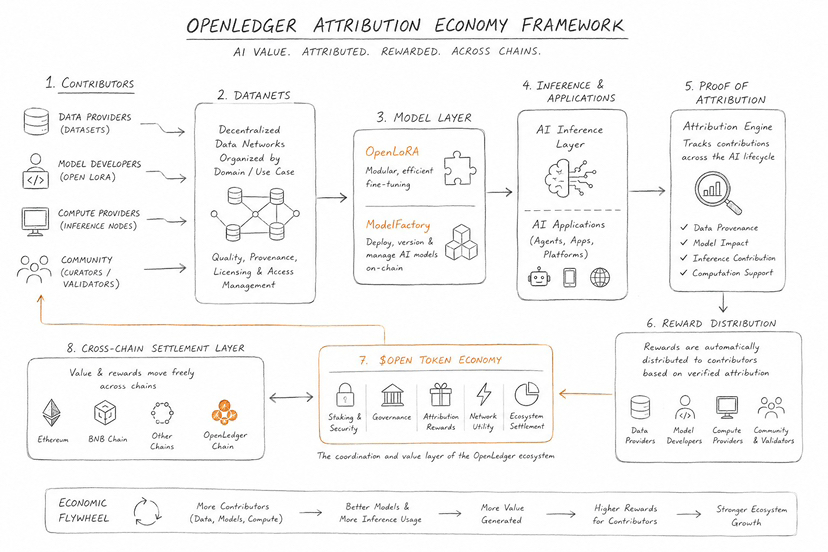
What really stood out to me was how central attribution is to everything. Most AI systems today still operate like closed machines where intelligence appears without transparent ownership underneath. OpenLedger’s Proof of Attribution model pushes in the opposite direction. Instead of treating AI outputs as disconnected results, the protocol keeps tracking the datasets, fine tuning activity, inference contributions, and participants responsible for improving the model over time. The interesting part is that attribution itself becomes portable across ecosystems. That’s where the cross chain infrastructure suddenly matters much more than simple liquidity transfers.
The Datanets layer honestly feels like one of the more overlooked parts of the whitepaper. People usually reduce it to “decentralized datasets,” but it’s much more economic than that. Datanets create structured environments where specialized data can continuously feed AI models while remaining connected to attribution and rewards. So if a financial AI model improves because of a specific dataset or contributor group, the protocol can theoretically route value back toward the participants who strengthened the intelligence in the first place. That creates a feedback loop most AI platforms today still completely ignore.
I also think OpenLedger understands something important about AI monetization that the broader market still underestimates. Intelligence alone is not enough. There has to be infrastructure connecting model deployment, inference demand, contributor incentives, and liquidity coordination together in one system. That’s where OpenLoRA and ModelFactory started making more sense to me. OpenLoRA allows smaller specialized models to operate efficiently without retraining massive systems repeatedly, while ModelFactory creates deployment rails for AI-native applications directly inside the ecosystem. But both still remain connected to the attribution framework underneath, which means the protocol is effectively monetizing the full lifecycle behind AI instead of only the final output.
The OPEN token becomes much easier to understand once you view the network from that perspective. A lot of AI tokens still feel detached from actual protocol activity, almost like speculative placeholders waiting for future utility. OpenLedger integrates OPEN into validator coordination, staking, governance, attribution rewards, and ecosystem participation itself. Validators securing inference activity and contributors supplying useful intelligence both become part of the same economic loop. Right now the protocol sits around a $68 million market capitalization with daily trading volume near $20 million and more than 28,000 holders. Those numbers are still relatively early, but large enough that the ecosystem already feels active instead of theoretical.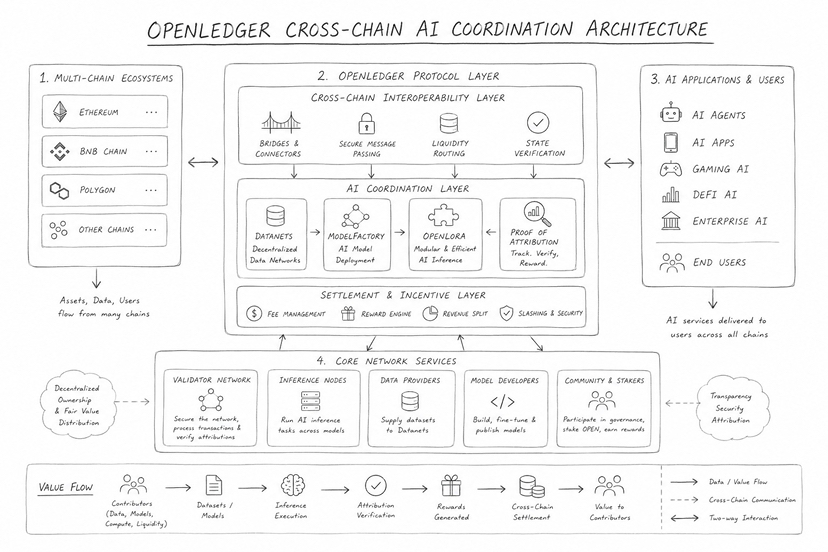
At the same time, I don’t think the market has fully decided whether this kind of infrastructure is investable yet. Cross chain systems have historically struggled with fragmentation and security concerns, while decentralized AI economics are still mostly experimental across crypto. Even after recent ecosystem growth, OPEN remains significantly below previous highs. Personally, I don’t necessarily see that as weakness. Infrastructure projects usually look confusing before they look obvious because their value depends on long term coordination rather than short term speculation.
What keeps pulling me back toward OpenLedger is that the protocol feels less focused on AI hype and more focused on economic continuity. Most projects are trying to decentralize models. OpenLedger seems to be trying to decentralize the relationships surrounding those models, the ownership, the contribution tracking, the rewards, the liquidity, and the movement of value across ecosystems. That’s a much harder thing to build, but it also feels far more durable if decentralized AI actually becomes a real industry instead of another temporary narrative cycle.
And honestly, that’s probably the biggest reason the project feels different to me now. It doesn’t behave like a protocol chasing attention. It behaves like infrastructure quietly preparing for a future where AI applications, cross chain assets, datasets, validators, and users all operate inside the same connected economy. Most crypto projects still treat those layers separately. $OPEN is one of the few trying to make them function together from the beginning.