
I’ve been thinking a lot about where AI value actually comes from, and honestly most people still focus only on the front-end layer. Better chatbots, faster generation, cleaner UX. But underneath all that, the real battle seems to be forming around ownership and liquidity.
That’s partly why OpenLedger (OPEN) caught my attention.
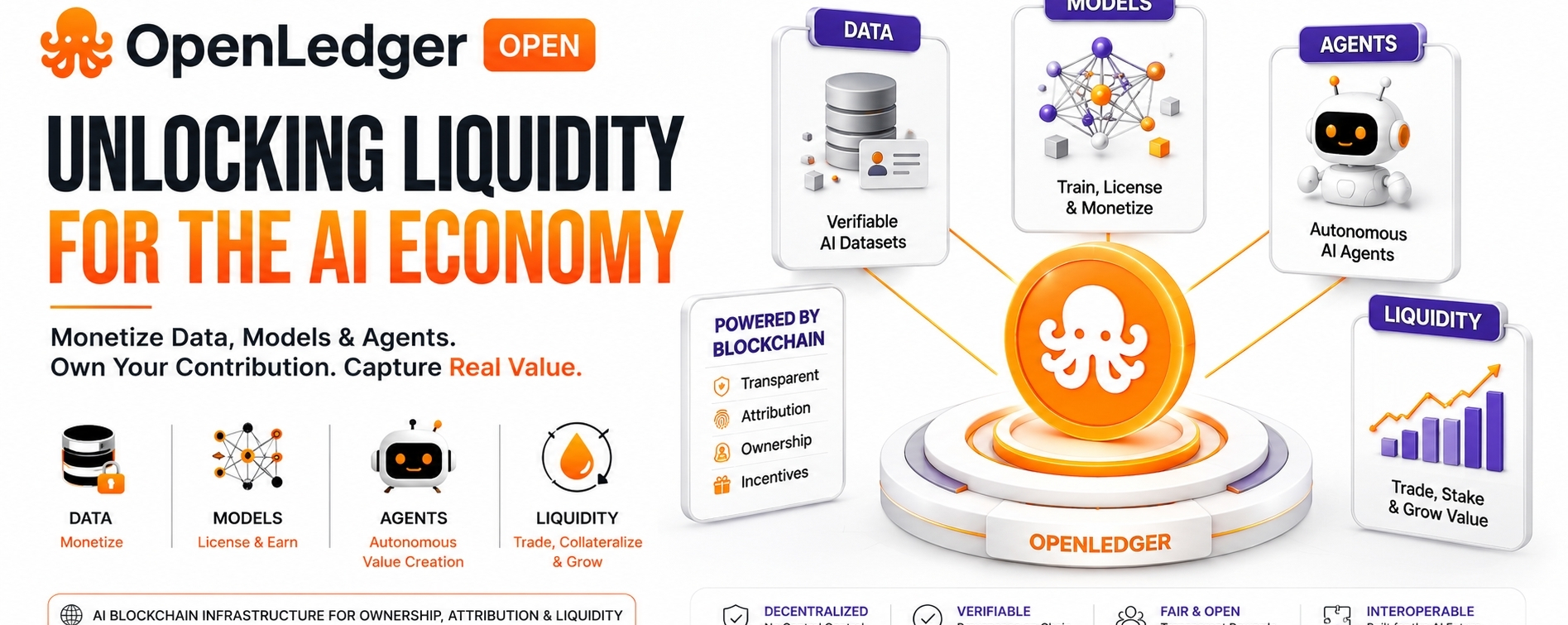
It’s positioning itself as an AI blockchain where data, models, and even agents can become monetizable assets instead of closed systems sitting inside private companies. And if that model works at scale, it changes the economics of AI completely.
Right now the AI market feels weirdly fragmented. People contribute data, train models, create workflows, run inference, build agents… yet most of the value capture still flows upward into centralized platforms. The contributors themselves usually don’t own much of the upside.
OpenLedger seems to be approaching this from a different angle. More like infrastructure for attribution and liquidity rather than just another AI app trying to ride hype cycles.
What interests me most is the liquidity side.
Data has always been valuable, but it’s been hard to price properly because ownership and provenance are messy. Same problem with AI models and autonomous agents. Everyone talks about “AI economies” but without transparent rails, these assets stay illiquid and difficult to monetize fairly.
OPEN is basically trying to create an environment where those assets can move, interact, and generate value on-chain. That’s a much bigger narrative than just “AI token + blockchain” in my opinion.
And honestly, this feels early.
Most AI discussions on crypto Twitter still revolve around speculation instead of infrastructure. But infrastructure is usually where durable value gets built. We saw that in previous cycles too. The loudest narratives weren’t always the ones that lasted.
Another thing I find interesting is how AI agents could evolve if they become economically independent entities. Imagine agents that can access verified datasets, pay for compute, license models, and execute tasks while operating through transparent on-chain systems. Sounds futuristic, yeah… but parts of it are already forming.
Of course, execution matters way more than vision. Plenty of projects have ambitious AI roadmaps and never deliver meaningful adoption. I’m watching OpenLedger more from the perspective of whether it can create real network effects around contribution, attribution, and usage.
Because if AI eventually becomes an ownership economy instead of a platform economy, projects building those rails early could end up sitting in a very important position.
Feels like the market still hasn’t fully priced that possibility in.
