
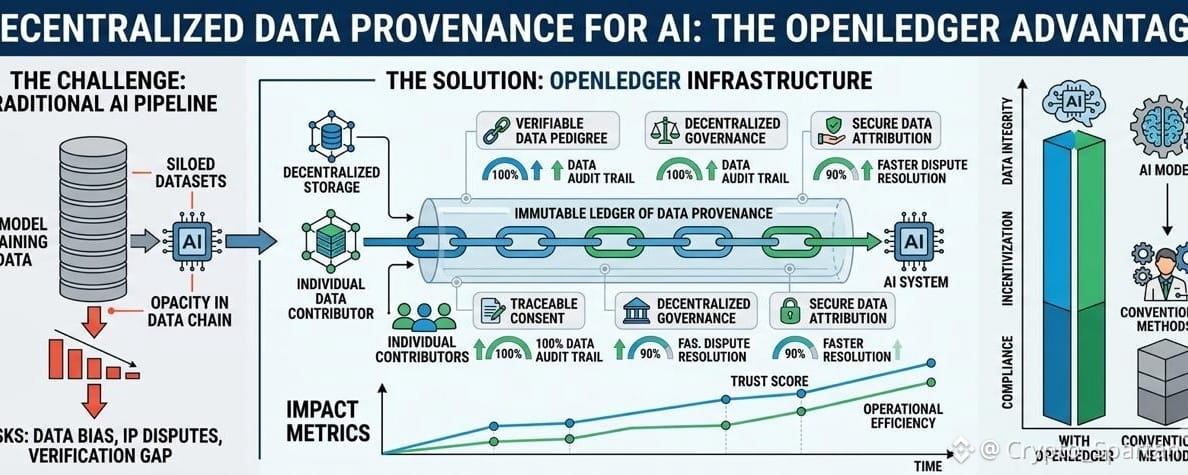
I’ve been spending the last few weeks going deep into OpenLedger docs. Not the hype posts on X or random “next 100x AI coin” threads. I mean the actual docs. Datanets, Proof of Attribution, the architecture stuff, all the boring pages most people skip.
And honestly… after a while something just clicked for me.
Not in a dramatic “this changes everything overnight” kind of way. More like when you’re trying to solve a puzzle for hours and suddenly the pieces finally start fitting together. The more I read, the more OpenLedger just… made sense.
That’s rare nowadays.
Most AI projects are loud. Every week there’s a new “revolutionary” AI platform screaming about how they’ll change the world. But OpenLedger feels different because it’s not trying so hard to look flashy. It’s focused on fixing a real problem that almost nobody talks about properly.
And that problem is ownership.
Right now AI is moving insanely fast. Models are getting smarter every month. New datasets everywhere. Fine-tuning, agents, inference layers, all of it. But almost nobody stops and asks the most important question:
Who actually gets paid for helping make these systems smarter?
Not the big companies. Not the investors.
I mean the people actually doing the work.
The researcher cleaning terrible datasets for weeks.
The guy fixing bad labels no one noticed.
The domain expert correcting model mistakes.
The people quietly improving the intelligence behind the scenes.
Most of them get basically nothing.
Maybe a small credit somewhere nobody reads. Maybe a thank you message. Then the value they helped create gets absorbed into billion dollar systems and they’re forgotten.
That’s the part that kept sticking in my head while reading OpenLedger.
Because their whole system is built around attribution. Around proving who contributed what.
At first “Proof of Attribution” sounded super technical to me honestly. But once I understood it in simple terms, it actually feels pretty powerful.
Every dataset.
Every model improvement.
Every inference.
All of it gets connected back to contributors in a verifiable way.
So instead of AI being this giant black box where value disappears into corporations, there’s actually a system keeping track of where intelligence came from.
And the crazy part is… that changes human behavior alot more than people realize.
If people know they’ll actually get rewarded for quality contributions, they stop acting careless.
They don’t spam junk data.
They don’t rush low quality work.
They spend more time refining things properly.
Over time that compounds.
That creates better datasets.
Better models.
Better outputs.
More trust.
And honestly I think trust is gonna become one of the most valuable things in AI over the next few years.
The tech side of OpenLedger is interesting too. The Datanets structure feels very intentional. Everything is designed to be auditable and traceable instead of hidden behind “trust us bro” AI systems.
That matters.
Because right now most people using AI have no clue where outputs came from or how models were shaped. OpenLedger is basically trying to turn that invisible process into something transparent.
The crypto-economic side is what really surprised me though.
A lot of crypto AI projects just launch tokens first and figure out utility later. We’ve all seen that story before.
But OpenLedger feels more focused on incentives than hype.
When contributions are directly linked to wallets and attribution is provable, participation becomes economically meaningful. People compete to provide useful data because the system can actually recognize and reward it.
That’s a completely different incentive structure compared to normal AI platforms.
And honestly? I think that’s where the moat is.
Not in louder marketing.
Not in trend chasing.
Not in pretending every update is revolutionary.
The moat is solving the “who deserves value” problem before everyone else realizes how important that problem actually is.
Because AI is creating value insanely fast right now, but almost none of the infrastructure around ownership has caught up yet.
That gap is getting bigger every day.
I’ve watched tons of projects explode in popularity and disappear like 18 months later because they were solving fake problems. Problems that only sounded important inside their own whitepaper.
But attribution is different.
That problem is real.
Researchers feel it.
Creators feel it.
Data contributors definitely feel it.
People are feeding intelligence systems constantly while having almost zero ownership over the value they help create.
OpenLedger doesn’t magically solve everything overnight obviously. But I think it points in a direction that actually matters long term.
A future where contribution can be measured.
Where value can be traced.
Where people helping build intelligence systems aren’t invisible anymore.
And honestly, the more I think about it, the more important that feels.
I’m not looking at OpenLedger because of hype or some short term pump narrative. I’m paying attention because it feels like infrastructure. Quiet infrastructure.
The kind people ignore early on because it’s not flashy enough.
But years later everyone suddenly realizes it was important the whole time.
Maybe I’m wrong. Maybe the market keeps rewarding noise forever.
But I kinda doubt it.
At some point AI probably stops being about who talks the loudest and starts being about who can actually prove where value came from.
And OpenLedger feels like one of the few projects already building for that future. #OpenLedger $OPEN
