
I used to think AI and crypto were solving completely different problems.
AI focused on intelligence. Crypto focused on ownership and value transfer.
Now the gap between them feels much smaller.
Both industries are starting to solve the same thing at scale. Coordination.
Crypto spent years turning idle assets into markets. Anything sitting unused eventually became tradable.
AI is moving in a similar direction now, but the assets are different.
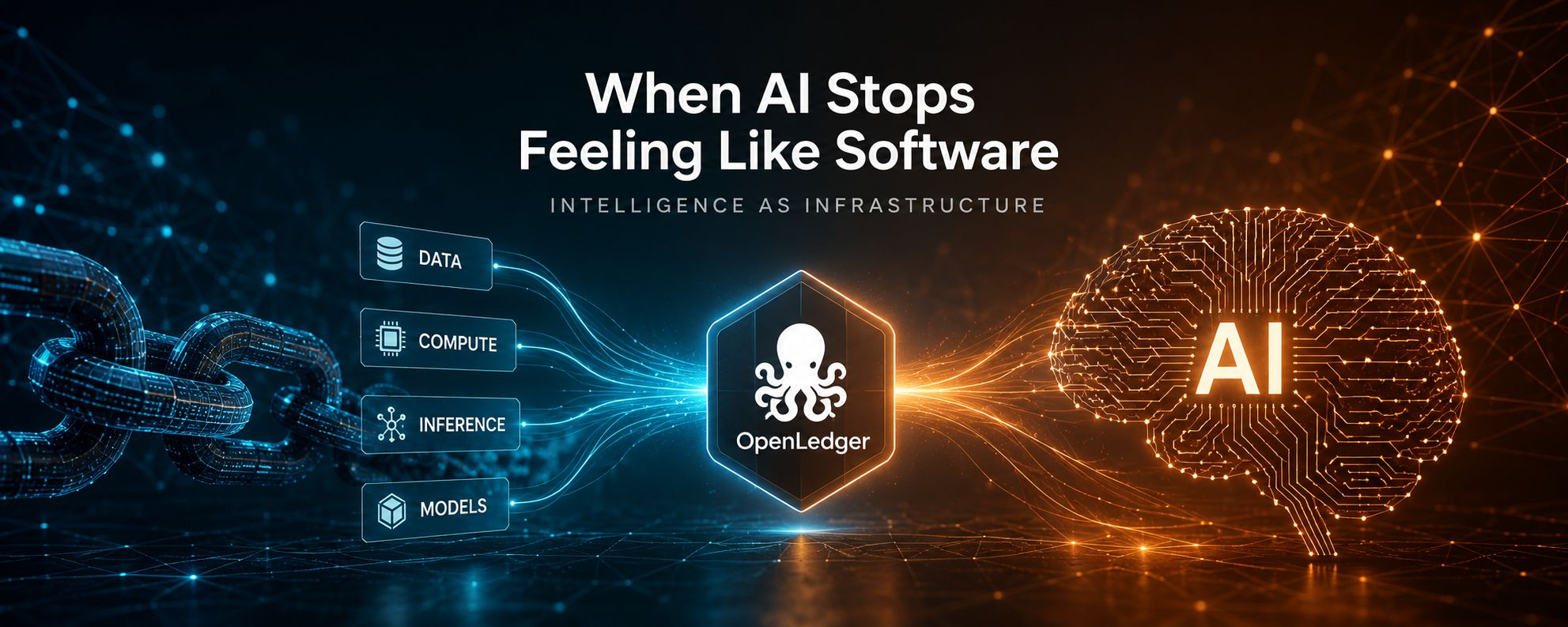
Data. Compute. Inference access. Even model behavior.
Most people still see AI competition at the model layer, but the deeper shift looks infrastructural.
Who controls compute during shortages. Who gets access to strong datasets. Who can distribute intelligence across networks instead of keeping it locked inside private systems.
That is why OpenLedger stands out to me.
Not because it connects blockchain with AI. That idea alone is no longer interesting.
What matters is the possibility that intelligence production itself could become something markets coordinate directly instead of something large companies fully control through private infrastructure.
If that happens, AI stops behaving like a normal software product.
Data starts moving economically instead of staying trapped inside closed platforms. Compute becomes negotiable. Agents interact with other agents with less human coordination.
I still do not know whether that shift becomes healthy long term.
Markets activate dormant resources very efficiently. They do not always preserve quality.
The moment financial incentives enter a system, behavior changes quickly.
Low quality data gets pushed for profit. Access concentrates around whoever controls scarce infrastructure. Systems optimized for monetization slowly move away from systems optimized for reliability.
That pattern already exists across the internet. AI probably will not avoid it either.
At the same time, decentralization narratives often ignore a basic reality.
Compute is physical. Energy is physical. Supply chains are physical.
No matter how digital the coordination layer becomes, advanced AI still depends on industrial infrastructure controlled by a small number of players.
That contradiction may become the defining tension of this space.
Because what OpenLedger points toward is not only smarter AI.
It points toward intelligence becoming part of an economic network.
Not AI as a tool. AI as infrastructure people build on, trade through, and quietly depend on in the background.
And once markets connect to something deeply, they rarely stop expanding around it.