
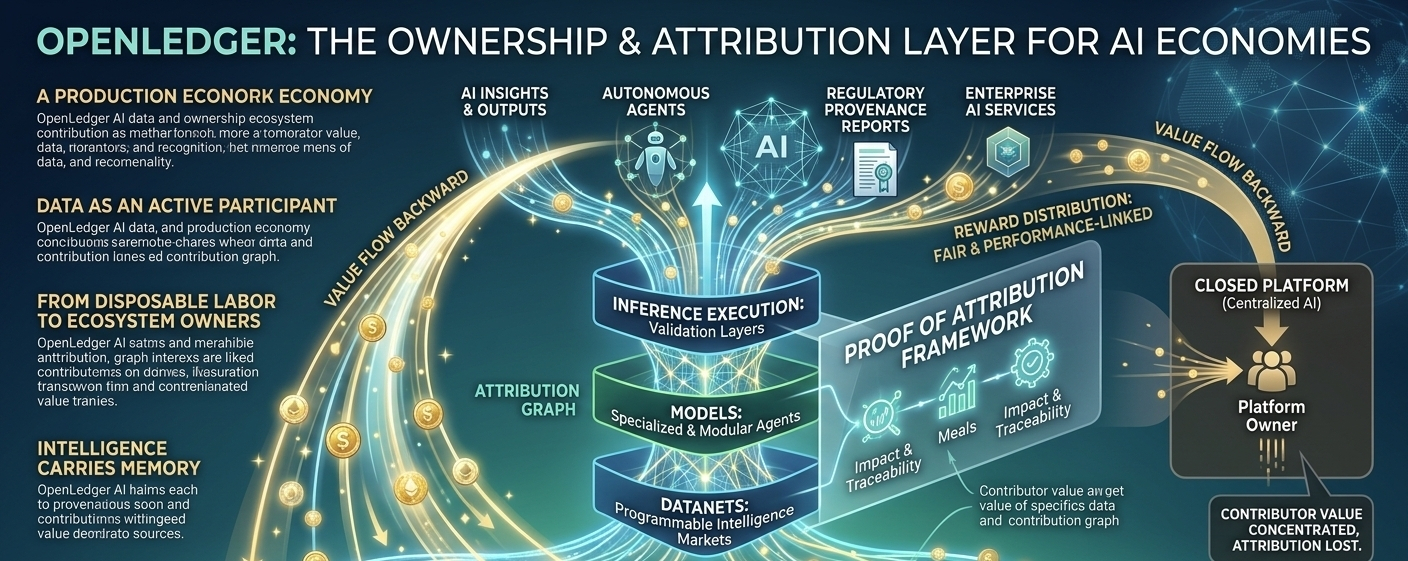
Most AI systems today hide a simple tension: the people who create the value—data contributors, model builders, and infrastructure providers—rarely benefit in proportion to what they produce.
OpenLedger becomes interesting because it doesn’t just talk about AI infrastructure. It talks about monetizing data, models, and agents together inside one system.
At first glance, that looks like better liquidity for AI assets. More ways to earn, more ways to participate. But the more I looked at it, the more it felt like something else as well.
Because once multiple layers of AI—data, models, agents—become economically connected, they stop behaving independently. Activity in one layer starts influencing expectations in the others.
That changes incentives.
If certain models start attracting more economic attention, builders notice. If some datasets become easier to monetize, contributors notice that too. And if agents start generating more participation or demand, they begin shaping what kinds of models and data get prioritized upstream.
None of this requires bad intentions. It’s just what happens when markets become feedback signals for production.
In that environment, builders don’t only optimize for technical quality. They also start considering visibility, monetization potential, and downstream demand. The same applies to data contributors, who may gradually shift toward datasets that are more economically “active” inside the system.
That is where OpenLedger’s structure becomes more than just infrastructure.
Because linking data, models, and agents inside a single monetized environment creates cross-layer feedback loops. A change in one layer doesn’t stay local—it affects behavior across the stack.
Liquidity, in this sense, is not neutral. It becomes a signal system. It shows where attention and value are already concentrating, and participants naturally move toward those areas.
Over time, that can quietly shape what gets built.
Useful AI components that are niche or less economically visible may receive less focus. Not because they are less important, but because they don’t stand out in the system’s internal economy.
That is the subtle trade-off in OpenLedger’s design.
It can increase coordination and connect fragmented builders into a shared economic layer. But it can also reduce randomness in what gets created, because market signals become stronger and more directional.
So the deeper implication is not just “AI liquidity.”
It is that once AI data, models, and agents become economically linked, the system doesn’t only fund intelligence production—it begins to influence what kinds of intelligence feel worth producing in the first place.
