
When I first started looking at AI through the lens of blockchain, my focus wasn’t on tokens or market hype. It also wasn’t about the usual grand narratives that appear whenever two powerful technologies are mentioned together. What stood out to me was something much simpler: AI is built by many hands, but it is often remembered as if it was built by only a few.
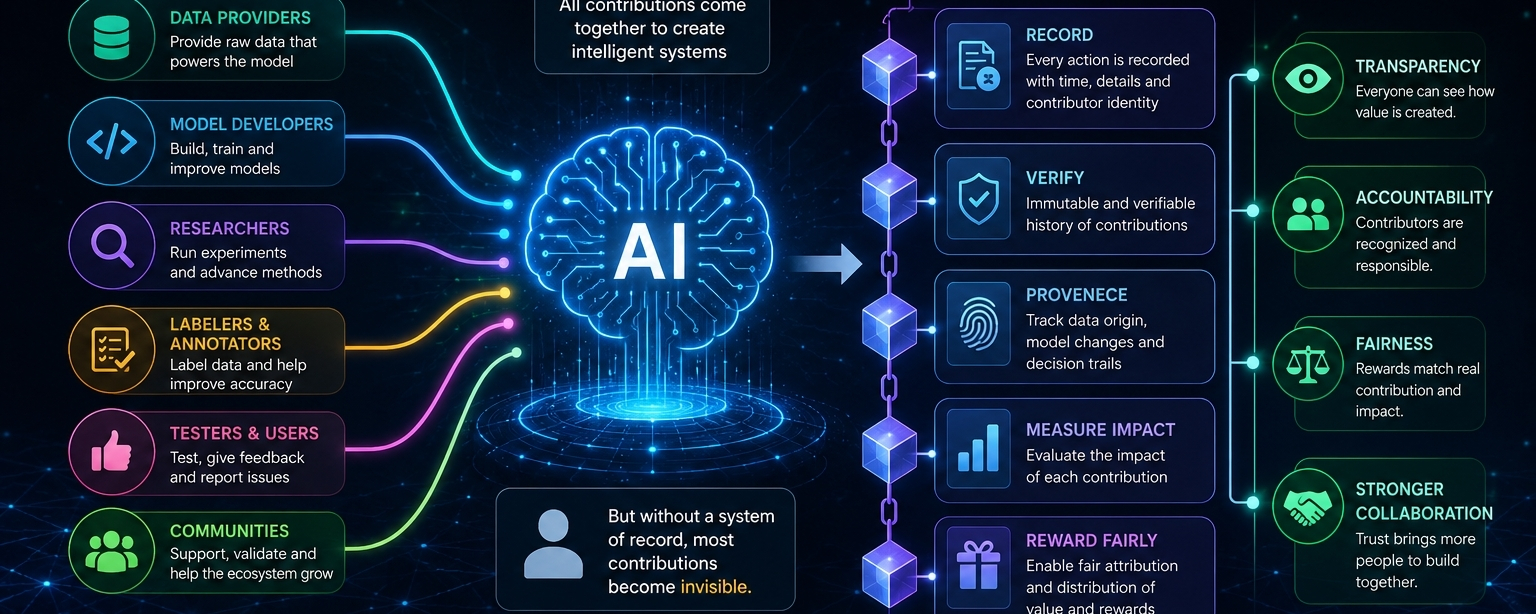
Behind every useful AI system lies a long chain of invisible effort. Someone provides data. Someone refines the model. Someone points out mistakes. Someone tests, labels, trains, evaluates, or gives feedback. Each of these actions may seem small on its own, but together they shape the final system in a meaningful way. The strange part is that most of this contribution fades into the background. When the model improves and the product becomes more valuable, it is rarely clear who actually contributed to that improvement.
For a long time, this was considered normal because AI development has mostly been centralized. Closed systems allowed companies to move faster, collect data, train models, and ship products without exposing much of what happens underneath. While this approach accelerated progress, it also created a gap. When value is created through many contributors but there is no reliable way to trace their input, ownership becomes blurred, rewards become uneven, and trust in collaboration weakens.
This leads to a simple but important idea: AI does not only need stronger infrastructure, it needs a better way to preserve contribution.
This matters because the future of AI will not be shaped by a single company, model, or dataset. It will emerge from large networks of contributors. Data providers, researchers, developers, communities, and everyday users will all play a role. But if their contributions are not clearly recorded, they effectively disappear into the system. Their work becomes part of the output, but not part of the recognition.
This is where blockchain becomes relevant. Not as a trend or marketing layer, but as an infrastructure for recording contribution. It can provide a verifiable history of what was done, when it was done, and who was involved. In the context of AI, this record is not just technical—it becomes the foundation for attribution, ownership, governance, and fair rewards. The question is no longer only “Who built the model?” but “Who helped improve it?”
However, general-purpose blockchains have limitations here. Most were designed around financial transactions, DeFi, NFTs, and asset transfers. While they are powerful in those domains, AI workflows require something more nuanced. They need to track data provenance, model iterations, feedback loops, and the actual impact of contributions—not just simple transactions.
This is why approaches like OpenLedger feel interesting. The core idea is not just connecting AI and blockchain, but introducing a missing layer: contribution memory. In a world where AI is becoming increasingly collaborative, the ability to track meaningful input may become as important as the models themselves. Without it, systems risk becoming powerful but unfair. With it, they can become more transparent, accountable, and open to genuine participation.
There is also a subtle tension emerging. AI systems continuously demand more data, more feedback, more collaboration, and more human input. But contributors are also becoming more aware of their value. People do not want to feed systems that do not acknowledge them. Developers do not want their work to vanish into black boxes. Communities do not want to contribute without any connection to the outcome.
So the issue is not purely technical—it is also cultural. If AI is to become a shared layer of the digital economy, then its underlying systems must become more honest about where value originates. Transparency will not solve everything, but it changes the starting point. It turns invisible work into visible contribution, vague ownership into traceable ownership, and passive participation into something more trustworthy.
The next phase of AI may not just be about smarter models. It may be about fairer systems behind those models. Because intelligence without memory creates imbalance. And if AI is built by many, then it should also remember the many.#OpenLedger @Pixels $OPEN