
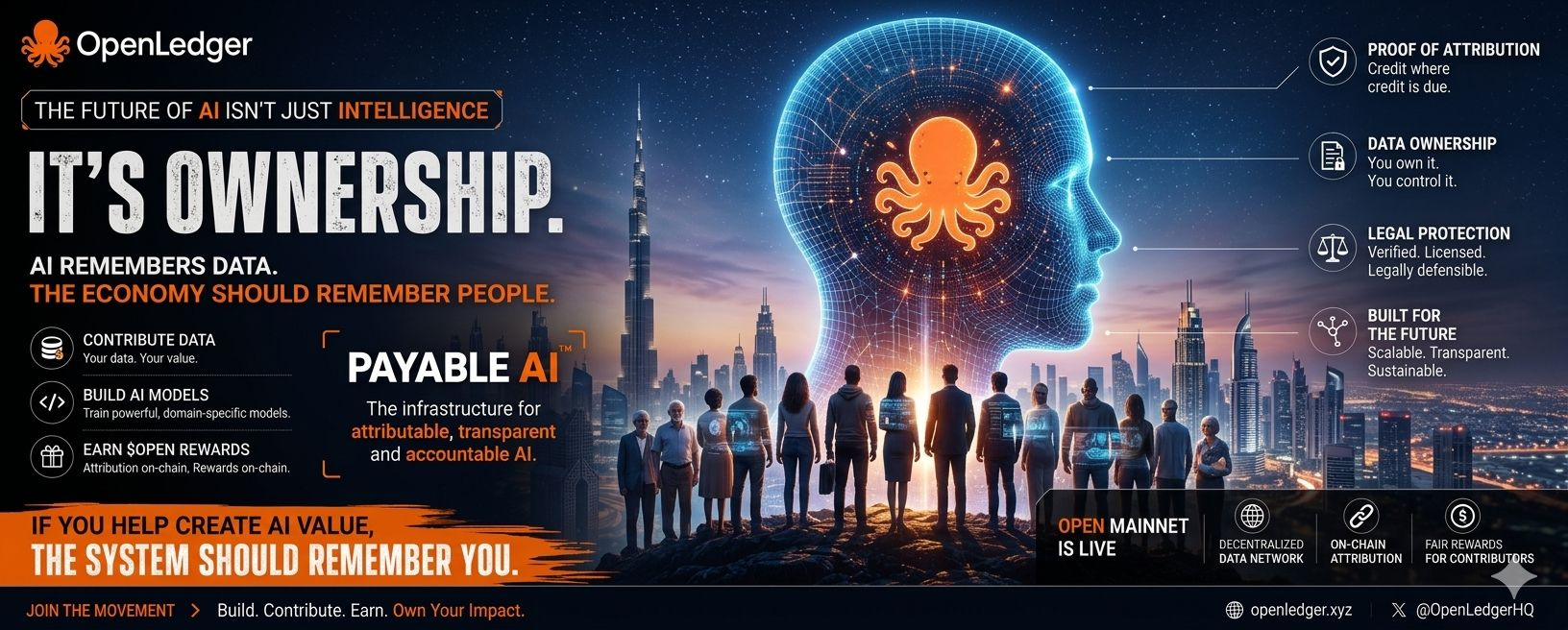
I spent a few hours going through OpenLedger stuff again last night and honestly… I think most people are still looking at AI completely wrong.
Everybody keeps arguing about the surface layer.
Which model is smarter.
Which one reasons better.
Which company raised another billion dollars this week.
But I swear the deeper thing happening underneath AI right now has almost nothing to do with model flexing anymore.
I think the real battle is slowly becoming about ownership.
More specifically:
who actually gets remembered when AI becomes valuable?
And yeah… that sounds philosophical at first. But the more I think about it, the more economic it feels.
Because current AI systems are basically giant machines built on human contribution. People feed these systems everything — conversations, datasets, corrections, niche expertise, feedback loops, years of internet behavior — and then eventually the model becomes valuable while the contributors disappear from the economic picture entirely.
The AI remembers the data.
The market forgets the people.
That sentence kept sitting in my head today because honestly… it explains a huge part of the imbalance in modern AI.
And this is where OpenLedger started becoming interesting to me personally.
Not because “AI + crypto” is some magical new narrative. Let’s be real, crypto creates ten new buzzwords every month
But because they seem to be attacking a genuinely uncomfortable problem most projects avoid:
what happens if contributors actually expect ownership from AI systems?
That changes the conversation completely.
Since OPEN mainnet launched, the idea feels less theoretical now too. Contributors can submit datasets, developers can train domain-specific models, and rewards move directly on-chain through the attribution layer.
That’s the part I keep thinking about.
Because suddenly data stops feeling like invisible fuel.
It starts feeling closer to labor.
Traceable labor.
And psychologically that is a HUGE shift.
I was reading about their attribution systems earlier and honestly the small-model gradient attribution part makes sense to me. If removing certain data weakens the model measurably… then obviously that data had value.
Simple logic.
But the crazy part is trying to do this for LLMs at scale.
That’s where things get messy fast.
Large language models are blurry by nature. Outputs come from millions of tiny influences merged together. So trying to trace output influence back toward original training data feels almost like trying to reverse engineer memory itself.
I honestly don’t think attribution will ever become perfectly mathematically clean.
Probably impossible.
Still… I think even ATTEMPTING to build transparent attribution infrastructure matters more than people realize right now.
Because most AI companies optimized extraction first.
OpenLedger at least seems to be experimenting with accountability first.
And another thing I think people are underestimating badly is the legal side of AI data.
Everybody talks about intelligence today.
Nobody talks enough about legitimacy.
But once AI moves deeper into healthcare finance legal systems enterprise automation etc… companies are going to care a LOT about where the training data came from.
Not just:
“Is the model smart?”
But:
Can this dataset be verified?
Is it licensed?
Can attribution be proven?
Can this survive legal disputes later?
That future honestly feels inevitable to me.
And if that happens, legally clean datasets may become more valuable than massive messy datasets scraped from everywhere.
That’s why integrations connected to provenance and IP infrastructure — like Story Protocol stuff — actually seem more important than people currently realize.
Of course none of this means the system automatically succeeds.
Actually the hardest part probably starts NOW.
Because once money enters any ecosystem, manipulation follows instantly.
Spam datasets.
Synthetic garbage.
Leaderboard farming.
Attribution disputes.
People optimizing for rewards instead of quality.
That pressure is unavoidable.
So the real test isn’t whether the vision sounds smart on Twitter.
The real test is whether attribution systems still work once millions of people start gaming them.
And honestly?
I don’t know yet.
But I think that uncertainty is exactly why this phase feels important.
For the first time in a while, an AI project isn’t only talking about faster models or hype narratives.
It’s asking a deeper question:
If humans help create AI value…
should the infrastructure remember them after the value gets monetized?
I think the entire AI industry is eventually going to be forced to answer that question one way or another.