I think the market is looking at AI completely the wrong way.
A few weeks ago, I was digging through another wave of AI related crypto projects, mostly out of habit at this point. The cycle has become predictable. Liquidity rotates into a narrative, CT turns it into a religion for two weeks, influencers start recycling the same buzzwords, and then attention disappears overnight like nobody ever believed in it to begin with. We watched it happen with modular chains, restaking, RWAs, DePIN, and now AI has become the latest battlefield for speculative capital.
The strange thing is that most AI projects start sounding identical after a while.
Everyone claims to be building “infrastructure.” Everyone promises decentralization. Everyone has beautiful diagrams explaining how they will power the future.
But after enough time in this market, you stop listening to the words and start paying attention to the incentives underneath them.
That’s honestly why OpenLedger caught me off guard.
At first glance, I almost ignored it. The branding looked polished in that suspiciously clean way crypto projects sometimes do when they are trying too hard to look important. But the deeper I went, the more I realized it was approaching AI from a direction most people in crypto still don’t fully understand.
Most projects are obsessed with AI models.
OpenLedger seems obsessed with the economy underneath AI itself.
And I think that difference matters far more than people realize.
Right now, AI feels powerful, but it also feels strangely centralized. Millions of people contribute data every single day. Developers build tools. GPU providers supply compute. Communities generate behavioral feedback constantly. Yet somehow almost all the value still concentrates into a handful of companies controlling closed ecosystems.
Crypto spent years talking about decentralization like it was inevitable, and then AI arrived and we quietly rebuilt the same concentration of power all over again.
That’s the uncomfortable part nobody wants to admit.
The issue is no longer whether AI works. It already does. The real question is who owns the rails underneath it.
Who owns the data? Who supplies the compute? Who controls distribution? Who captures the economic upside once AI agents start interacting with each other autonomously?
That’s where OpenLedger became genuinely interesting to me.
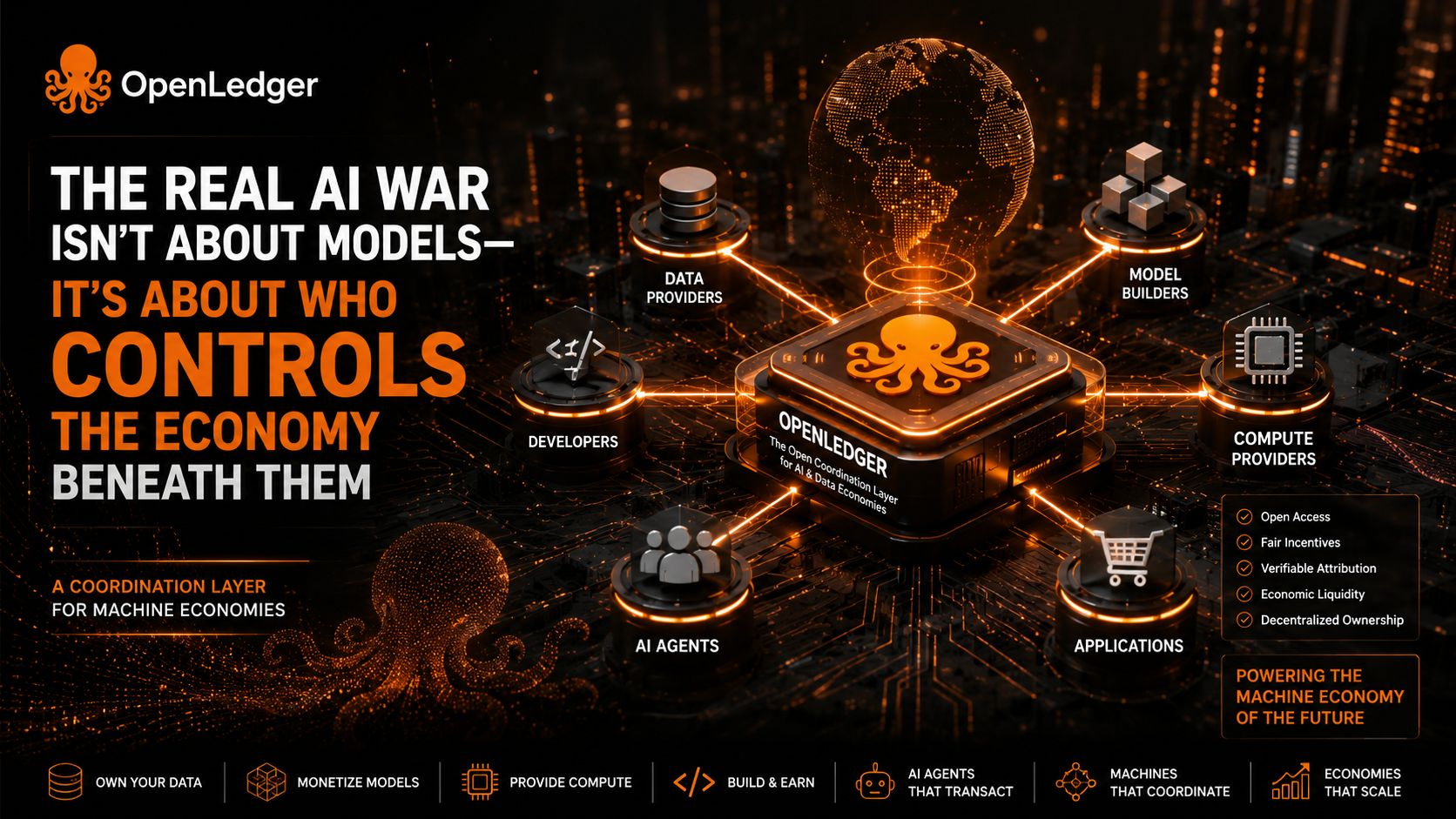
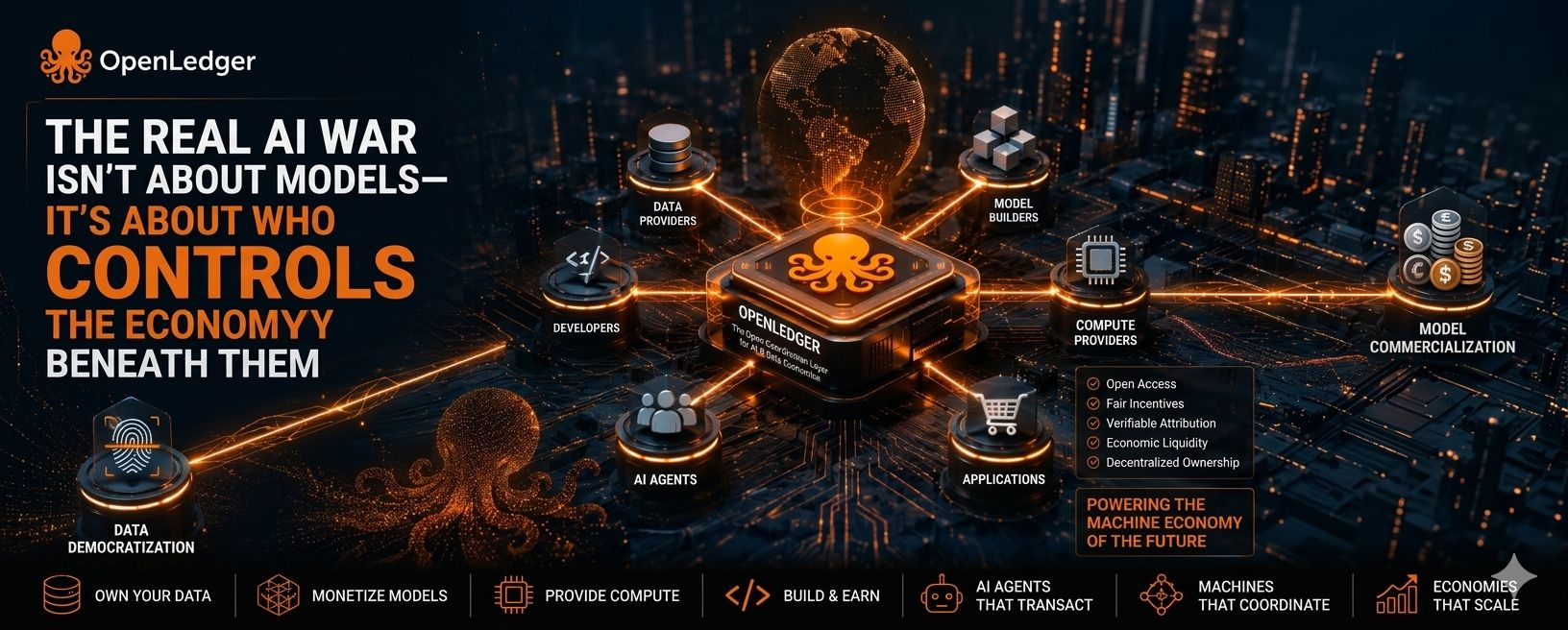
The idea is actually simple once you remove the technical jargon. Instead of AI systems operating inside isolated corporate silos, OpenLedger is trying to create an open coordination layer where datasets, models, compute suppliers, developers, and AI agents can interact through shared economic incentives.
In simple terms, it feels less like building another AI application and more like building a marketplace for machine economies.
And honestly, that framing feels much bigger.
Because the deeper I think about AI, the less I believe intelligence itself will remain the scarce asset everyone assumes it is today. Models are improving rapidly. Open-source competition is accelerating. Costs eventually compress in every technology cycle.
What becomes valuable long term is coordination.
Who connects the participants efficiently. Who routes incentives correctly. Who creates economic liquidity between machines, data, compute, and applications.
That may become the real infrastructure layer of the AI era.
Most people still think AI competition is about building the smartest model. I’m starting to think the bigger war is about building the systems that allow intelligence to move, transact, and coordinate at scale.
And that changes the entire conversation.
Because once AI agents become increasingly autonomous, markets themselves start evolving into something different. Machines will eventually source information, rent compute, purchase services, execute transactions, and coordinate outcomes with minimal human involvement.
At that point, AI stops behaving like software and starts behaving more like an economy.
That’s the future OpenLedger seems to be positioning around.
Not “AI on blockchain.” Not another chatbot narrative. Not another tokenized wrapper chasing temporary hype.
A coordination layer for machine economies.
Now obviously, theory is always the easy part.
The real challenge is adoption.
Crypto has a brutal history of building elegant systems that nobody actually needs once token incentives disappear. You can manufacture temporary activity with emissions, rewards, and speculative liquidity, but real economic networks only survive if participants continue finding value after the incentives fade.
That risk still exists here.
If developers don’t see monetization opportunities, they leave. If compute providers find better yields elsewhere, liquidity disappears. If the quality of data weakens, the entire system loses value quickly.
And competition will become ruthless.
The part people underestimate is that centralized AI companies are not standing still. The second decentralized coordination starts looking economically efficient, large corporations will attempt to replicate parts of the model while still keeping ownership concentrated.
Decentralization does not automatically win because it sounds morally better.
It only wins if it coordinates markets more efficiently.
Still, I can’t ignore where this space seems to be heading. The market is slowly getting tired of empty AI wrappers pretending to be infrastructure plays. Capital is becoming more selective again. Narratives still matter, but people are beginning to ask harder questions about actual economic behavior underneath these systems.
That shift matters.
Because if intelligence eventually becomes cheap and abundant, then ownership of coordination may become the most valuable layer in the entire AI economy.
And if that happens, projects like OpenLedger stop looking like niche crypto experiments and start looking more like early prototypes for digital economic systems we haven’t fully understood yet.
Or maybe it’s simply another beautifully packaged idea competing for the same rotating pool of speculative liquidity everyone else is chasing.
Honestly, that’s still possible too.
But I can’t shake the feeling that the next phase of AI will belong less to the companies building intelligence itself and more to the networks deciding how intelligence moves, coordinates, and creates value across the digital world.