
I’ve stopped asking whether the next AI breakthrough will be faster, bigger, or smarter.
The question that actually matters now is simplerand far more uncomfortable:
Who gets paid when intelligence becomes cheap?
That’s the lens through which I’ve been reading everything around @OpenLedger . And once you see it this way, the narrative snaps into focus. This isn’t another AI token chasing compute hype. It’s an attempt to build the economic coordination layer for a world where AI is everywhere and value is harder to define.
Most AI conversations obsess over scale: GPUs, model size, benchmarks, speed. But scale is a temporary advantage. Models commoditize. Outputs flood the market. Intelligence becomes abundant.
Trust doesn’t.
That’s the quiet truth sitting underneath all of this content. As intelligence gets cheaper, the bottleneck shifts. Not to compute but to permission, attribution, and verification. To knowing who contributed, what they’re allowed to do, and why their output should be trusted.
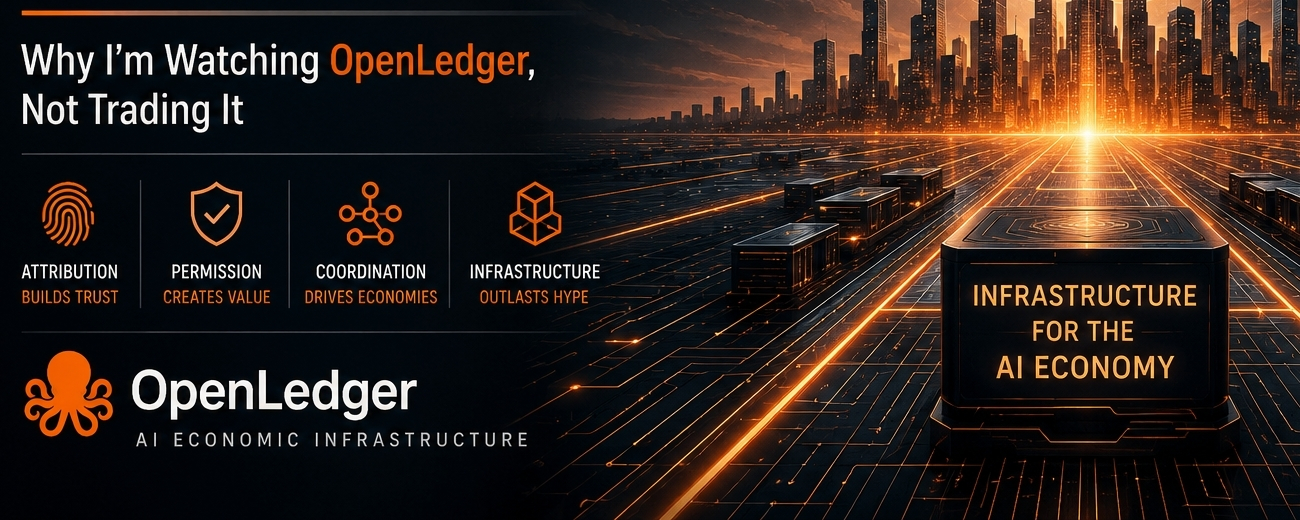
That’s where OpenLedger positions itself not as an app, not as a model, but as economic infrastructure.
The writing around it keeps pulling the same move: it refuses to talk about features first. Instead, it starts with macro tension. Centralized AI extracts value from contributors. Attribution is vague. Ownership is murky. Enterprises can’t trust black-box outputs. Contributors can’t prove impact. Markets can’t price participation.
Then only then does $OPEN enter the frame. Not as a reward system, but as attribution architecture. Not as payouts, but as permission rails. Not as hype, but as middleware that decides who is allowed to participate in AI economies at all.
That reframing is everything.
Most people hear “attribution” and think royalties. I read this content and see something much larger: attribution as economic credibility. As a trust primitive. As the foundation for AI accountability and ownership.
When intelligence is everywhere, permission becomes the product.
That’s why the narrative keeps comparing OpenLedger to invisible infrastructure cloud backends, payment rails, internet protocols. The most important systems don’t shout while they’re forming. They disappear into workflows. They feel boring. Until one day, you realize nothing works without them.
There’s also a strong psychological restraint here that I respect. No moon language. No price talk. No certainty. The content ends with observation, not conviction. “Watching this as infrastructure.” “The chart will tell the story later.” That tone matters. It signals long-term thinking. Institutional thinking.
It also explains why the “permission scarcity” framing hits so hard. Everyone is racing to build intelligence. Fewer are asking how AI participation will be governed, verified, and priced. Yet that’s exactly where enterprise adoption, compliance, and real money flow.
The vibecoding angle brings this back to human scale. Ideas don’t fail because they’re bad. They fail because execution is gated by tools, by access, by permission. Lowering those barriers doesn’t just create apps. It creates new economic actors. Humans and machines coordinating around provable contribution.
That’s the throughline I can’t ignore.
This isn’t trader content. It’s infrastructure analysis. It’s the belief that the next AI race won’t be won by whoever builds the smartest system but by whoever controls the rules of participation around intelligence.
So no, I’m not watching #OpenLedger as a quick trade.
I’m watching it the way you watch foundations being poured quietly, early, before the building makes sense to anyone else.
Because in a world where intelligence is abundant, trust is the last scarce asset. And the systems that coordinate it tend to matter more than anyone expects right up until they’re unavoidable.
