
Most people watching AI right now are staring at the wrong thing. They are obsessed with which model scored higher on some benchmark, which company raised the biggest round, which product launched fastest. And I get it. Those things are visible. They are easy to track.
But there is something much more uncomfortable sitting underneath all of that progress that almost nobody wants to talk about honestly.
AI is being built by many people and remembered by almost none of them.
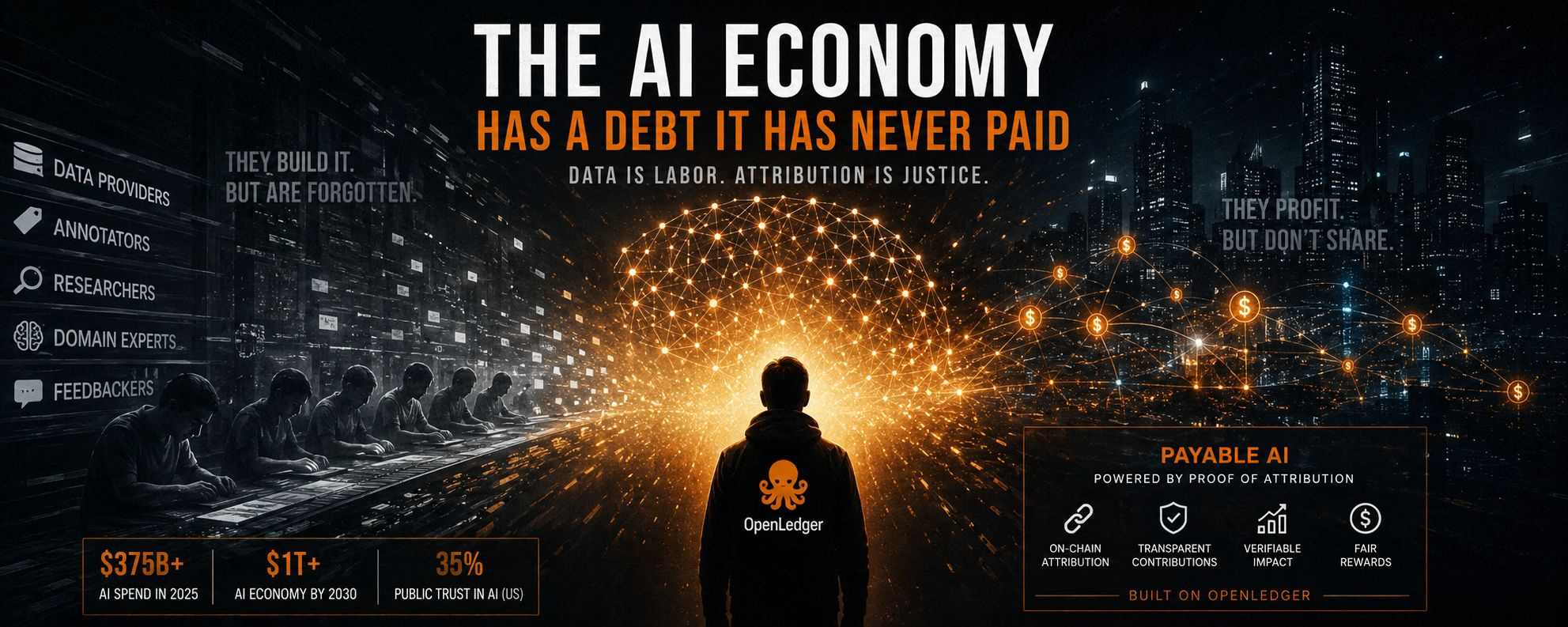
Think about what actually goes into making a useful AI system. Someone provides the data. Someone else cleans it. Someone flags the wrong outputs. Someone contributes domain knowledge from years of working in medicine or law or finance. Someone gives feedback that quietly shifts how a model behaves. None of these people are small contributors. Together they are the reason the model works at all. But the moment their input enters the pipeline it essentially disappears. The model gets better, the product becomes more valuable, and the person who helped make that happen has no real way to point to what they did or claim any part of what they helped create.
For a long time this was just accepted. Centralized systems move faster. Companies needed control to ship things quickly. That logic made sense in the early days. But we are not in the early days anymore.
Global AI spending is crossing $375 billion in 2025. The total value of the AI economy is being projected well past a trillion dollars before the end of the decade. And public trust in AI has dropped to around 35 percent in the United States. Those numbers sit next to each other in a very uncomfortable way. The system is becoming enormously valuable while the people feeding it are becoming increasingly skeptical of it. That is not a coincidence. That is what extraction looks like over time.
This is the part where @OpenLedger genuinely caught my attention. Not because of the token or the hype cycle around AI plus crypto. Those narratives come and go. What caught my attention was the framing around something they are calling Payable AI. The idea that data is not just fuel. It is labor. And labor that actually shaped the output of a system deserves to be traceable and compensated in proportion to its real influence.
I kept thinking about YouTube when I tried to make sense of this. YouTube did not invent video. What YouTube did was build a system where the people creating value inside the platform could actually receive a portion of that value back. Before YouTube, creators were just content. After YouTube, creators had economics. AI has never had that moment. The people contributing to these systems are still just content.
The Proof of Attribution engine is OpenLedger's attempt to change that. Every dataset, every training step, every model update gets recorded on chain. When a model produces an output, the system can trace which contributions actually shaped it and route rewards accordingly. That sounds straightforward when you write it in one sentence but the actual problem it is trying to solve is genuinely hard. A response from a large language model is not the product of one source. It is a blend of thousands of influences across millions of training decisions. Mapping that honestly without just approximating it is a serious infrastructure challenge and most platforms have simply chosen to sidestep it entirely.
$OPEN Mainnet launched in November 2025 and one of the updates that followed specifically addressed attribution durability. Making sure data and output links do not break as models are updated and fine tuned over time. That detail is easy to overlook but it is actually the whole game. Attribution that resets every time a model improves is not attribution. It is a receipt with an expiration date.
The Story Protocol integration also added something that I think will matter a lot more in the next two or three years than it does right now. Legally verifiable datasets. As AI moves into healthcare, finance, legal services and other regulated industries, the question is going to shift from whether a model is accurate to whether anyone can actually prove where it learned what it knows. Enterprises are already starting to ask those questions. Building the infrastructure to answer them before it becomes a regulatory requirement is a very different posture than reacting to it after the fact.
And underneath all of this there is a cultural problem that is just as real as the technical one.
Developers do not want their work to vanish. Researchers do not want their domain expertise absorbed without acknowledgment. Communities do not want to keep improving systems that have no memory of them. AI keeps asking the world for more. More data, more feedback, more talent, more participation. But contributors are not as passive as they used to be. They are starting to notice the asymmetry. And once people start noticing an asymmetry like that, the trust erodes in ways that are very hard to reverse.
I am not going to pretend the hard questions have been answered. What happens when people start gaming the attribution system for rewards. Whether validation will hold its integrity when it is processing millions of interactions instead of thousands. Whether the whole thing actually holds up in high stakes domains where wrong attribution has real consequences. Those questions only get answered through time and sustained performance under pressure.
But here is what I keep landing on. Almost every uncomfortable tension in AI right now traces back to the same place. Who contributed. Who owns it. Who should be paid. These are not edge case questions. They are the questions that will define how the next decade of this technology gets built, trusted, and governed. Most of the industry is still treating them as footnotes. OpenLedger is at least treating them as the actual problem.
That is a different starting point. And sometimes a different starting point is everything.
