
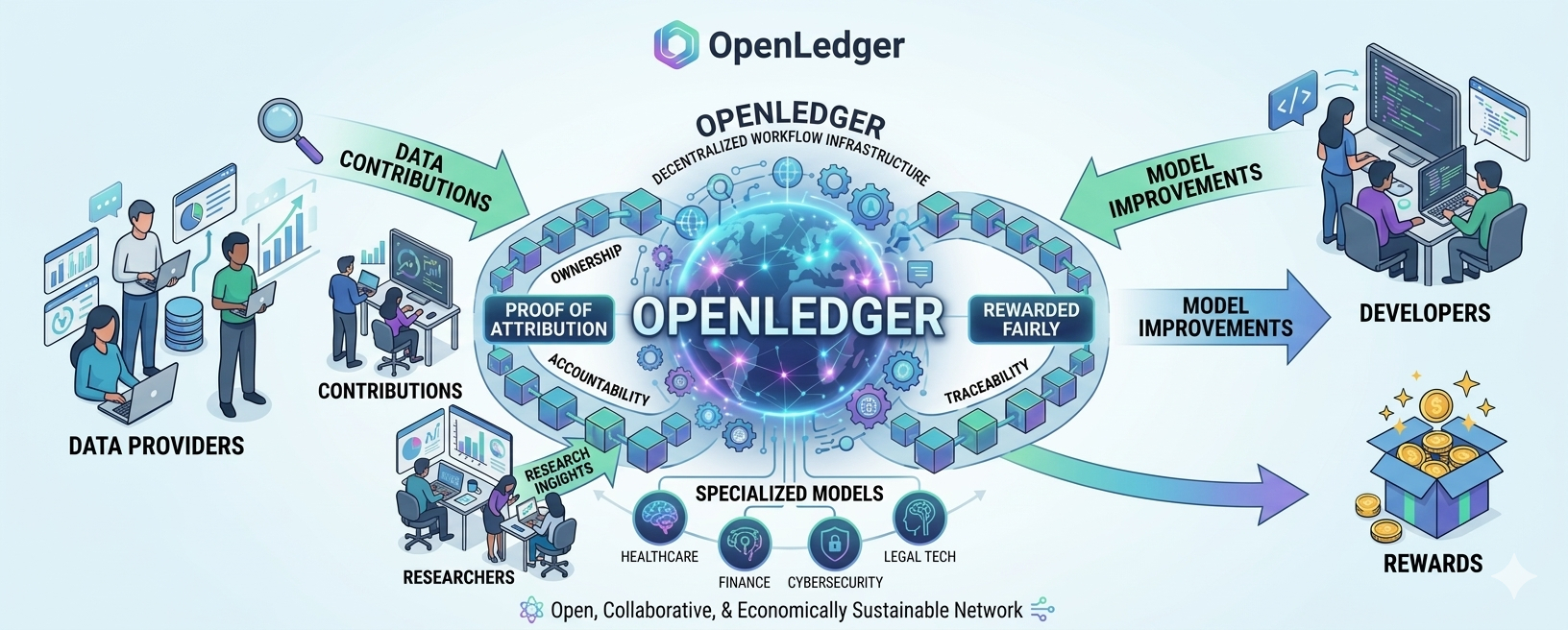
Artificial intelligence is evolving faster than ever, but the systems supporting it are still deeply flawed. Most AI platforms today operate behind closed doors, where contributors rarely receive recognition for their work, ownership remains centralized, and the entire development process lacks transparency. OpenLedger aims to change this by introducing a completely new approach known as the AI Blockchain.
Rather than treating AI as a product controlled by a few large companies, OpenLedger creates an ecosystem where data providers, developers, researchers, and contributors can collaboratively build and improve AI systems while receiving fair rewards for their participation. Its infrastructure combines blockchain technology with AI development to establish transparency, accountability, and economic fairness throughout the entire lifecycle of artificial intelligence.
At the center of OpenLedger’s vision is the idea that AI should not belong to a small number of centralized organizations. Instead, AI should become a shared economy where every contribution is visible, traceable, and rewarded according to its impact.
Why Traditional AI Infrastructure Is Failing
Modern AI systems depend heavily on massive datasets collected from across the internet. These systems are often trained using information contributed by millions of individuals, yet very few contributors receive recognition or compensation. Most AI companies control the models, the infrastructure, and the monetization systems, leaving contributors disconnected from the value they help create.
This problem becomes even more serious as AI moves toward specialized applications. General-purpose models may perform well in broad tasks, but industries such as healthcare, finance, cybersecurity, and legal technology require highly accurate and domain-specific intelligence. Building these specialized systems depends on access to high-quality datasets and expert knowledge.
However, the current AI ecosystem provides no efficient way to verify who contributed valuable data, who improved the models, or how the final outputs were developed. This creates a major issue around ownership and incentives. Without proper attribution, contributors lose motivation, collaboration becomes limited, and the quality of AI development suffers over time.
OpenLedger introduces a framework specifically designed to solve these challenges.
The Concept of the AI Blockchain
Unlike traditional blockchains that mainly focus on financial transactions or digital assets, OpenLedger was created entirely around the needs of artificial intelligence. It is designed to record every stage of AI development directly on-chain, including data contributions, model updates, evaluations, and collaborative improvements.
This creates a transparent environment where every participant’s role is permanently documented and verifiable.
One of the core technologies powering OpenLedger is Proof of Attribution. This mechanism ensures that contributors receive recognition and financial rewards based on the actual impact of their work. Whether someone provides training data, improves model performance, evaluates outputs, or develops AI tools, their contributions become part of a traceable system that cannot be manipulated or hidden.
By bringing attribution onto the blockchain, OpenLedger transforms AI development into a collaborative economy rather than a centralized industry.
Collaboration and Shared Ownership
A major weakness of today’s AI industry is the absence of shared ownership. Most models are developed behind closed systems where contributors have little visibility into how their data or work is being used.
OpenLedger creates a more open structure where collaboration becomes the foundation of development. Anyone can contribute datasets, refine models, improve outputs, or participate in governance processes. Every action is recorded transparently, ensuring contributors maintain ownership of their work.
This model has the potential to reshape how AI innovation happens. Instead of relying only on large corporations with enormous computational resources, specialized communities can work together to build highly focused AI systems tailored for real-world industries.
For example, medical professionals could collaboratively improve healthcare AI models, while cybersecurity researchers could continuously refine threat-detection systems. Because contributions remain traceable, contributors are rewarded fairly without losing ownership of their expertise.
This approach encourages long-term participation and creates a sustainable ecosystem where innovation is driven by collective effort rather than centralized control.
Monetizing AI Contributions Fairly
One of OpenLedger’s most important innovations is its economic structure. In traditional AI ecosystems, the majority of financial rewards flow toward platform owners, while contributors often receive nothing in return.
OpenLedger changes this by creating direct economic incentives for participation. Through Proof of Attribution, rewards are distributed according to measurable contributions made during the AI development process.
This means contributors are no longer invisible participants. Data providers, developers, model evaluators, and community contributors all become part of a reward-driven ecosystem.
The platform introduces tokenized AI economics, where value flows back to the people actively improving the system. This creates a decentralized economy around AI development and reduces dependency on centralized technology companies.
By connecting blockchain incentives with AI collaboration, OpenLedger allows contributors to participate in the growth of AI systems financially rather than simply supplying unpaid resources.
Transparency and Explainable AI
Another major challenge in artificial intelligence today is the lack of transparency. Most advanced AI models function as black boxes where users cannot clearly understand how decisions are made, what data was used, or how the models evolved over time.
This lack of explainability creates trust issues, especially in industries where accountability matters. In sectors like healthcare or finance, unclear AI decisions can create serious ethical and operational risks.
OpenLedger addresses this problem by recording every contribution and modification on-chain. Data sources, model changes, evaluations, and updates remain permanently accessible and auditable.
This creates a fully traceable history of how AI systems were developed. Instead of hidden processes controlled by centralized organizations, OpenLedger introduces explainable AI infrastructure where accountability becomes part of the system itself.
Such transparency could become increasingly important as governments and industries begin demanding stricter AI regulations and oversight.
Why General-Purpose Blockchains Are Not Enough
Many blockchain platforms already exist, but most were designed for decentralized finance, digital assets, or payment systems. They were never optimized for the complex workflows required in AI development.
Artificial intelligence involves continuous collaboration, model training, data refinement, and evaluation systems that general-purpose blockchains struggle to manage efficiently.
OpenLedger was specifically built for AI-native functionality. It supports model attribution, contribution tracking, governance systems, and reward distribution directly within its infrastructure.
Rather than adapting an existing blockchain for AI, OpenLedger reimagines blockchain architecture around the needs of AI collaboration itself.
This distinction is critical because AI development requires much more than transaction processing. It requires scalable systems capable of managing ongoing contributions, transparent provenance, and decentralized coordination between contributors.
The Rise of Specialized AI Models
The AI industry is gradually shifting away from relying entirely on massive general-purpose models. Instead, there is growing demand for smaller, specialized models optimized for specific industries and use cases.
These specialized systems offer several advantages. They are more efficient, require lower computational costs, and often provide better accuracy in focused domains. They also improve explainability because they are trained on more targeted datasets.
OpenLedger positions itself directly within this transition. Rather than competing with large foundational AI models, it supports a future where specialized models work alongside broader AI systems.
Its infrastructure enables decentralized fine-tuning, collaborative model improvement, and transparent governance for industry-specific AI applications.
This could significantly expand the accessibility of AI development by allowing smaller communities and organizations to build powerful AI systems without relying entirely on centralized providers.
A New Economic Era for AI
The rise of artificial intelligence is not only changing technology but also transforming the digital economy itself. Traditional internet business models built around advertising, search engine optimization, and centralized platforms are beginning to lose relevance as AI-driven systems become more dominant.
AI assistants are replacing traditional search interactions, automated content generation is reshaping digital media, and centralized data ownership models are increasingly being challenged.
OpenLedger introduces infrastructure designed specifically for this AI-driven economy. It creates a decentralized environment where AI systems, contributors, and developers can interact within a transparent economic framework.
Instead of concentrating value within a handful of companies, OpenLedger distributes economic participation across the broader ecosystem.
This shift represents more than technological innovation. It represents a new model for digital ownership, collaboration, and value creation in the age of artificial intelligence.
Conclusion
OpenLedger is attempting to solve some of the most important structural problems facing artificial intelligence today. By combining blockchain transparency with AI collaboration, it creates a system where contributions are traceable, ownership is protected, and rewards are distributed fairly.
Its AI Blockchain introduces a new foundation for how AI systems can be developed, improved, and monetized collectively. Through Proof of Attribution, decentralized governance, and transparent model tracking, OpenLedger moves AI away from centralized control toward a more open and collaborative future.
As artificial intelligence continues expanding into every industry, platforms that prioritize transparency, accountability, and contributor ownership may become essential. OpenLedger positions itself as one of the early infrastructures aiming to build that future from the ground up.
