
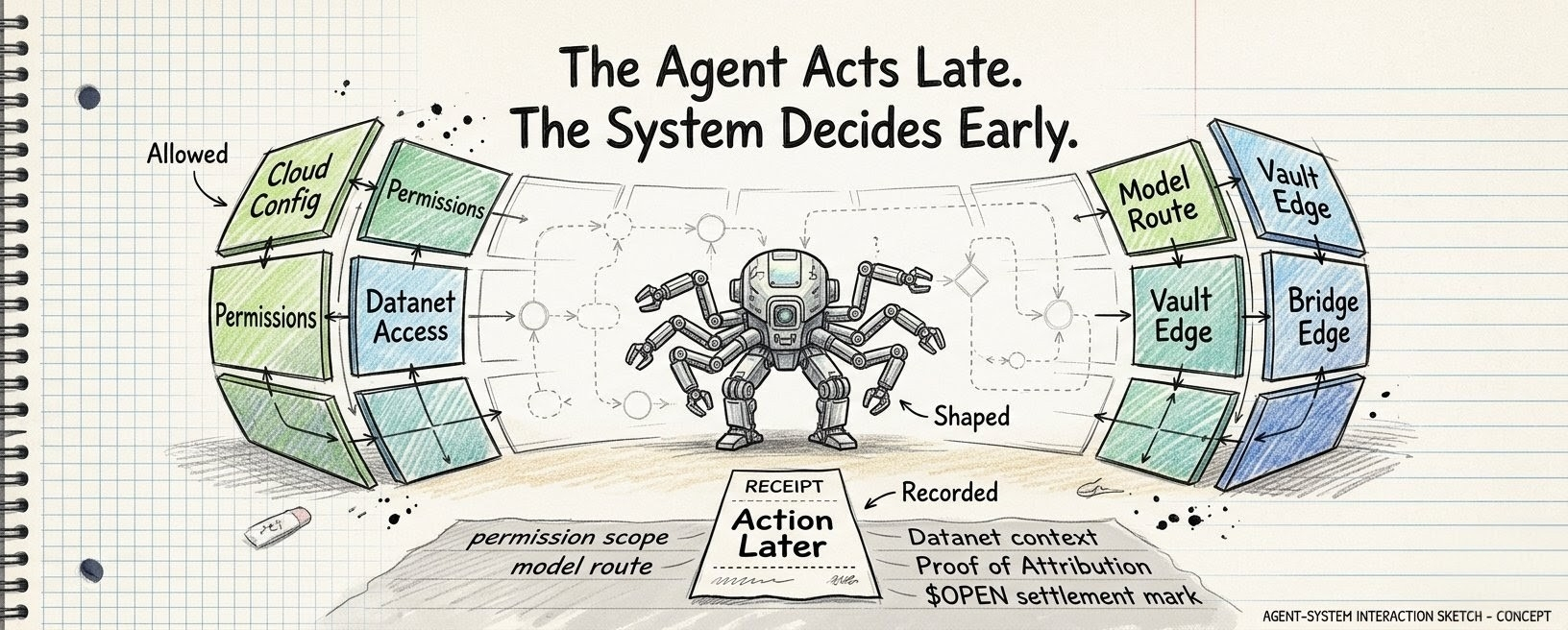

i keep thinking about the moment before an agent does anything inside openLedger (@OpenLedger ).
not the trade. not the execution. not the little final action everyone notices because something moved and now there is a result to stare at.
before that.
the config.
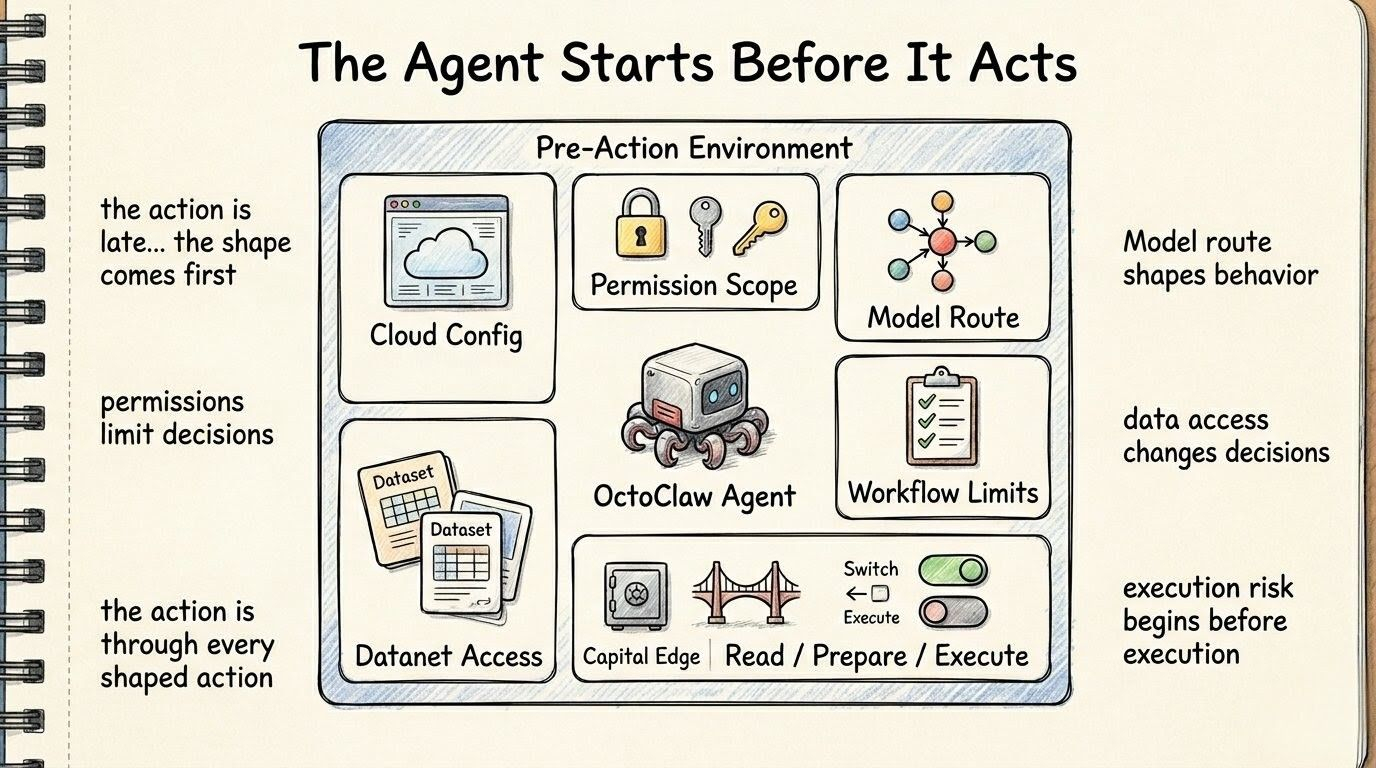
that boring little layer nobody wants to romanticize because it feels like settings. cloud config, routes, permissions, model access, data access, what the agent can touch, what it cannot touch, which workflow it is allowed to follow, where the action is supposed to settle if it goes that far. all the small boxes checked before the agent looks alive.
on openLedger, trading agent makes the action feel like the main thing. but the longer i sit with OctoClaw, the more the action feels like the late part.
the agent starts earlier.
maybe that is the uncomfortable thing.
because an agent does not become dangerous only when it clicks execute. it becomes shaped before that, in the permissions around it. in the paths opened for it. in the data it is allowed to read. in the model route it can call. in whether it can approach vault logic, bridge rails, contracts, or capital at all.
so when people talk about agents like they are little brains with hands, i always feel like something is missing.
hands attached to what?
what are they allowed to grab?
OctoClaw makes that question feel less abstract. if an OpenLedger agent is being configured to research, prepare a workflow, build a trading route, or touch some on-chain action later, then the serious part is not only whether the model gives a good answer. the serious part is how the agent was boxed before the answer ever turned into movement.
the box matters.
a badly boxed agent can look smart right until it finds the wrong door open.
that is the part i keep coming back to openLedger. not in some dramatic killer robot way. more boring. more real. an agent is told to optimize something. it gets access to some data. it gets a model path. maybe a Datanet gives context. maybe ModelFactory is part of the deployment route. maybe Proof of Attribution will later remember what shaped the output. and maybe the agent is sitting near a place where value can actually move.
then what?
if the config is loose, the action inherits that looseness. if the permissions are lazy, the execution carries that laziness forward. if the agent can touch things it does not understand, or route through paths nobody later wants to explain, then the problem did not begin at execution. it began when the system let the agent become that shape.
that is why the pre-action layer feels like the real architecture.
OctoClaw cloud config is not just setup. setup is too harmless a word. setup sounds like the boring screen you rush through before the real product starts. but for agents, setup is policy wearing a dull jacket. it decides what can happen later. it decides what kind of mistake is even possible.
clean agent demos always feel a bit suspicious to me. they show the final move. agent finds something, agent does something, maybe agent trades, maybe agent runs a task. looks smooth. maybe too smooth.
but what was allowed before that smoothness?
which data could it read?
which model did it route through?
which contract edge was open?
which vault rail was near enough to matter?
who decided that?
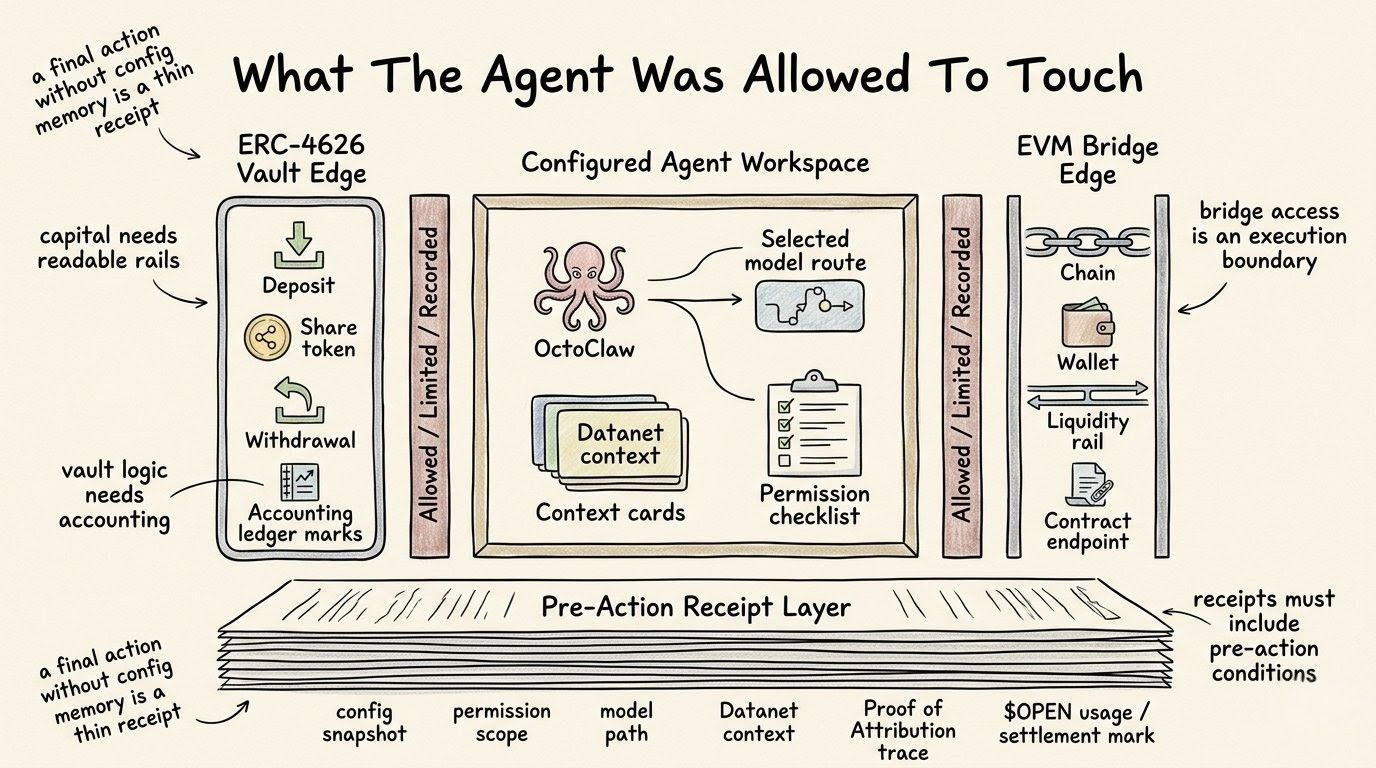
these questions feel annoying, but once money or execution enters, annoying becomes necessary. a text answer can be wrong and disappear into the day. an agent action is different. if it routes capital, touches ERC-4626 vault logic, prepares a strategy, or sends value across EVM bridge rails, the openLedger system needs something more than confidence.
the trail has to start before the action.
not just a log after the action. a record of the conditions that made the action possible. the agent did not act from nowhere. it acted from a configured environment. so the environment should not vanish behind the action like it was just background.
background is where mistakes hide.
on openLedger, ERC-4626 makes this sharper because vaults do not care how inspired the agent sounded. deposits, shares, withdrawals, yield accounting… these are not vibes. if an agent is allowed to move near a vault, then its permissions and route have to be boringly clear. what can it deposit? what can it withdraw? can it only read? can it prepare? can it execute? who signs? what happens if the model route was influenced by weak data or stale context?
maybe that sounds too much like plumbing.
but capital is plumbing with consequences.
and the EVM bridge sits in the same kind of uncomfortable place. a bridge can look like token movement from far away, but for an AI-native system it is also a boundary. OpenLedger’s agent world on one side, broader EVM liquidity and contracts on the other. if an agent can cross that boundary, or prepare an action that depends on it, then the configuration before the movement matters as much as the movement itself.
what was the allowed rail?
what was the settlement path?
was the agent only observing liquidity, or could it actually push something toward execution?
that distinction is small until it is not.
i think this is where openLedger becomes part of the quieter story too. not as decoration, not as noise around the agent. more like the system’s way of making actions costed, settled, participated in, or recorded when usage turns real. if an agent consumes model routes, leans on data context, uses compute, creates an execution trail, or triggers activity that needs settlement, openLedger ($OPEN ) sits where the agent’s usage stops being a request and starts becoming cost, execution, or settlement.
the agent moves, but something has to account for why it moved and what it used.
that is the part the interface makes easy to miss. it treats action like the beginning of intelligence. i think action is usually the end of a long list of earlier decisions nobody wanted to read.
the permission was a decision.
the route was a decision.
the data access was a decision.
the model path was a decision.
and OctoClaw makes those decisions visible enough to think about. maybe not glamorous, but useful. because a openLedger system that wants AI agents to operate around real workflows cannot pretend the only important thing is the final output. the agent’s behavior is downstream from the environment it was given.
so if an agent makes a trading suggestion, where did the suggestion start? in the prompt? in the model? in the Datanet context? in the workflow route? in the config that allowed it to interpret one signal and ignore another?
and if the agent later acts, which part gets blamed?
that question does not have a clean answer, which is probably why it matters.
inside openLedger Proof of Attribution makes sense in this frame too, but not as a slogan. more like a pressure under the agent. if the action was influenced by certain data, model routes, or system inputs, the agent should not get to become a black box just because it has a nice interface. attribution should not stop at content. it has to matter when output becomes instruction, and instruction becomes action.
because once an agent acts, the output is not only information anymore.
it is a cause.
that is a different category.
and maybe that is why the config keeps bothering me. data access is not just access if it changes what the agent can decide. model routing is not just routing if it changes what the agent can execute. permission is not just permission if it decides which mistake is possible.
everything becomes less innocent once it can move.
and weirdly, the design problem is boring in the most serious way. decide what the agent can touch. record the route. price the usage. remember the inputs. make the action reconstructable. do not let “AI did it” become an excuse for nobody knowing which part of the system gave it permission.
because “AI did it” is not a record.
so the question keeps coming back: what was the agent allowed to become before it moved?
that is where openLedger OctoClaw feels important to me. not because agents are new, not because trading agents sound exciting, not because automation is some magical future word. but because the pre-action layer becomes real infrastructure when the agent can do more than talk.
before the action, there is a shape.
before the execution, there is a route.
before the mistake, there was probably permission.
and if OpenLedger wants agents to operate in a world where data, models, workflows, vaults, and bridges all touch each other, then the boring configuration layer cannot stay boring. it becomes the place where responsibility starts.
maybe users never care. they see the agent act or not act. they see the result, the task, the trade, the output, the workflow. they do not sit there wondering about cloud config and permissions and model routes at 5am like something is wrong with them.
but the system has to care.
because if the agent starts before it acts, then the trail has to start before execution too.
openLedger (#OpenLedger ), the action is only the part we notice. the stranger question sits earlier: what did the architecture allow before the agent ever moved?