
Looked at the ModelFactory and Vibecoding combination properly. separately, each one is a useful product. Together, they create a specific economic loop that changes who can participate in the model buuilder royalty system and that combination is worth mapping carefully.
Pulled up every available document on both products on my Pc before forming an opinion.
ModelFactory is OpenLedgers nocode and low code AI model building tool. a developer publishes a Specialized Laanguage Model on chain through Model Factory. once live every time that model receives a query a smart contract executes and distributes OPEN tokens to the model developer automatically. no platform intermediary. No reveenue share. direct payment from protocol to builder based purely on usage. the royalty machanism is real and it is already live.
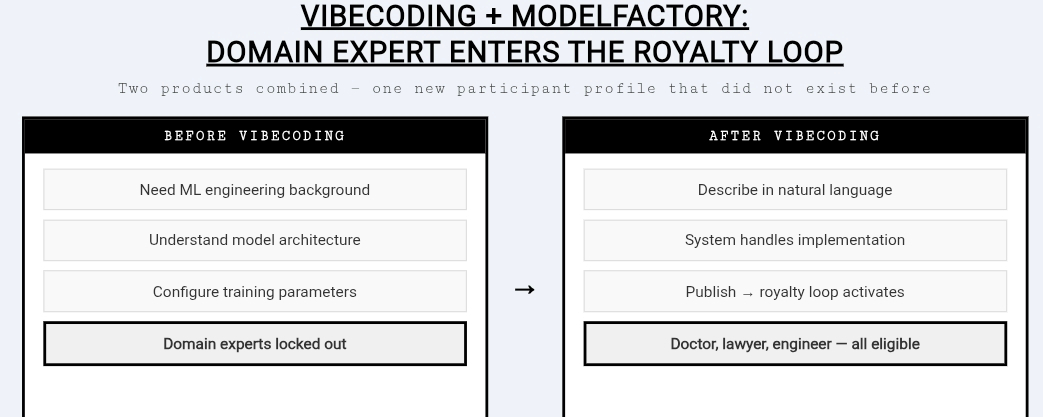
Vibecoding removes the remaining technical barrier. before Vibeccoding building a model through ModelFactory still required understanding model architecture at some level training parameters, dataset formmatting, inference optimization. Vibecoding allows a user to describe what they want their model to do in natural language. the system handles the technical Implementation.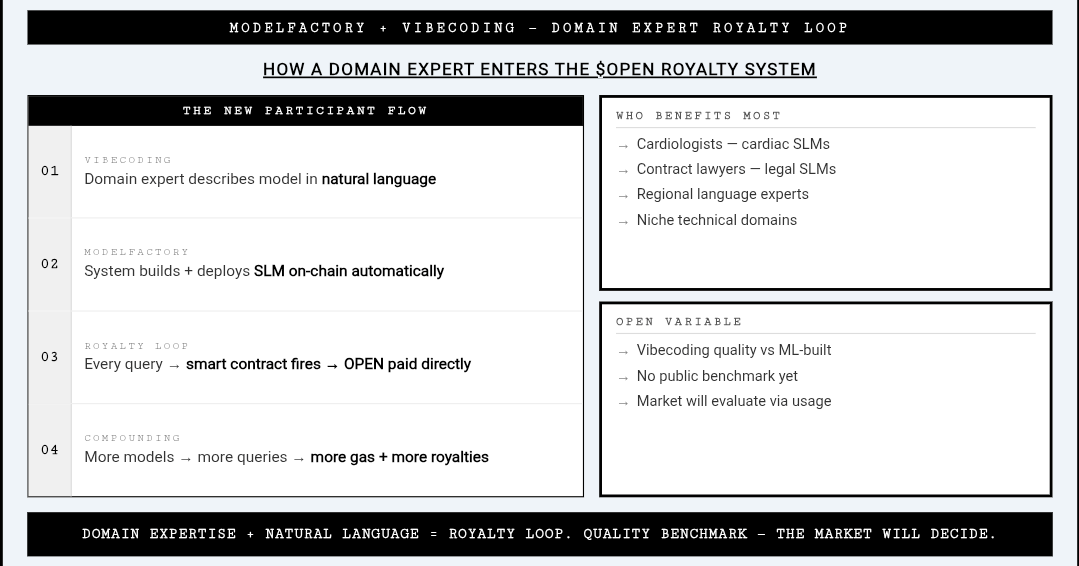
The output is a deployable SLM that enters the ModelFactory royalty loop immediately upon publication.
The combination creates a specific participant profile that did not previously exist in AI development. a domain expert a cardiologist, a contract lawyer a structural engineer a regional language specialist who has deep expertise in their field but zero machine learning background can now build a domain Specific SLM publish it on OpenLedger and earn OPEN tokens every time that model gets queried.
The technical barrier that previously separated domain knowledge from AI monetization has been removed at the infrastructure level.
The economic implications compound as the model marketplace scales. more domain experts building more Specialized models means more SLMs covering more domains. more domain coverage means more potential use cases for the network. more use cases means more queries. more queries means more gas consumption and more royalty distribution.
The supply side of the model marketplace expands through a participant base that was previously locked out entirely.
Spent time thinking through who specifically benefits most from this combination on my phone. the answer is not software developers they could already build models. the answer is domain experts in fields where specialized AI is commercially valuable but where no developer has bothered to build a domain specific model because the addressable market seemed too small. regional language processing. Highly specialized medical sub fields. niche legal domains. industry specific technical analysis. these are exactly tthe SLM use cases that OpenLedger s architecture is optimized for and exactly the use cases that Vibecoding makes accessible to the most qualified builders.
The structural tension w0rth watching is model quality. a cardiologist building a cardiac terminology SLM through natural language prompting versus an ML engineer building the same model with full technical control the quality gap between those two outputs has not been publicly benchmarked on OpenLedger's infrastructure. accessible development and optimal development are not always the same thing. if Vibecoding built models consistently underperform traditioonally engineered models on the same domain, the royalty loop rewards will reflect that gap through lower usage. the market will evaluate quality automatically.
Still waiting to see published quality benchmarks comparing Vibeccoding built SLMs against traditionally engineered models on equivalent domain tasks.