
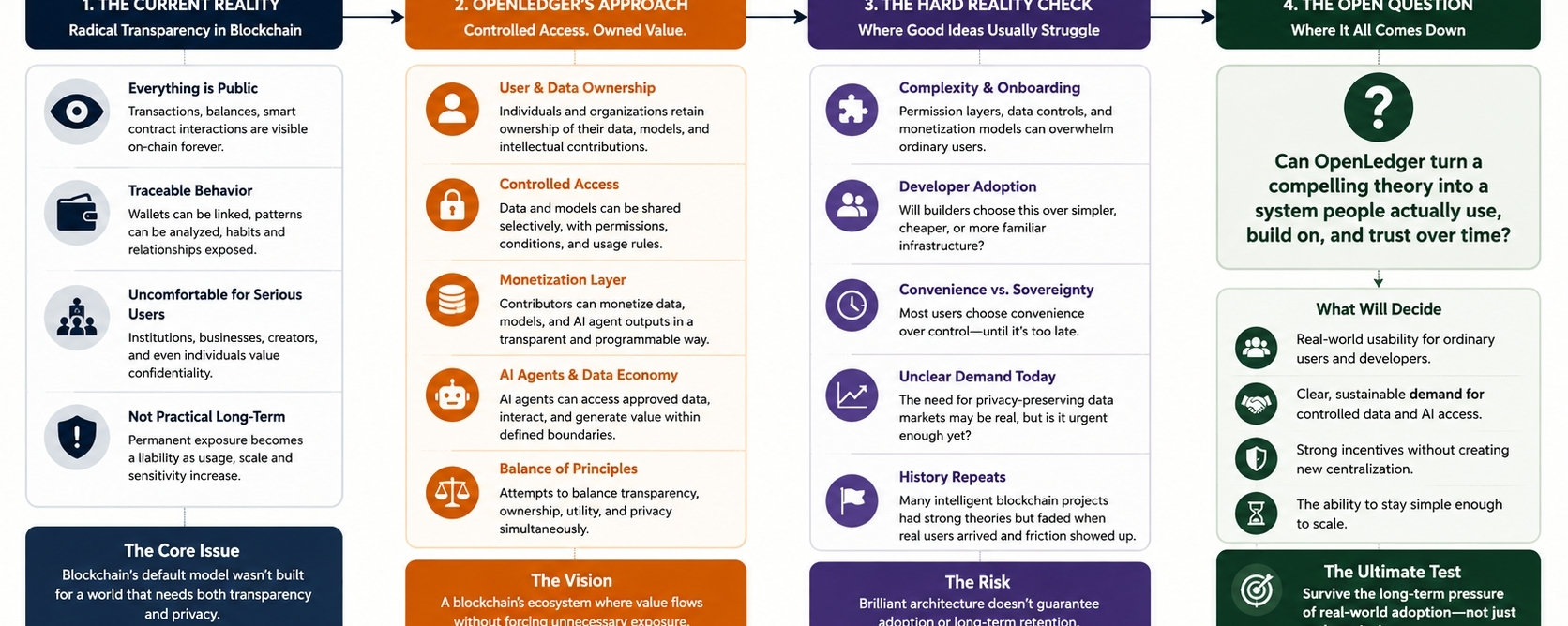
For a long time, one of the quiet assumptions inside crypto was that transparency itself was inherently virtuous. The early culture around blockchain treated visibility almost like a moral principle. Every transaction could be traced. Every wallet could be followed. Every movement of capital, every interaction with a protocol, every token transfer existed permanently in public view. In the beginning, this felt revolutionary. After the opacity of traditional finance, radical transparency looked clean, honest, even liberating.
But after enough cycles, the appeal starts to feel more complicated.
Projects like #OpenLedger emerge from that discomfort. Not necessarily from rebellion against blockchain itself, but from an acknowledgment that permanent exposure may not scale as comfortably as early crypto enthusiasts imagined. upcoming Phase 1 seems to revolve around a different interpretation of blockchain utility, one where data ownership, controlled access, AI coordination, and monetization exist without forcing every detail into fully public infrastructure.
At least in theory.
That distinction matters because the industry has spent years pretending that transparency and usability naturally coexist. In practice, they often collide. A casual trader may tolerate public wallets for a while. Speculators rarely care until they suddenly do. But institutions, businesses, creators, researchers, and even ordinary users eventually run into the same uncomfortable reality: blockchain remembers everything. Not just balances, but behavioral patterns. Habits. Relationships between wallets. Spending tendencies. Timing. Strategy. Exposure accumulates slowly until users begin recognizing how much of themselves is visible.
Crypto still tends to underestimate how strange this feels outside its own culture.
Traditional businesses do not operate with fully public accounting visible to competitors in real time. Consumers do not normally publish their spending history permanently on an immutable ledger. AI companies certainly do not want sensitive training data fully exposed. Yet much of Web3 infrastructure still assumes users will accept a level of openness that most industries abandoned decades ago for practical reasons.
This is where OpenLedger becomes interesting, at least conceptually. The project appears to recognize that the next stage of blockchain infrastructure may require more nuanced control over information itself. Rather than treating transparency as absolute, it attempts to create a system where users, contributors, and AI agents can participate economically while retaining selective ownership over what becomes visible, monetized, or shared.
That sounds reasonable. Maybe even necessary.
But crypto has always been strongest at producing compelling theories.
What becomes harder is translating those theories into systems ordinary people consistently use. I have watched too many technically sophisticated projects arrive with convincing architectures only to slowly dissolve once real-world behavior entered the equation. The whitepapers were coherent. The token models sounded rational. The infrastructure solved meaningful problems on paper. Then friction appeared. Users stopped caring. Developers lost momentum. Incentives weakened. Complexity accumulated quietly until the ecosystem became too exhausting to engage with regularly.
OpenLedger may eventually face the same pressure.
Because privacy in blockchain is not simply a technical challenge. It is also a behavioral one. Users consistently claim they value ownership and sovereignty, but their actions often suggest otherwise. Most people choose convenience almost every time. They use centralized exchanges despite understanding custodial risks. They sacrifice privacy for smoother onboarding. They tolerate surveillance from major platforms because the alternatives feel cumbersome. Even within crypto itself, many users prefer ecosystems that reduce cognitive load rather than increase control.
That tension sits underneath OpenLedger’s entire thesis.
The project seems to envision a world where data becomes an asset class users actively manage. AI agents interact with controlled datasets. Contributors monetize access without fully surrendering ownership. Infrastructure coordinates permissions, incentives, and utility simultaneously. In theory, this creates a more sustainable relationship between transparency and confidentiality. Instead of forcing everything into public exposure, value can emerge from selective disclosure.
Again, intellectually, it makes sense.
But systems built around controlled access often introduce layers of complexity that become invisible during early excitement. Managing permissions sounds elegant until ordinary users have to understand them. Monetizing data sounds empowering until contributors struggle to determine pricing, trust, or usefulness. AI infrastructure sounds transformative until developers realize integration costs exceed practical demand.
This is the point where many crypto narratives quietly weaken. Not because the ideas are foolish, but because real adoption tends to reward simplicity more than philosophical correctness.
I think this is especially relevant now that AI and blockchain are increasingly being merged together rhetorically. The industry currently treats AI integration almost the same way it once treated metaverse infrastructure or DeFi composability: as an inevitability rather than a hypothesis. $OPEN exists inside that atmosphere. There is growing belief that AI systems will require decentralized data coordination, permission structures, and tokenized incentives. Perhaps they will. But crypto has a long history of assuming future necessity before current utility actually exists.
The uncomfortable question is whether developers truly need blockchain-based data ownership models badly enough to tolerate additional friction.
Because developers, more than anyone, are ruthless about convenience. If centralized infrastructure remains faster, cheaper, easier, and sufficiently trusted, many will continue choosing it regardless of ideological concerns around sovereignty. History suggests this repeatedly. Open-source ideals rarely eliminate corporate platforms entirely because convenience exerts enormous gravitational pull.
And then there is the question of user retention, which ultimately destroys more crypto projects than technology ever does.
Early curiosity is abundant in this industry. Users experiment constantly. Capital rotates quickly. Narratives trend for months before attention migrates elsewhere. What becomes difficult is creating systems people continue using after speculation fades. Privacy-focused ecosystems face a particularly difficult balancing act because the benefits are often abstract until something goes wrong. Most users do not feel urgency around data ownership until after exposure harms them. Until then, convenience usually wins.
That creates a strange paradox for projects like OpenLedger. If privacy remains invisible, adoption may stay weak because users do not perceive immediate pain. But if privacy failures become widespread enough to drive demand, the broader digital environment may already be deeply compromised by the time these systems mature.
I do not say this dismissively. If anything, I respect projects willing to engage with structural weaknesses rather than simply launching another interchangeable chain promising speed and scalability. There is at least a seriousness to OpenLedger’s direction that feels more thoughtful than much of the market’s current noise. The attempt to reconcile ownership, AI coordination, utility, and selective transparency reflects a genuine awareness that existing blockchain models may not comfortably support long-term mainstream behavior.
Still, experience makes optimism difficult.
Crypto has repeatedly produced infrastructures that looked inevitable during early phases and irrelevant a few years later. Markets confuse intellectual sophistication with survivability all the time. Sometimes the best-designed systems fail simply because they demand too much attention from users. Sometimes ecosystems collapse not from technical flaws, but from emotional exhaustion. People eventually gravitate toward whatever feels easiest, even if it compromises principles they claim to value.
So when I look at OpenLedger and its Phase 1, I do not really see certainty. I see an experiment testing whether blockchain can evolve beyond its obsession with radical transparency without losing the qualities that made it compelling in the first place. I see an attempt to build infrastructure around a future where AI, data ownership, and privacy become economically interconnected rather than publicly exposed by default.
The architecture may be intelligent. The reasoning may even be correct.
But crypto history has taught me that being correct in theory is rarely enough.
The harder question is whether enough people will care consistently enough, for long enough, to make the system feel necessary rather than merely interesting. And that is usually where the real survival test begins.