
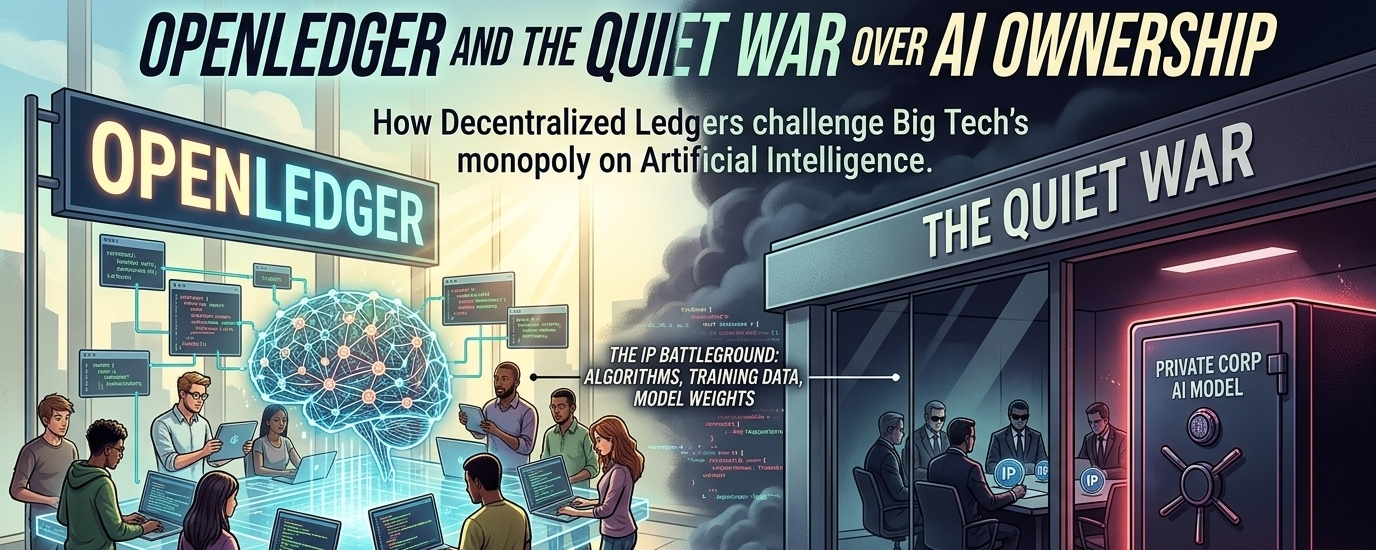
For most of crypto’s short life, the industry has had a habit of rediscovering the same problem under different names.
In one cycle it was blockspace. In another it was liquidity fragmentation. Then interoperability. Then attention. Every few years the market develops a new vocabulary for an old coordination failure, wraps it in cleaner branding, attaches incentives to it, and watches capital flood toward the narrative until the friction becomes impossible to ignore again.
AI now sits in that position.
Not AI in the abstract sense. Not the endless stream of tokenized chatbots and synthetic personalities that appeared during the last speculative phase. Those came and went quickly because there was never much underneath them besides liquidity looking for a temporary story. What remains, after the noise fades, is a quieter and more difficult question about ownership and economic alignment around intelligence infrastructure itself.
Who owns the data?
Who captures the value produced by models?
Who controls distribution?
And maybe more importantly, who gets paid when machines increasingly interact with other machines instead of people?
That last question matters more than most investors realize. Markets tend to focus on the visible layer first. Consumer apps. Interfaces. Token price charts. But infrastructure markets are usually shaped by invisible dependencies. Storage. Compute. Routing. Incentive systems. Reputation systems. The boring plumbing that nobody discusses until it fails under pressure.
That is roughly where projects like OpenLedger begin to enter the conversation.
Not because the market suddenly discovered some entirely new architecture. It rarely does. But because the economic structure around AI is beginning to look increasingly uncomfortable for everyone except the largest incumbents.
Most of the current AI stack is vertically concentrated. Data pipelines, model training, cloud infrastructure, distribution channels, and monetization mechanisms are all dominated by a small number of companies with enormous capital advantages. Open source models introduced some resistance to that concentration, but even open source eventually runs into economic gravity. Training costs money. Inference costs money. Distribution costs money. And contributors generally stop contributing once idealism collides with operational reality.
Crypto sees this and immediately reaches for tokenization as the solution. Sometimes too quickly.
The instinct is understandable. If data has value, tokenize it. If models generate revenue, create ownership rails around them. If AI agents transact autonomously, build settlement infrastructure underneath them. The logic is internally coherent. The execution is where things become difficult.
OpenLedger positions itself inside that gap.
The basic premise is straightforward enough. Create a blockchain-based infrastructure layer where data, models, and AI agents become economically composable assets. In theory, contributors can monetize datasets, developers can deploy models into a shared ecosystem, and agents can interact economically without relying entirely on centralized intermediaries.
That sounds clean on paper. Most systems do.
The harder question is whether markets actually behave the way whitepapers assume they will.
Because data markets have historically struggled for reasons that are less technical than social.
High-quality data is difficult to verify. Participants often overestimate the uniqueness of what they contribute. Incentives drift toward quantity instead of quality. Reputation systems get gamed. Sybil behavior appears almost immediately once rewards become extractable. Eventually the network spends more time filtering noise than creating value.
Crypto veterans have seen versions of this movie before.
Move-to-earn struggled with incentive decay. Play-to-earn discovered that extracting value and creating value are not the same thing. DePIN networks learned that hardware coordination at scale introduces operational complexity most token models underestimate. Even decentralized compute markets, despite solving real problems, continue wrestling with reliability guarantees and enterprise trust.
AI compounds these issues because the outputs are probabilistic by nature. There is no universally clean mechanism for measuring the quality of intelligence production at scale. Human evaluation does not scale well. Automated evaluation creates recursive problems where models assess models. Reputation systems eventually centralize around trusted validators anyway.
So the real challenge for OpenLedger is not building infrastructure. Crypto is reasonably good at producing infrastructure layers. The challenge is creating sustainable incentive alignment around intelligence assets without turning the system into another speculative extraction environment.
That distinction matters.
A lot of AI-crypto projects quietly depend on the assumption that token incentives can bootstrap genuine economic activity before speculative interest fades. Sometimes that works. More often, incentives attract participants who optimize for emissions rather than utility. Networks become crowded with actors farming rewards instead of contributing durable value.
The market usually notices eventually.
One of the more interesting aspects of OpenLedger is that it at least appears aware of this problem structurally. The emphasis on liquidity around data and models suggests an attempt to treat AI outputs as productive economic primitives rather than purely narrative-driven assets. There is a subtle but important difference there.
Whether that works depends on usage density.
Infrastructure networks become meaningful when participants rely on them because leaving becomes inconvenient. Not because APYs are temporarily attractive. Ethereum achieved this through developer gravity. Stablecoins achieved it through settlement utility. Even Bitcoin, despite endless ideological debates, survives because its simplicity became socially legible over time.
AI networks do not yet have that level of embedded necessity.
And there is another uncomfortable reality underneath all this.
Most businesses do not actually want decentralization. They want reliability, legal clarity, predictable costs, and operational accountability. Decentralization only becomes attractive when centralized dependency becomes sufficiently painful or expensive. Until then, convenience wins almost every time.
This creates a strange tension for AI blockchains.
The projects often market themselves toward openness and permissionless contribution, while the actual enterprise world continues consolidating around highly centralized providers with service guarantees and compliance infrastructure. There is a mismatch between ideological preference and institutional behavior.
OpenLedger may eventually discover that the harder problem is not technical coordination but trust abstraction.
Can enterprises trust decentralized data sources?
Can model contributors prove provenance?
Can agent interactions remain economically secure without introducing unbearable complexity?
Can governance systems avoid capture once meaningful value accumulates?
These are not impossible problems. But they are slower problems than crypto markets usually tolerate.
The industry still operates with venture-style time compression. Narratives emerge, liquidity rotates, expectations inflate, and patience disappears within quarters. Infrastructure adoption rarely moves that quickly. Especially when the infrastructure depends on behavioral change across multiple industries simultaneously.
AI itself is already difficult enough for most businesses to operationalize. Adding blockchain coordination layers introduces another cognitive and regulatory burden.
That does not mean the thesis is wrong.
If anything, the long-term direction feels somewhat inevitable. Machine economies probably will require native digital settlement layers eventually. Data attribution probably will become economically important. Autonomous agents interacting across networks probably will need programmable financial infrastructure. Centralized systems alone may not scale elegantly into that future.
But inevitability is not timing.
Crypto frequently confuses the two.
There is also the governance question, which tends to receive less attention during optimistic periods. AI networks are not politically neutral systems. Whoever controls model incentives, data validation, and economic routing mechanisms effectively shapes the behavior of the network itself. Over time, governance becomes less about token voting and more about power concentration around infrastructure dependencies.
This is where many decentralized systems quietly recentralize.
Not through explicit corruption necessarily. Just through operational necessity. The most competent validators gain influence. The largest data providers gain bargaining power. Liquidity consolidates around dominant hubs. Smaller participants become economically irrelevant despite theoretical openness.
Open systems often drift toward soft oligarchies.
Again, crypto veterans recognize the pattern.
None of this invalidates OpenLedger’s direction. If anything, it makes the project more interesting because it operates in a domain where the contradictions are real instead of cosmetic. AI and crypto both suffer from incentive distortion independently. Combining them does not magically remove those distortions. It intensifies them.
And yet the broader market may still underestimate the significance of what projects like this are attempting.
Not because every AI blockchain will succeed. Most probably will not. Infrastructure graveyards are filled with technically competent systems that failed to achieve social coordination. But the intersection itself matters. The industry is gradually moving from purely financial abstraction toward computational economics.
That changes the texture of the conversation.
Earlier crypto cycles were dominated by monetary experiments. Stablecoins. Lending protocols. Yield systems. Financial engineering wrapped around speculative liquidity. AI introduces something slightly different. Productive systems. Systems where the output is not merely financial activity but synthetic labor, inference, prediction, automation.
Value begins shifting from capital coordination toward intelligence coordination.
That is a more complicated market.
Harder to model. Harder to govern. Probably harder to decentralize than people currently assume.
OpenLedger sits somewhere inside that uncertainty. Not fully proven. Not obviously irrational either. Just another attempt to solve a coordination problem that becomes more visible each year as AI infrastructure centralizes faster than the public narrative admits.
The market will likely oversimplify it for a while. It always does. Some participants will treat it as an AI beta trade. Others will dismiss it entirely as another tokenized abstraction searching for relevance. Reality is usually less dramatic than either side expects.
Infrastructure stories tend to unfold slowly, then suddenly.
Most of the important changes happen quietly before the market notices what actually became indispensable.
