
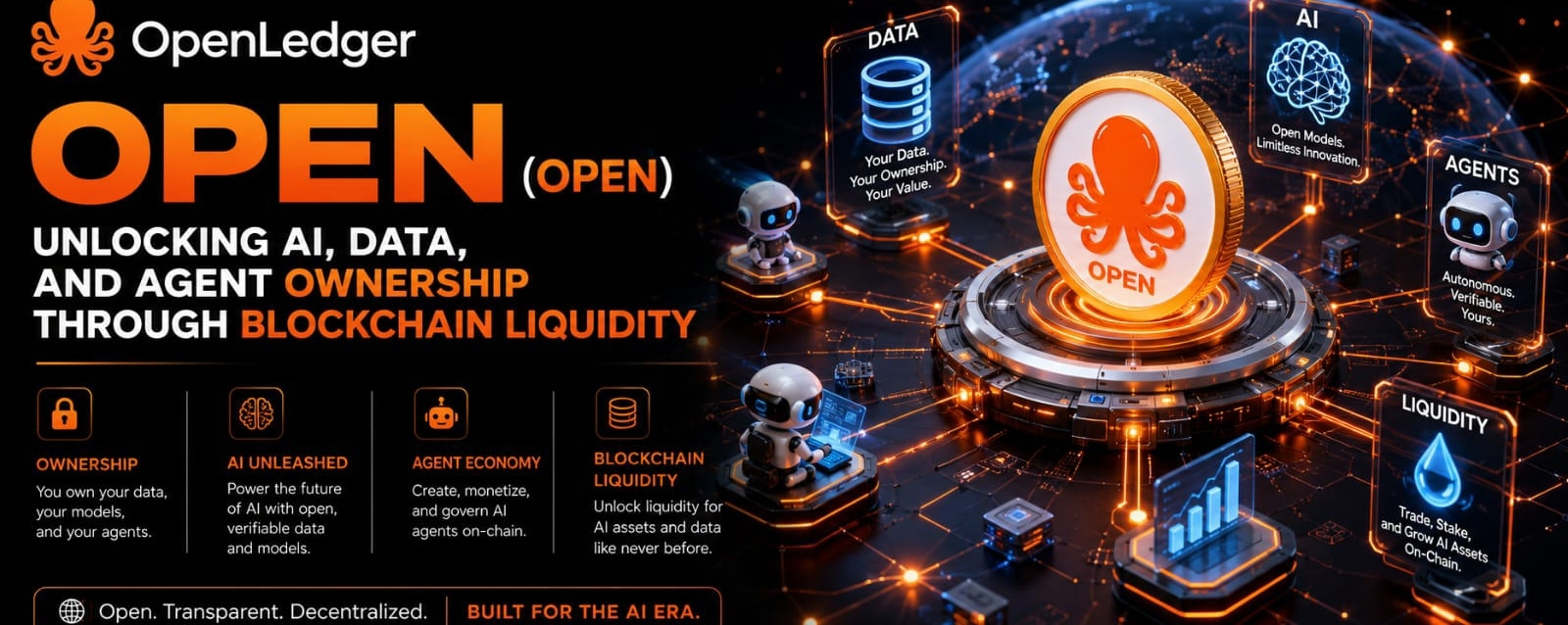
OpenLedger (OPEN), an AI blockchain project, is often presented as an attempt to reshape how I understand the relationship between data, artificial intelligence, and ownership in a digital economy where value is created continuously but not always distributed fairly, and I see it as an infrastructure idea that tries to connect liquidity with intelligence, meaning data, models, and autonomous agents are no longer just tools sitting inside closed systems but become measurable assets that can potentially be tracked, attributed, and monetized in a transparent way.
In the current AI landscape, I observe that most systems rely heavily on centralized data collection where users interact with models and generate information, yet I do not directly control or benefit from the long-term value of that contribution, and OpenLedger is trying to change that structure by introducing a ledger-based mechanism where every interaction, dataset contribution, or model improvement can be recorded as part of an economic layer, and if it becomes successful at scale, I’m effectively moving from being just a user of AI systems to being a participant in the value creation process itself.
The way I understand the system is that it separates computation from attribution, because AI models are too large and complex to run entirely on-chain, so the actual processing happens off-chain while blockchain technology is used as a settlement and ownership layer that records provenance, contribution history, and usage rights, and this design allows data and models to become traceable assets, which means I can theoretically see how information flows through systems and how it contributes to outcomes instead of it disappearing into a black box of machine learning training.
In this structure, data is not just raw input anymore but becomes a financial and informational resource with metadata attached to it, and models are not just static algorithms but evolving assets that can be versioned, improved, and reused, and autonomous agents built on top of those models act as active participants in digital environments, performing tasks, generating outputs, and even producing new data, which then feeds back into the system, creating a continuous loop where I see intelligence as something that compounds over time rather than staying fixed.
The reason behind building something like OpenLedger, as I understand it, comes down to three core motivations: I want transparency so contributions are visible instead of hidden, I want fair incentive alignment so value creators are rewarded proportionally, and I want liquidity so that data and models can move freely across systems instead of being locked inside single platforms, and these choices reflect a broader shift in thinking where AI is not just a product but an economy in itself.
To make such a system functional, I recognize that metrics become extremely important because without clear measurement, the system would collapse into speculation, so I would need to track signals like how often data is used, how much it improves model performance, how agents contribute to task success, and how demand flows through different models and datasets, and while these measurements are still imperfect in real-world systems, I can see that future versions will likely combine cryptographic proofs, usage analytics, and incentive mechanisms to create more reliable attribution models.
At the same time, I also see significant risks in this direction because if I monetize data too deeply, privacy becomes a critical concern, and even with selective disclosure systems, there is always a risk that sensitive patterns can be inferred indirectly, and I also recognize that participants might start optimizing purely for rewards rather than genuine quality, which could degrade the system into a gameable environment instead of a meaningful intelligence economy, and if the design becomes too complex, it may also recreate centralization indirectly because only technically advanced participants would fully understand how value is distributed.
Scalability is another challenge I cannot ignore because tracking every contribution across millions or billions of interactions requires extremely efficient systems, and blockchain alone cannot handle that load, so hybrid architectures become necessary, but they introduce trust assumptions that I must carefully evaluate because if the off-chain components are not secure or transparent enough, then the entire ownership model becomes questionable.
Despite these challenges, I still see a long-term direction where AI systems evolve into economic ecosystems rather than isolated tools, and in that future, I imagine data, models, and agents forming a continuous value loop where every interaction contributes to growth, and I’m not just a consumer anymore but a stakeholder in the intelligence I help create, which changes how I think about everyday digital activity because even small actions could carry long-term economic meaning.
If this vision becomes real, then I’m no longer outside the system observing AI from a distance, but I am inside it as a contributor, a participant, and potentially a beneficiary of its growth, and that shift changes everything about how value is defined in digital space, because intelligence is no longer owned by a single company but becomes something distributed across everyone who helps it evolve, and in that future I can clearly see a world where ownership, participation, and innovation are not separate ideas anymore but part of one connected system that grows through collective human and machine interaction.