reading through how openledger structures its datanet architecture, the thing that keeps standing out is what's deliberately absent. there's no application process for creating a datanet. no approval queue for building a specialized model. no committee deciding which domains deserve infrastructure support. deliberate absences carry consequences that the presence of a feature never does and this one is worth reading carefully.
the way AI infrastructure has been built until now embeds a permission layer that rarely gets called by that name. providers decide what outputs are acceptable. terms of service define what you can build. access can be restricted, pricing changed, capabilities limited. that layer is framed as quality control or policy compliance and some of it genuinely is. but embedded in the same layer is a filter on which domains are worth serving. use cases that don't fit the provider's direction, applications for markets too niche to generate sufficient volume those get filtered not because they're wrong but because the permission layer optimizes for the center, and the center doesn't include them.
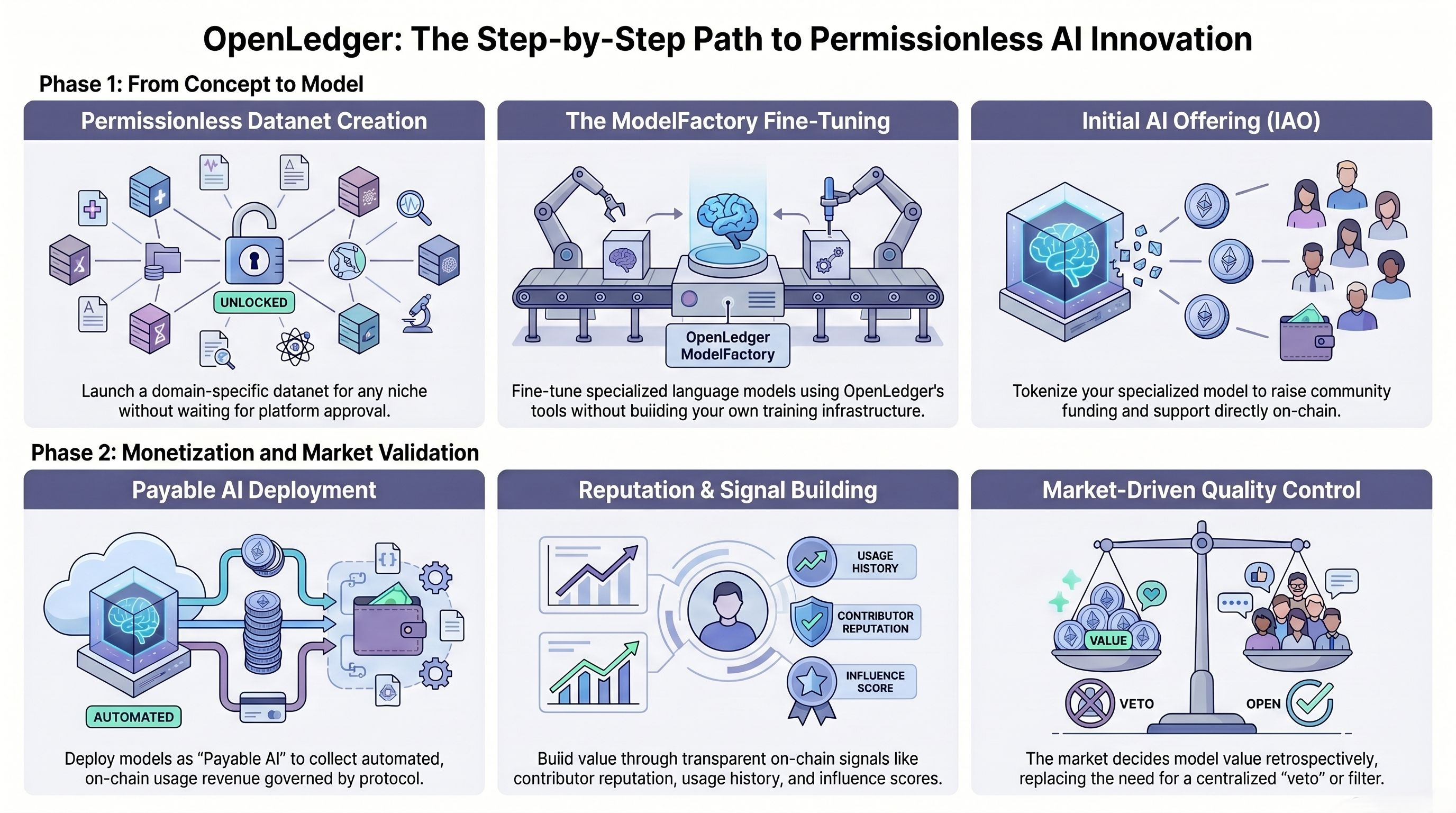
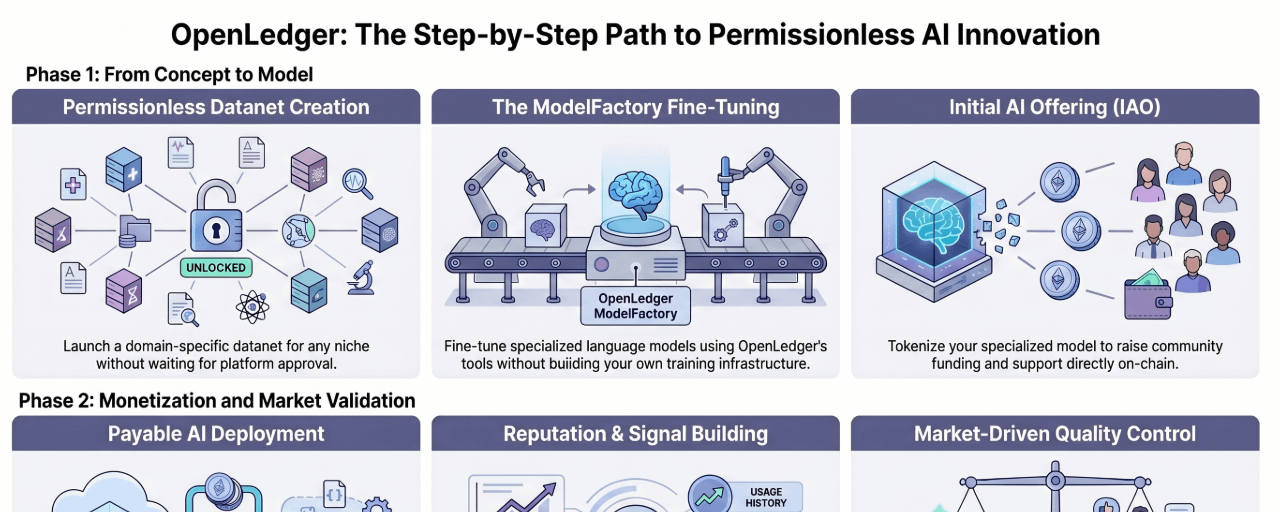
what openledger provides here is real. anyone can create a datanet for any domain. anyone can contribute domain-specific data. ModelFactory lets developers fine-tune a specialized language model without building training infrastructure. anyone can deploy that model as payable AI and collect on-chain usage revenue. the Initial AI Offering mechanism lets builders tokenize models and raise community funding. every critical action executes on-chain, governed by protocol not by editorial decisions about which domains deserve support.
so yes openledger is creating space for permissionless innovation. the entry architecture is genuinely open in a way AI infrastructure has not been before.
but removing the permission layer doesn't only unlock innovations that would have been wrongly blocked. it unlocks everything the permission layer would have filtered, correctly or not.
here's what keeps pulling focus: when any domain can have a datanet and any contributor can populate it, quality varies in ways a gated system would have moderated. a specialized model for rare disease research built with verified clinical data is a different product from a model labeled specialized but trained on unverified inputs. proof of attribution rewards based on usage the market decides value. but market validation is retrospective. the model deploys before the market has time to validate it. the architecture that makes the rare-domain specialist possible is the same architecture that makes the low-quality entry possible. openledger cannot apply a quality gate without reinstating the permission layer it was designed to remove.
and this creates an asymmetry in how different participants experience the same architecture.
for a builder with deep expertise in a domain gated platforms would never prioritize — a rare clinical context, a small legal jurisdiction, a specialized financial instrument — permissionless infrastructure is the mechanism that makes their use case buildable at all. the absence of a veto is not ideology for them. it's the practical condition under which their work becomes possible.
for a user selecting a model from openledger's ecosystem, the same architecture means no quality certification, no vetted directory, no platform signal that a model has been reviewed. on-chain attribution data exists usage history, contributor reputation, influence scores but reading those signals requires familiarity with what they actually measure. a user who can't evaluate attribution scores is navigating a permissionless space without the tools a gated system would have provided by default.
there is a productive contradiction here that nobody resolves cleanly.
a permissionless system that wants to be genuinely useful has to solve a discovery and trust problem without centralized curation because curation is the permission layer it removed. the available tools are market signals that take time to develop and community reputation mechanisms that require ecosystem maturity. in the early period, quality and noise coexist without a reliable mechanism to distinguish them quickly. whether that variance is early-stage immaturity or a permanent characteristic of the architecture is something only accumulated usage data will answer.
and yet removing the veto reflects a genuine bet about where innovation actually comes from.
most AI infrastructure assumes the domains worth serving are large enough to justify investment, and that the permission layer correctly identifies them. openledger is built on a different assumption that the domains needing specialized AI most urgently are often the ones gated systems have systematically underserved. the rare disease without enough patients to generate platform attention. the legal context too specialized for general training data. if that assumption is right, permissionless infrastructure isn't ideological preference — it's the mechanism for reaching the parts of the problem space that gatekeeping has consistently left unbuilt.
the question worth sitting with is not whether openledger's architecture enables innovation. it does. the question is whether the ecosystem develops the signals and reputation mechanisms that make the permissionless space legible to the people navigating it.
because the value of removing the veto is fully realized only when what gets built without permission is findable by the people who need it without requiring openledger to become the permission layer it replaced in order to make that possible.
Trading always carries risks. This is not financial advice.
@OpenLedger $OPEN #OpenLedger $ZEC $HYPE