I watch these things longer now.
Not the announcements. Not the diagrams. I watch what continues after attention leaves. I watch who comes back when there’s nothing to earn from pretending they care. Most of the time, the answer arrives quietly.
OpenLedger sits in a familiar place. Infrastructure built around a future that hasn’t fully formed yet. Data, models, agents, liquidity. The language arrives already optimized for belief. Everything connected to everything else. Markets understand this immediately. Markets are fast with abstractions.
People are slower.
I’ve seen projects become culturally significant before they become necessary. Sometimes necessity never arrives at all. The architecture remains intact, technically coherent, economically inactive. A system waiting for behavior that never settles into habit.
What interests me here isn’t the promise of AI on-chain. That part almost feels inevitable now, at least rhetorically. Every cycle develops a vocabulary that absorbs whatever the broader industry is currently unable to price correctly. This time it’s models, agents, ownership of intelligence itself. The words move faster than the infrastructure beneath them.
And still, I keep watching.
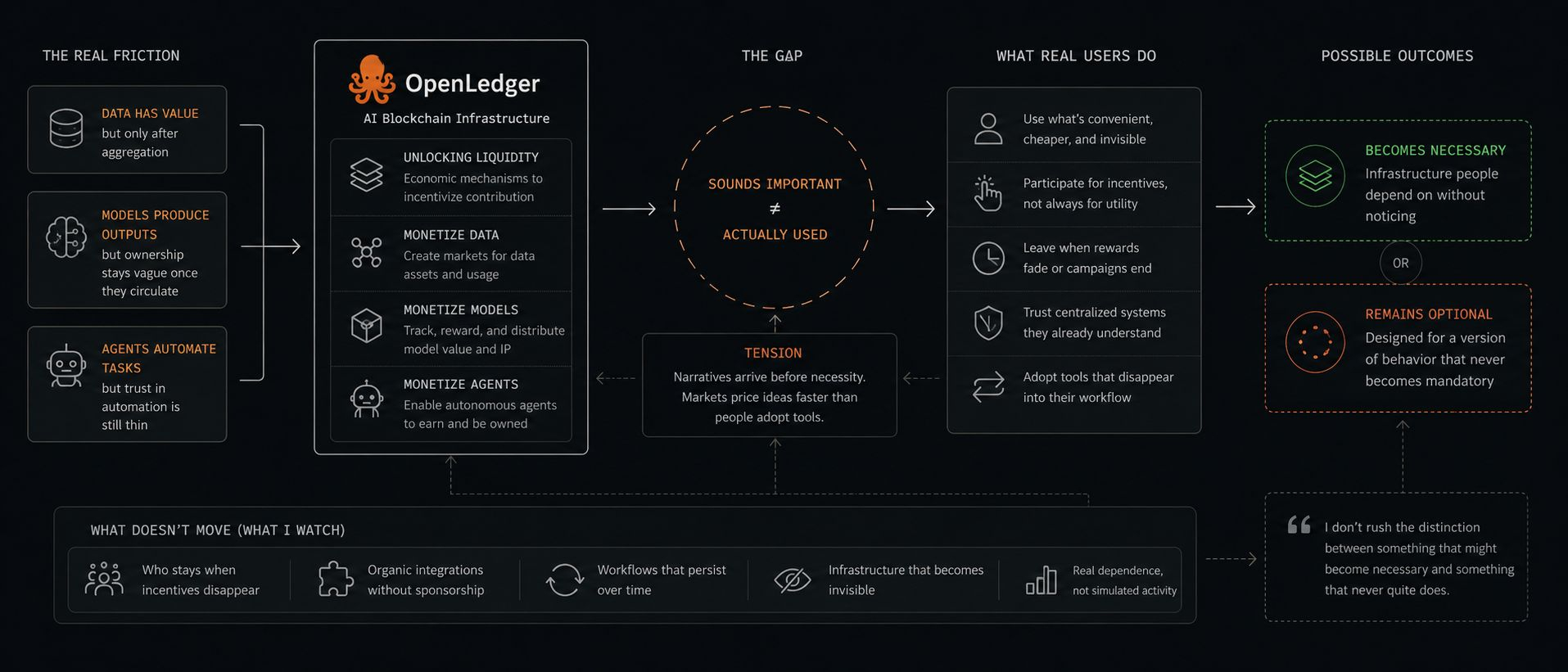
Because there is a real friction underneath this. Data has value, but usually only after aggregation. Models produce outputs, but ownership around outputs remains vague the moment they circulate. Agents automate tasks, but most people still barely trust automation inside systems they already understand. Somewhere inside that confusion, projects like this try to build rails before behavior exists.
That part matters more than the roadmap.
The market reacts as if the missing component is coordination. I’m not sure that’s true. Sometimes the missing component is desire. People say they want decentralized intelligence until centralization becomes more convenient, cheaper, invisible enough to ignore. Convenience wins quietly. It doesn’t need ideology.
OpenLedger seems aware of this, at least indirectly. The design points toward monetization mechanisms because participation alone no longer persuades anyone. Networks now need economic gravity immediately. If users contribute data, train models, operate agents — there has to be extraction, liquidity, return. Otherwise activity disappears the moment incentives weaken.
But incentives create their own distortion.
You start seeing behavior optimized for rewards instead of utility. Contribution without relevance. Volume without dependence. Entire ecosystems learn how to appear alive before becoming useful. Crypto became very efficient at simulating necessity. Sometimes I think infrastructure projects suffer most from this because they’re evaluated long before ordinary users ever encounter them naturally.
So I look for smaller things.
Whether anyone integrates without sponsorship. Whether workflows persist after campaigns end. Whether the product becomes invisible in the way real infrastructure eventually does. Most projects never reach that stage. They remain permanently discussed. Permanently emerging.
There’s also the timing problem. AI is moving at a velocity that makes blockchains feel procedural by comparison. Governance cycles, token coordination, consensus layers — all of it feels heavy next to systems iterating weekly. Maybe that tension becomes valuable later. Maybe provenance and ownership matter once autonomous systems interact economically at scale. Or maybe speed decides everything before verification becomes culturally important.
I don’t know.
That uncertainty is probably the only honest part left in this market.
OpenLedger could become one of those layers people depend on without noticing. Or it could remain another structure designed for a version of behavior that sounds inevitable in theory and optional in practice. Right now it exists somewhere between those two states. Visible enough for speculation. Not yet unavoidable.
I’ve learned not to rush that distinction.