
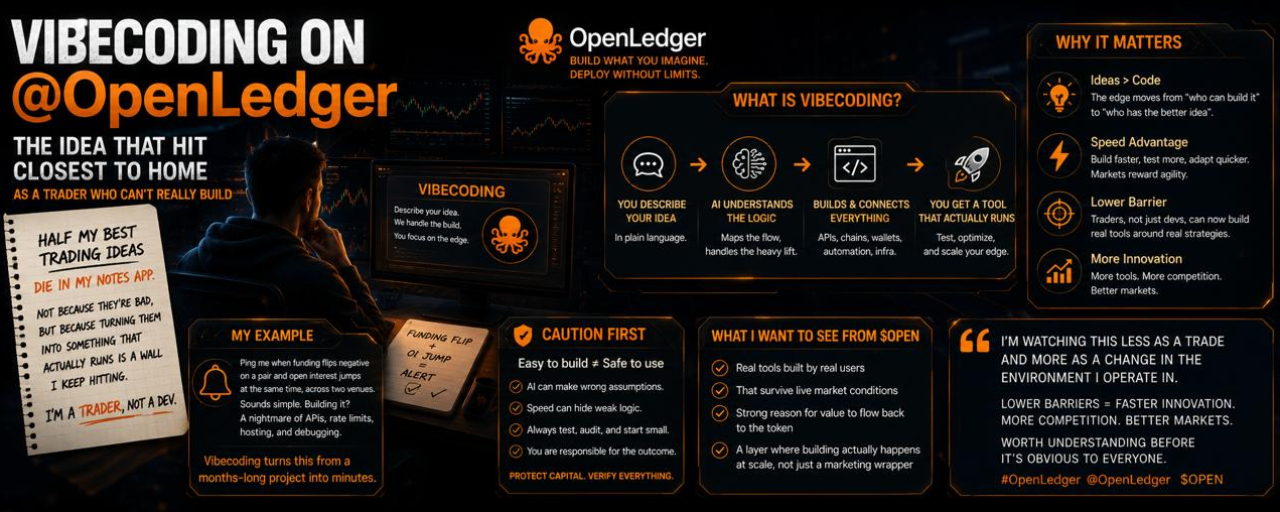
That’s probably the biggest reason why so many good strategies never get built.
Not because the logic is weak.
Because the barrier between “idea” and “execution” is still too high for non-developers.
That’s why the vibecoding direction from @OpenLedger feels interesting to me.
For years, building anything around trading meant learning APIs, hosting, debugging, smart contracts, automation, backend infrastructure, and a dozen things completely unrelated to the actual strategy itself.
A trader could understand the market perfectly and still be unable to build even a simple working system around their edge.
That creates a strange imbalance:
the people with ideas often can’t build,
and the people who can build don’t always understand the market deeply.
Vibecoding potentially changes that relationship.
If someone can describe a workflow, trading logic, automation process, or AI interaction in natural language and actually turn it into something functional, then the bottleneck shifts completely.
Now the advantage becomes:
• originality of thinking
• quality of execution
• understanding market behavior
• discipline in testing
Not just raw coding ability.
I also think this changes how fast markets evolve.
When building becomes easier, strategies spread faster.
Simple edges disappear quicker.
But creative execution becomes more valuable.
The next generation of traders may not compete only on analysis anymore.
They may compete on how quickly they can transform ideas into usable systems.
That’s why infrastructure around AI-assisted building feels more important than most people realize right now.
Because eventually the market won’t reward the person who has ideas.
It will reward the person who can deploy them fastest.