
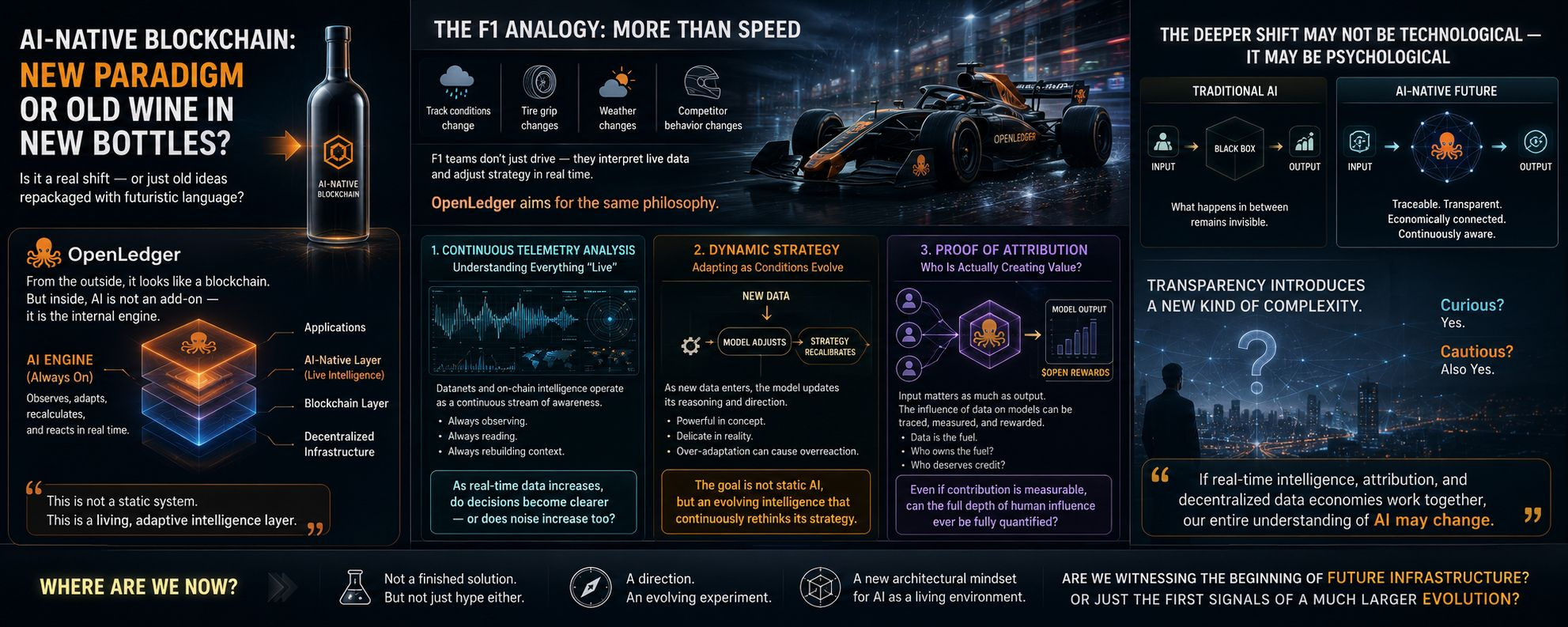
Sometimes I genuinely stop and think about it —
when a project introduces itself as an “AI-native blockchain,” what are we really hearing?
Is it actually a new paradigm?
Or are old ideas simply being repackaged with more futuristic language?
At times, it feels a little like putting old wine into new bottles.
And honestly, this is exactly the question that comes to mind when I look at OpenLedger.
From the outside, it looks like a blockchain network.
But the deeper explanation behind the architecture feels slightly different.
Here AI is not just another feature layered onto the system.
It is positioned as the internal engine itself a live layer that continuously observes, adapts, recalculates, and reacts.
When they use the Formula 1 racing team analogy it can sound a bit dramatic at first.
But the more I think about it the more the comparison starts to make sense.
Because Formula 1 is not only about speed.
It is about constant decision-making under changing conditions.
Track conditions shift.
Tire grip changes.
Weather changes.
Competitor behavior changes.
Everything evolves second by second.
And the teams are not simply driving —
they are continuously interpreting live data and adjusting strategy in real time.
I think this is the philosophy OpenLedger is trying to describe.
Continuous Telemetry Analysis — understanding everything “live”
From what I understand, their Datanets and on-chain intelligence operate like a continuous stream of awareness.
The system is not really “offline.”
It is always observing.
Always reading.
Always rebuilding context.
And honestly, that idea feels both fascinating and slightly unsettling at the same time.
Because if AI evolves from simply answering questions into something that continuously senses its environment, then the nature of decision-making itself begins to change.
But this also raises an important question:
As real-time data increases, do decisions actually become clearer?
Or does the noise increase as well?
Because more information does not always create more clarity.
Dynamic Strategy — adapting as conditions evolve
In Formula 1, when rain suddenly appears, teams immediately rethink tire strategy.
The idea here feels similar.
As new data enters the system, the model adjusts its behavior.
It updates its reasoning.
It recalibrates direction.
Conceptually, it sounds powerful.
But in reality, this kind of adaptability is extremely delicate.
Because systems that adapt too quickly can sometimes overreact.
Still, I think the core idea here is genuinely strong.
This is not trying to create static AI.
It is trying to imagine an evolving intelligence layer capable of continuously rethinking its own strategy.
Proof of Attribution — who is actually creating value?
This is probably where OpenLedger becomes most interesting to me.
Their argument is that AI is not only about output.
Input matters just as much.
They suggest that the influence of specific data on specific models can be traced, measured, and economically recognized through OPEN rewards.
And honestly, this touches one of the biggest questions inside Web3:
If data is the fuel, then who truly owns the fuel?
Who deserves credit for the value being created?
But there is also a philosophical dilemma hidden inside this idea.
Even if contribution becomes measurable, can the full depth of human influence ever really be quantified?
Or will some forms of value always remain invisible?
The deeper shift may not even be technological — it may be psychological
Traditional AI often felt like a black box.
You provide input.
You receive output.
What happens in between remains invisible.
But the narrative here is different.
The claim is that AI should become traceable, economically connected, and continuously aware of the systems surrounding it.
And to be honest, that thought makes me both curious and cautious at the same time. 🤔
Because transparency often introduces a new kind of complexity.
Still, one thing feels increasingly clear:
If real-time intelligence, attribution, and decentralized data economies truly begin working together, then our entire understanding of AI may slowly start to change.
So I do not think it is completely accurate to call OpenLedger a finished “solution.”
But I also do not think it is fair to dismiss it as pure hype.
Right now, it feels more like a direction.
An evolving experiment.
A new architectural mindset where AI is no longer treated as a static tool, but as a continuously evolving environment.
And maybe the biggest question still remains unanswered:
Are we truly witnessing the beginning of future infrastructure?
Or are we only watching the first signals of a much larger evolution?