
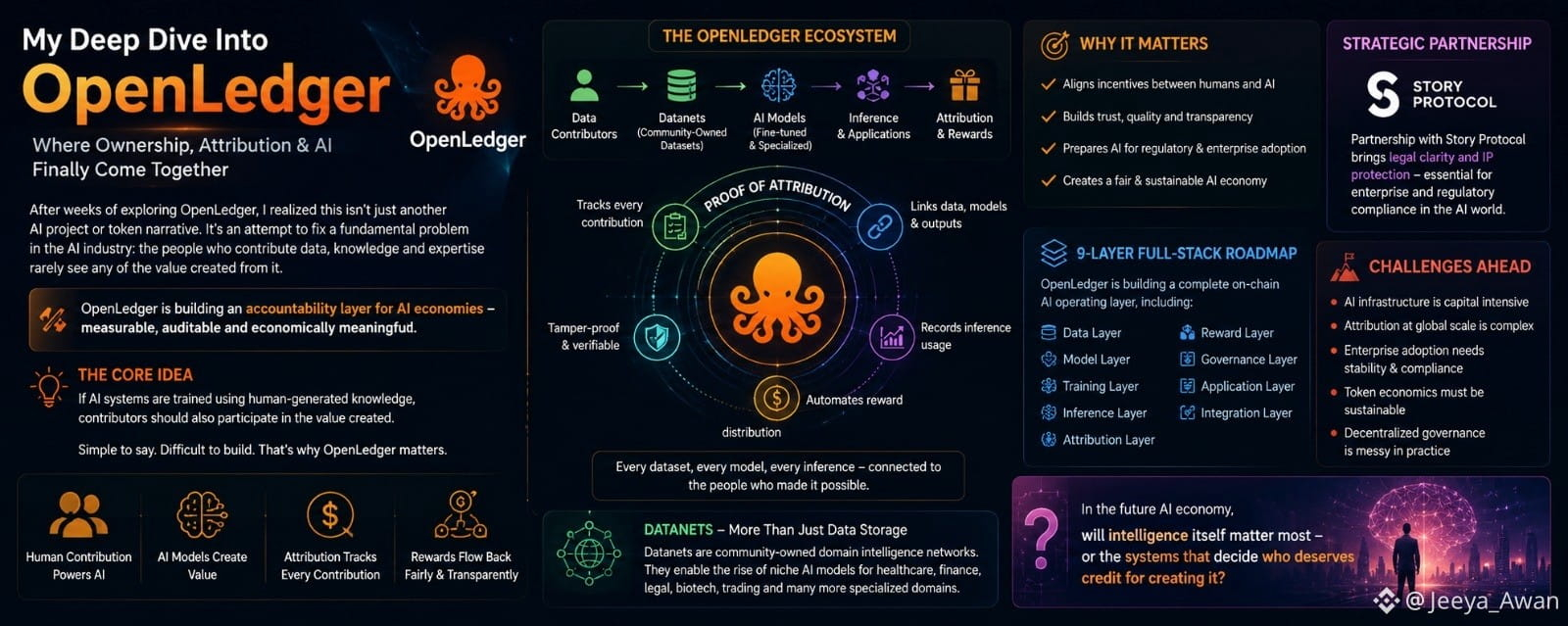
Over the past few weeks, I’ve spent a lot of time studying OpenLedger beyond the usual crypto excitement and AI marketing threads. At first glance, I honestly thought it was just another “AI + blockchain” narrative trying to ride the current trend. But the deeper I explored its architecture, Datanets, attribution systems, and long-term vision, the more I realized this project is attempting to solve a problem most people in AI still ignore: ownership.
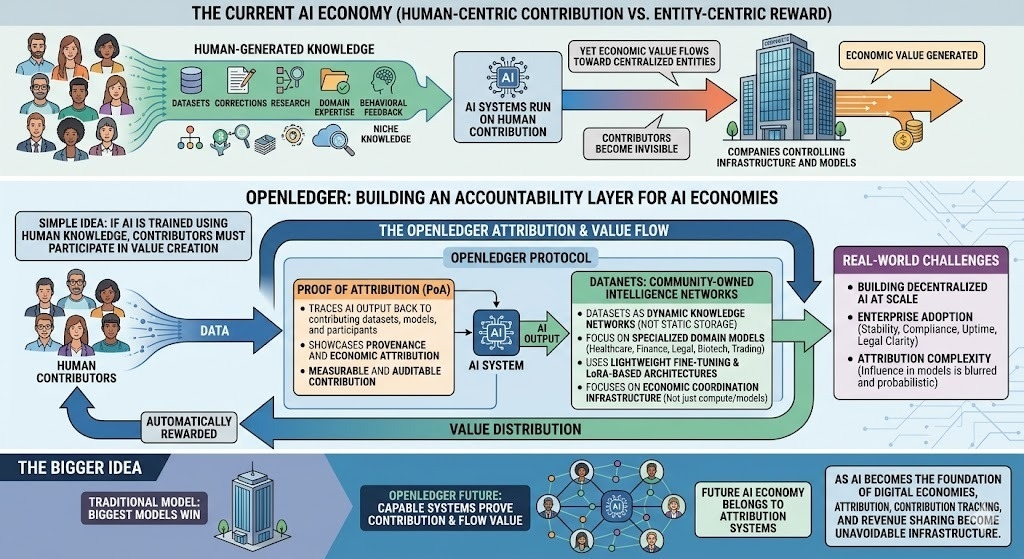
Today, the AI industry runs on human contribution. People provide datasets, corrections, research, domain expertise, behavioral feedback, and niche knowledge every single day. Yet most of the economic value flows toward the companies controlling the infrastructure and models. Contributors become invisible the moment their data enters the system.
That’s where OpenLedger started making sense to me.
Instead of focusing only on bigger models or cheaper compute, OpenLedger seems focused on building an accountability layer for AI economies. Their core idea is surprisingly simple: if AI systems are trained using human-generated knowledge, then contributors should also participate in the value created from those systems.
What impressed me most was their Proof of Attribution concept. The idea that an AI output can be traced back to contributing datasets, models, and participants changes the conversation entirely. Most AI platforms showcase capabilities. OpenLedger is trying to showcase provenance and economic attribution. That distinction matters more than people realize.
The deeper I looked, the more I understood that this isn’t just about token speculation or flashy AI demos. It’s about creating infrastructure where contribution becomes measurable, auditable, and potentially rewarded automatically. In a future where specialized AI models dominate industries like healthcare, finance, legal research, biotech, and trading, attribution could become just as important as raw model performance.
Their Datanets idea also caught my attention. Instead of treating datasets as static storage, OpenLedger approaches them as community-owned intelligence networks. That feels important because AI is moving toward highly specialized domain models rather than one giant system trying to solve everything. Lightweight fine-tuning and LoRA-based architectures are making smaller, focused AI ecosystems far more realistic than they were a few years ago.
At the same time, I don’t think the challenges are small. Building decentralized AI infrastructure at scale is extremely difficult. Enterprise adoption requires stability, compliance, uptime, legal clarity, and reliable economics. Attribution itself is messy because AI systems don’t behave like traditional accounting systems. Influence inside models becomes blurred and probabilistic.
But even with those risks, OpenLedger feels different from most AI crypto projects I’ve seen. Many projects focus on attention farming. OpenLedger feels like it’s trying to build economic coordination infrastructure for AI itself. Not just compute. Not just models. But the invisible layer connecting contributors, intelligence, ownership, and value distribution.
What really stayed with me is this thought: maybe the future AI economy won’t belong only to the companies with the biggest models. Maybe it will belong to the systems capable of proving who contributed value and how that value should flow back across the network.
And honestly, that’s a much bigger idea than just another AI token narrative.
If AI eventually becomes the foundation of global digital economies, then attribution, contribution tracking, and revenue sharing may become unavoidable infrastructure rather than optional features. Maybe OpenLedger succeeds. Maybe it pivots. Maybe it fails completely. But I think it’s asking the right questions much earlier than most projects in this space.
The real question is: in the future AI economy, will intelligence itself matter most, or the systems that decide who deserves credit for creating it?
