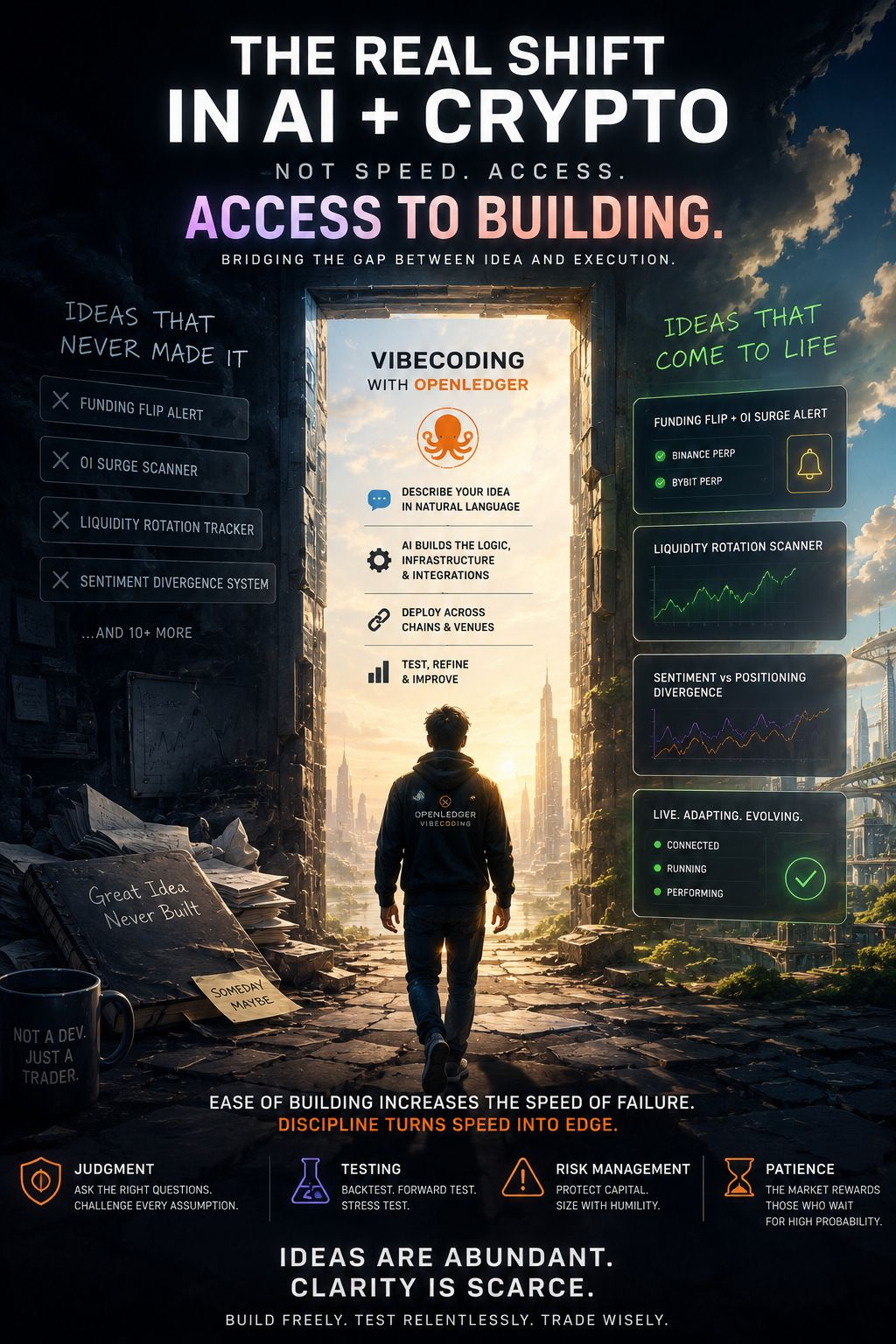
Most people still think the future of AI in crypto is about speed.
Faster bots. Faster agents. Faster execution.
But I’m starting to think the real shift is something quieter.
Access.
Not access to information.
Access to building.
Because for years, there’s been a hidden wall between traders and the tools they imagine.
I know that wall well.
Half my best ideas never failed in the market.
They failed before they were even born.
Not because the logic was weak.
Not because the edge disappeared.
But because turning an idea into something real meant crossing into developer territory.
And that gap is larger than most people admit.
As traders, we can feel patterns long before we can explain them.
We notice funding distortions.
Liquidity imbalances.
The strange behavior that happens right before volatility expands.
The signal appears in the mind almost instantly.
But translating that instinct into a working system?
That’s where most ideas die.
Notebooks become graveyards.
Screenshots pile up.
Concepts stay trapped in conversations with ourselves.
That’s why @OpenLedger OpenLedger caught my attention differently than most AI narratives.
Not because it promises another polished dashboard.
But because vibecoding points toward something more important:
Reducing the distance between thought and execution.
And that changes everything.
We’ve already seen AI generate snippets of code.
That part is old news.
The difficult part was never writing ten lines of Python.
The difficult part was everything around it:
Connecting APIs.
Managing infrastructure.
Handling wallets safely.
Keeping systems alive during volatility.
Debugging edge cases at 3AM when feeds break and latency suddenly matters.
That messy operational layer is where non-developers usually give up.
And honestly, markets have probably lost thousands of genuinely good ideas because of that friction.
I’ve personally shelved strategies I still believe would work.
Simple things.
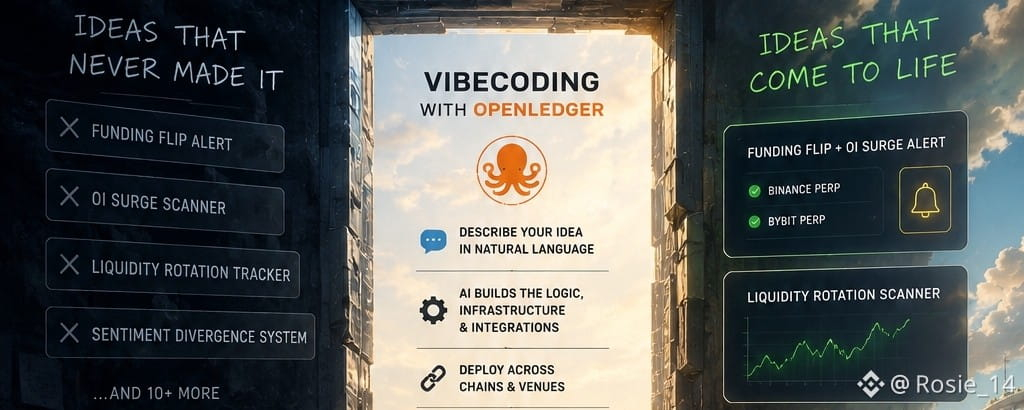
Alerts combining funding shifts with open interest expansion across venues.
Rotational scanners tracking liquidity migrations before narratives move.
Systems designed to detect when sentiment disconnects from positioning.
None of these ideas were impossible.
Just expensive in time.
And time kills more innovation than bad logic ever will.
That’s why vibecoding feels important.
Not because AI suddenly makes everyone an engineer.
But because it may finally allow people with domain insight to express it directly into functional systems.
That distinction matters.
Because the next generation of tools probably won’t come from the people best at syntax.
They’ll come from the people closest to real market behavior.
The trader.
The analyst.
The researcher.
The obsessed observer who sees inefficiencies before they become obvious.
For the first time, infrastructure might become accessible enough for those people to actually build.
But there’s another side to this that people don’t talk about enough.
Ease of building also increases the speed of failure.
AI can accelerate creation.
It can also accelerate bad assumptions.
And markets are merciless at exposing weak logic.
A generated strategy that misunderstands contract behavior, liquidity conditions, or execution timing doesn’t become less dangerous because AI wrote it faster.
If anything, the danger grows because confidence arrives before understanding does.
So I don’t think vibecoding replaces discipline.
I think it makes discipline more valuable.
Because once everyone can build, the edge shifts elsewhere.
Toward judgment.
Toward testing.
Toward risk management.
Toward patience.
The advantage will no longer belong only to the people capable of creating systems.
$OPEN will belong to the people capable of filtering noise from signal after creation becomes easy.
And that’s a profound shift.
We may be entering a market where ideas become abundant, but clarity becomes scarce.
Where thousands of strategies can be launched overnight, yet only a few survive contact with reality.
Where execution becomes democratized, but wisdom remains difficult.
That’s the future I see forming around projects like .
Not AI replacing traders.
AI removing friction between imagination and experimentation.And honestly, that may end up being far more disruptive than people expect.