
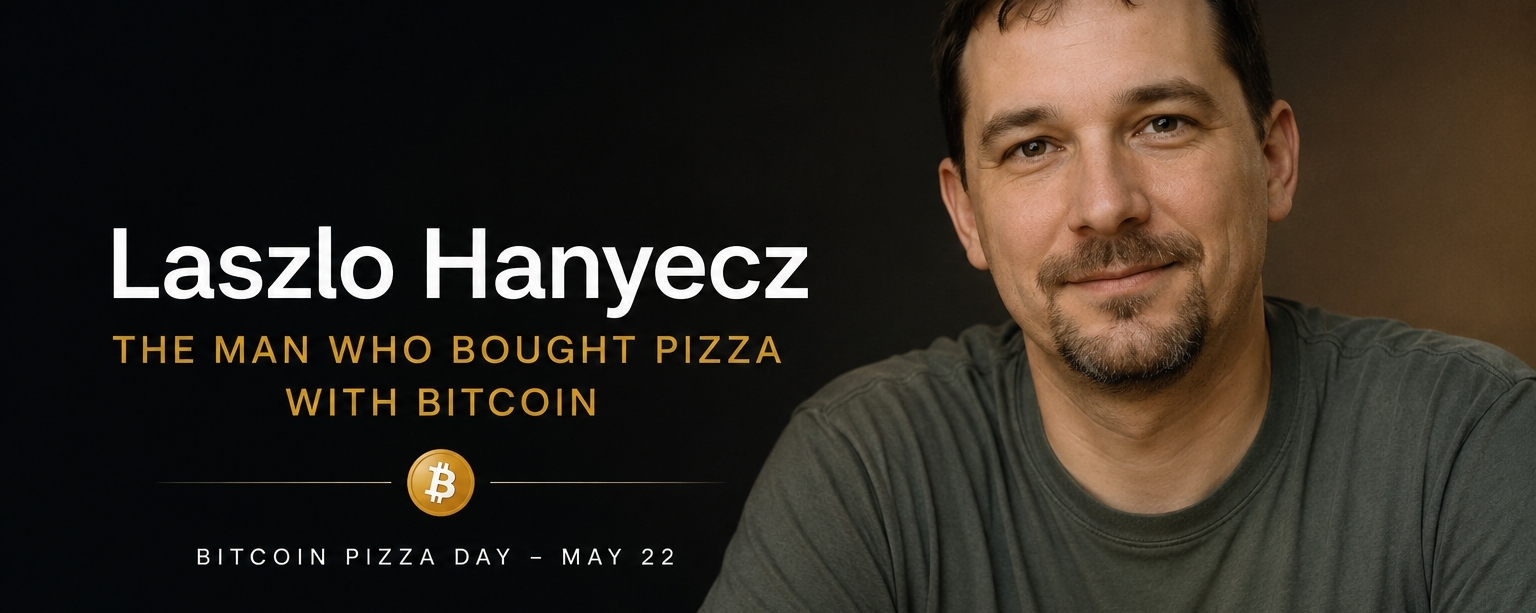


Crypto is full of stories about founders, traders, and billion-dollar wins, but some moments stand out not because of how much money was made, but because of what they changed forever. Laszlo Hanyecz is one of those names. In 2010, he did something that seemed ordinary at the time he bought two pizzas with Bitcoin. It wasn’t a flashy move or a calculated bet on the future. It was simply an experiment. But that small transaction became one of the most iconic moments in crypto history, and today the world remembers it as Bitcoin Pizza Day.
At the time, Bitcoin was still an experiment shared among a small group of developers and cryptography enthusiasts. There was no institutional adoption, no ETFs, no billion-dollar treasury allocations, and certainly no clear market price. Bitcoin was digital code with an idea attached to it. Hanyecz, an early Bitcoin contributor and software developer, wanted to answer a fundamental question: Could Bitcoin actually function as money? To test that idea, he made a now-famous forum post offering 10,000 BTC in exchange for two pizzas. Someone accepted. The pizzas were delivered. The Bitcoin was sent. In that moment, the first recorded real-world commercial Bitcoin transaction took place.
Looking back with hindsight, that purchase has become legendary because of Bitcoin’s meteoric rise. Those 10,000 BTC, once exchanged for a casual meal, would later be worth hundreds of millions of dollars depending on market price. That is why people often call it the most expensive pizza in history. But reducing the story to “a man who lost a fortune” misses the point entirely. Hanyecz was not making an investment decision. He was conducting an experiment. In 2010, Bitcoin had no proven utility outside niche online communities. By trading BTC for pizza, he helped demonstrate that Bitcoin could move beyond theory and become a medium of exchange.
This is why Bitcoin Pizza Day matters far more than internet jokes about expensive pizza. Every year on May 22, the crypto community marks the occasion not to mock Hanyecz, but to celebrate a milestone in Bitcoin’s evolution. It represents the moment Bitcoin transitioned from abstract software to usable money. It was proof of concept in action. Without experiments like that, Bitcoin’s path toward adoption may have unfolded very differently.
Hanyecz was also more than “the pizza guy.” He was an early Bitcoin miner and contributor to the network’s technical development. In Bitcoin’s infancy, mining could be done on ordinary home computers, and Hanyecz was among those helping improve mining efficiency. He is notably credited with early work related to GPU mining, which made Bitcoin mining faster and more effective in its formative years. His role in Bitcoin’s history extends beyond a pizza purchase; he was part of the early technical experimentation that helped strengthen the network itself.
One of the most common questions in crypto today is whether Laszlo Hanyecz still holds Bitcoin. The honest answer is simple: nobody knows for sure. Hanyecz has never publicly disclosed wallet balances, and there is no verified public record of a large Bitcoin fortune attached to him. In interviews over the years, he has suggested that he did not hold onto a massive reserve of BTC and that he used Bitcoin casually during its early days. Internet speculation about his net worth remains exactly that speculation. There is no confirmed public figure.
That mystery, however, is not what makes his story compelling. Hanyecz’s legacy is not about whether he became rich. It is about what he proved. In a world where many people chase profits, Hanyecz tested utility. He helped answer a question that would become foundational for the entire cryptocurrency industry: Can decentralized digital money work in the real world? His answer came in cardboard pizza boxes.
Today, Laszlo Hanyecz lives largely outside the spotlight, maintaining a private life and occasionally speaking about the event that made him famous. He is not a crypto influencer, exchange founder, or celebrity investor. Yet his impact remains enormous. Bitcoin Pizza Day is now a global symbol, celebrated by exchanges, traders, and crypto communities across continents.
A simple analogy explains why his story still resonates. Imagine buying the very first airplane ticket in history. At the time, it is just a ride. Years later, when aviation transforms the world, that first ticket becomes symbolic of something much bigger. Bitcoin Pizza Day is crypto’s version of that ticket.
Laszlo Hanyecz did not try to predict Bitcoin’s future. He tested an idea. That experiment became a milestone. And in crypto, milestones matter more than missed profits. While millions chase opportunity, only a few create history. Laszlo Hanyecz did exactly that with two pizzas and 10,000 Bitcoin.