
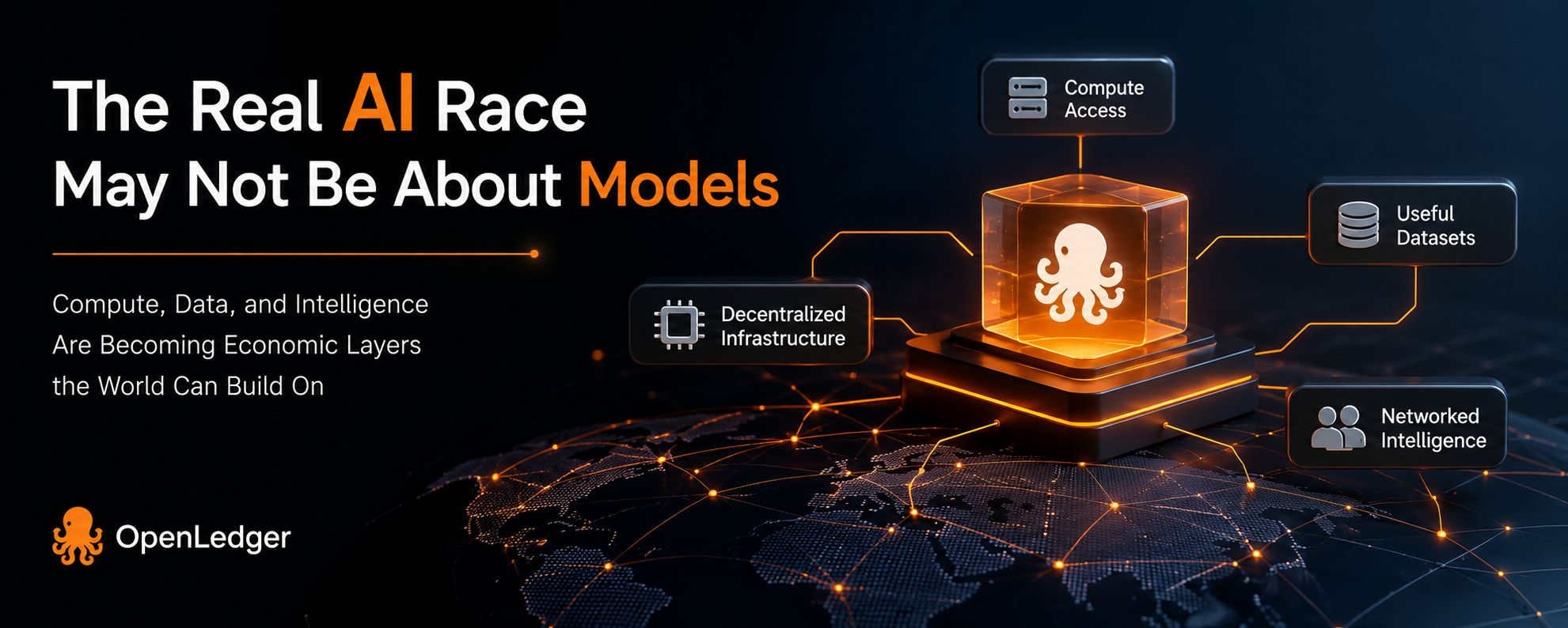
I used to think the biggest competition in AI would happen at the model layer.
Which company builds the smartest system.
Which model performs better.
Which architecture scales faster.
Now I think the bigger competition may happen underneath all of that.
Who controls compute access.
Who owns useful datasets.
Who keeps intelligence moving across networks instead of locking it inside private systems.
That shift is one reason OpenLedger keeps my attention.
Crypto already showed what happens when markets activate unused assets.
Inactive capital eventually becomes useful because systems naturally push resources into circulation.
AI infrastructure still feels early compared to that.
Most datasets stay inside closed platforms.
A large amount of compute stays concentrated around companies that secured hardware early.
Even advanced models behave more like controlled infrastructure than open systems people can build around.
At the same time, AI itself is becoming more modular.
Models interact with APIs.
Agents call other agents.
Inference moves separately from ownership.
Computation moves quietly between systems in the background.
After a while, intelligence stops feeling like a standalone product.
It starts feeling more like a resource moving between participants.
That is the part many people miss when discussing OpenLedger.
The shift is not only about blockchain integration.
It is about markets coordinating parts of intelligence production instead of leaving the full process inside a few centralized systems.
Data becomes economically active instead of staying dormant.
Compute access becomes negotiable.
Smaller contributors can participate in systems that previously required massive internal infrastructure.
The tradeoffs still become difficult very quickly.
Markets activate unused resources efficiently.
They do not always protect quality.
Once incentives enter a network, behavior changes.
Low quality data gets pushed for monetization.
Access slowly concentrates around whoever controls scarce infrastructure during bottlenecks.
Systems optimized for revenue often move away from systems optimized for reliability.
Crypto already exposed that pattern many times.
AI will likely face similar pressure once intelligence becomes part of economic coordination at scale.
At the same time, decentralization has limits because the physical layer still matters.
Energy infrastructure remains concentrated.
Hardware supply chains remain concentrated.
Advanced compute still depends on industrial systems controlled by a small number of companies.
That tension does not disappear just because coordination becomes more open digitally.
Maybe that becomes the defining contradiction of this space.
Projects like OpenLedger do not only point toward smarter AI infrastructure.
They point toward intelligence becoming an economic layer that networks can distribute, price, access, and build around.
Not AI as software.
More like AI becoming part of the market structure itself.