
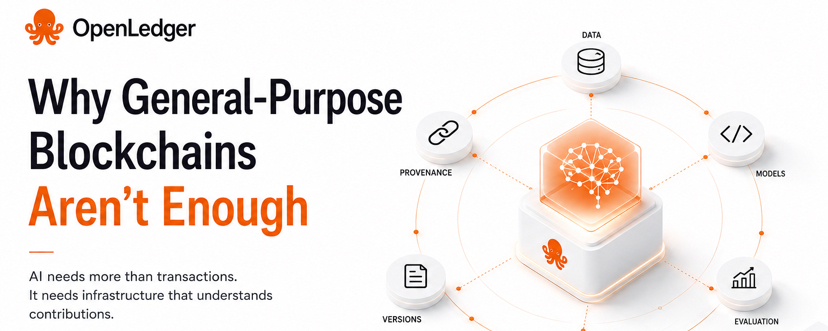
Most people seem to assume that if a blockchain can move value, it can probably support AI too.
At first, that sounds reasonable. AI systems involve payments, ownership, incentives. Data gets shared. Models get trained. Contributors need rewards. On the surface, it feels like another coordination problem waiting for a @OpenLedger 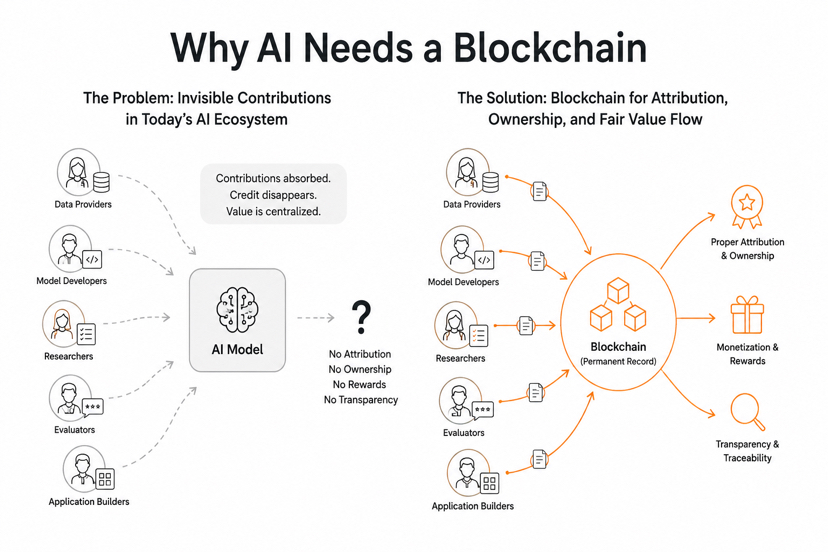
$OPEN For a while, I looked at it the same way.
A blockchain was infrastructure. Neutral rails. Something underneath the activity itself. As long as transactions were secure and transparent, the rest could be built on top later.
But the longer I watched how AI systems actually evolve, the less that framing made sense.
The strange thing about AI is that the important parts rarely happen in one clean moment. There is no single transaction that captures what created a model. No isolated event where value suddenly appears.
Most of it accumulates quietly.
Someone cleans a dataset at 2 a.m. Someone else fixes edge cases no one notices. A researcher tests five small variations and keeps only one. An evaluator flags subtle bias patterns that never make it into public announcements. Weeks later, another contributor fine-tunes the model on behavior that depends on all those invisible decisions.
None of these actions look important alone.
But together, they become the system.
That is where general-purpose blockchains begin to feel slightly out of place.
Most of them were designed around transfers. Assets moving between wallets. Finality. Ownership. They are remarkably good at recording the moment something changes hands.
But AI creation does not really behave like a transfer.
It behaves more like sediment.
The contribution is often unclear while it’s happening. Value appears slowly, through repetition, correction, and revision. Sometimes the most important work is not creating something new, but preventing degradation over time.
That creates a quiet mismatch.
When people talk about decentralizing AI on traditional blockchains, the conversation usually drifts toward tokens, validators, or compute markets. But those things sit around the edges of the actual process. They describe how people exchange value, not how intelligence itself gets shaped.
And shaping intelligence turns out to be deeply behavioral.
People contribute differently when attribution disappears after a few layers of updates. They share less when provenance becomes blurry. Evaluation quality drops when rewards favor visible activity over careful judgment. Small frictions compound slowly. Contributors stop documenting decisions because the system does not remember nuance anyway.
Over time, the network begins optimizing for what can be measured easily.
Not necessarily what matters.
I think that is the part many systems underestimate. Human behavior slowly bends toward the structure surrounding it. Not dramatically. Just through repeated micro-decisions.
If a contributor knows their work will be flattened into a generic transaction history, they behave one way.
If the system tracks lineage, revisions, attribution, and collaborative ownership directly, they behave another way.
The architecture quietly teaches people what counts.
Reading the OpenLedger whitepaper, that felt like the real shift underneath everything else.
Not the idea of combining AI and blockchain. A lot of projects already say that.
What stood out was the assumption underneath the design itself.
Instead of asking how AI can fit into existing blockchain infrastructure, the system seems to start from a different observation entirely: AI development is its own environment with its own rhythms, habits, and forms of coordination.
That changes the center of gravity.
Suddenly provenance is not secondary metadata. Contribution history is not an optional feature added later. Data flows, model evolution, evaluations, and reward distribution become part of the foundation itself.
The blockchain is no longer just tracking ownership.
It is tracking participation across time.
And time may actually be the missing layer in most discussions around decentralized AI.
Because intelligence rarely emerges in one visible event. It grows through accumulated corrections that almost nobody notices while they are happening. A dataset refined slowly. A model adjusted carefully. An evaluator catching subtle drift before it compounds into something larger.
These are quiet actions.
Traditional systems struggle to value quiet actions.
They reward the obvious moment. The measurable output. The final release. But AI systems depend heavily on invisible maintenance and long chains of contribution that blur together over months or years.
Trying to force that process into general-purpose blockchains often creates awkward workarounds. External databases for attribution. Separate pipelines for evaluation. Off-chain systems trying to reconstruct histories the base layer never really understood in the first place.
Technically, it works.
But it feels similar to forcing a spreadsheet to behave like memory.
Maybe that is why specialized AI infrastructure keeps appearing. Not because existing blockchains failed completely, but because the underlying assumptions were aimed at a different kind of human behavior.
Finance optimizes around transactions.
AI evolves through ongoing collaboration.
Those are not always the same thing.
And I still cannot tell whether the industry fully understands that distinction yet.#OpenLedger
