
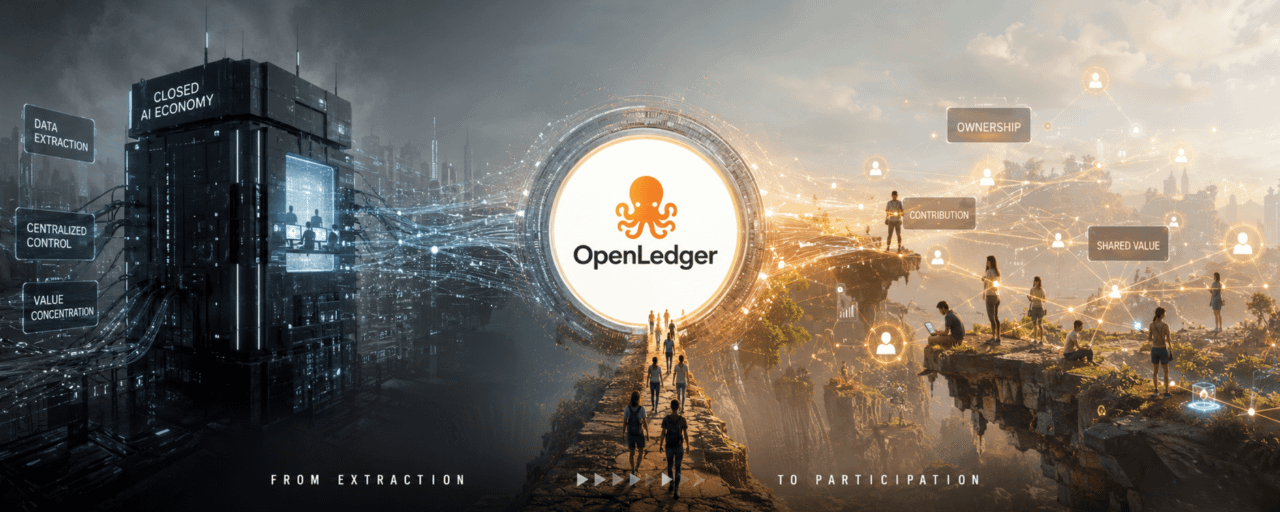

There’s been a subtle shift in crypto lately, and I don’t think it started with prices or headlines. I noticed it more in the way people talk now. The tone feels different. A few years ago, conversations around blockchain were full of ideals decentralization, transparency, community ownership. Now, even when people still use those words, I feel like the real focus has quietly moved toward something else: incentives.
I keep seeing the same pattern everywhere. People say they care about openness, but they stay where the experience is easiest. They criticize centralized systems while continuing to use them every day. And honestly, I don’t even think that’s hypocrisy anymore. I think it’s just reality. Most users don’t make decisions based on ideology. They make decisions based on convenience, access, and economic benefit.
AI made that contradiction impossible for me to ignore.
The moment data became valuable in a measurable way, the internet started changing underneath us. Suddenly, every interaction mattered. Every prompt, every correction, every dataset became part of a larger machine producing intelligence. And the strange part is how many people contribute to these systems without owning anything connected to them.
I kept thinking about that recently.
Developers train models they don’t control. Communities generate data they’ll never monetize. Users improve AI products simply by using them, while most of the long-term value accumulates somewhere far above them. The more I looked at it, the more I realized this isn’t really a technical issue anymore. It’s an economic one.
That’s partly why OpenLedger started feeling relevant to me.
Not because I see it as some massive breakthrough. Honestly, crypto has become overcrowded with projects trying to position themselves as the future of AI infrastructure. Most of them blend together after a while. Big claims, fast narratives, temporary excitement.
What interested me more about OpenLedger was the timing behind it.
I think the industry is slowly realizing that AI changes what we consider valuable on the internet. Data becomes an asset. Models become assets. Even autonomous agents eventually become economic participants in their own way. And once that happens, I naturally start asking different questions.
Who owns the intelligence being created?
Who gets rewarded for contributing to it?
And who quietly gets excluded from the upside?
I don’t think the current internet has good answers for any of that.
For years, platforms extracted value from contribution while giving users convenience in return. Most people accepted that trade because the systems worked well enough. But AI intensifies everything. The gap between contribution and ownership becomes much more visible when the outputs themselves become economically powerful.
That’s where OpenLedger feels structurally interesting to me.
Not because it promises to “fix” AI or decentralization, but because it seems designed around the idea that contributors should exist inside the value loop instead of outside it. I think that’s a much deeper shift than people realize.
Crypto narratives usually move too fast to notice these structural changes properly. One week everyone is obsessed with AI agents, then it rotates into inference markets, then decentralized compute, then something else entirely. I’ve started feeling like the market often confuses attention with importance.
But infrastructure rarely looks exciting in real time.
The systems that matter long term usually arrive quietly, before people fully understand why they’ll matter later. And I keep wondering if OpenLedger might fall into that category — not a hype cycle project, but an early response to a problem that’s still forming.
Because underneath all the excitement around AI, I think there’s a growing discomfort people haven’t fully articulated yet. We’re entering a period where intelligence itself becomes infrastructure, and infrastructure always raises questions about control, ownership, and extraction.
I don’t think users suddenly became ideological overnight. I still think incentives drive behavior more than principles ever will. But maybe that’s exactly why these conversations matter now. Once enough value concentrates into closed systems, people eventually start caring about ownership in a very practical sense.
Not because it sounds good philosophically.
Because they realize they’re helping create enormous value without participating in it.
And honestly, I’m still unsure whether the market is fully ready for projects like OpenLedger yet.
Centralized systems are still faster. Simpler. More convenient. Most people will continue choosing efficiency first, just like they always have. History usually rewards convenience before fairness.
But at the same time, I can feel the tension building underneath all of this.
And maybe that’s why OpenLedger feels interesting to me right now. Not because it arrives with certainty, but because it arrives at a moment when the internet itself seems uncertain about who should own the next generation of intelligence.
