
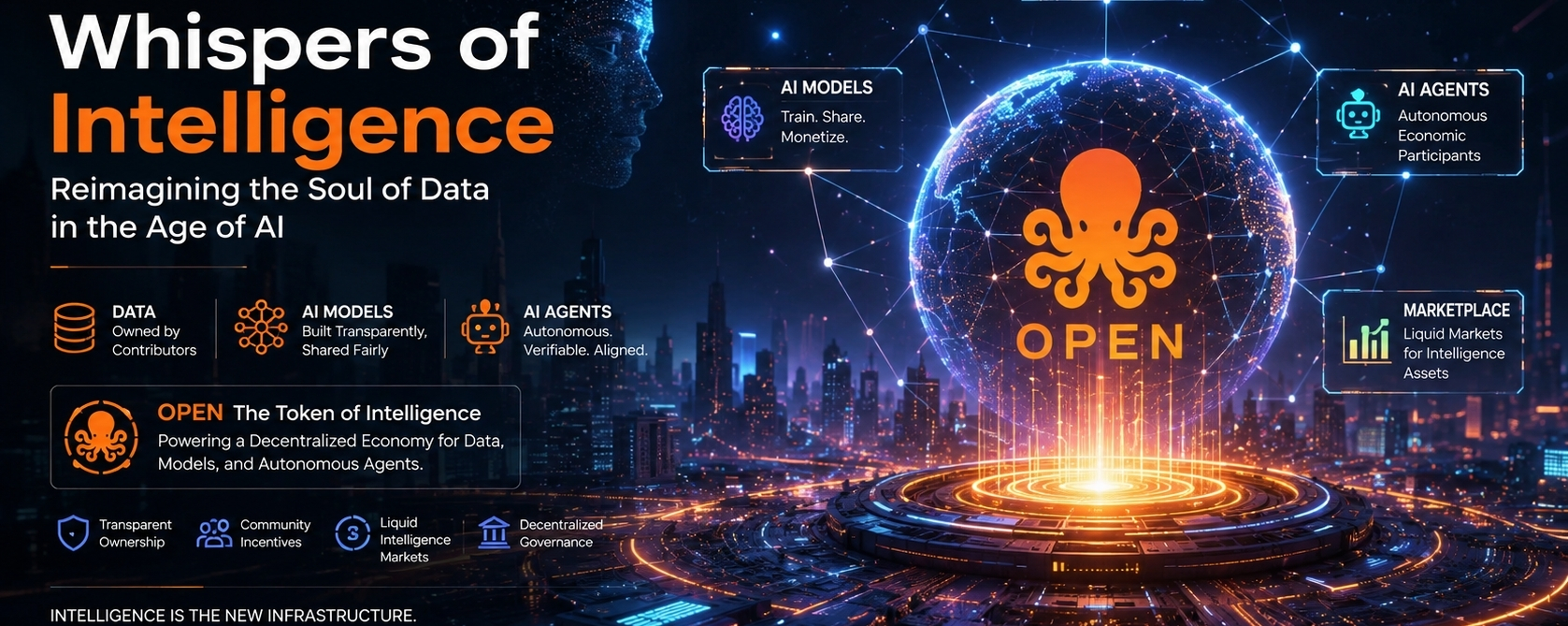
The digital world is changing quietly, but beneath the surface of every search query, every generated image, every intelligent assistant, a deeper transformation is unfolding. Artificial intelligence is no longer just a tool created by a handful of giant corporations. It is becoming an ecosystem shaped by people, communities, creators, and invisible streams of data moving across the internet like blood through veins. In this emerging landscape, OpenLedger (OPEN) enters not merely as another blockchain project, but as a philosophical shift in how intelligence itself may be owned, shared, and valued.
For years, the modern internet has revolved around extraction. Platforms collected user behavior, companies harvested information, and centralized systems transformed human activity into unimaginable profits. Most people contributed to these systems unknowingly. Their conversations, preferences, ideas, and creative patterns became fuel for algorithms they would never control. Artificial intelligence accelerated this imbalance. Models became more powerful, yet the value generated by data remained concentrated in the hands of a few dominant institutions.
OpenLedger challenges that structure with a remarkably simple yet profound idea. If data powers intelligence, then the people who create and contribute that data should participate in the value created from it. This principle sits at the emotional center of the OpenLedger ecosystem. It is not just about decentralization as a technical term. It is about restoring economic dignity to participation itself.
At its core, OpenLedger is building an AI-focused blockchain designed to unlock liquidity around data, AI models, and autonomous agents. These are not isolated components. Together, they form the architecture of the future digital economy. Data trains intelligence, models interpret the world, and agents act independently on behalf of users or organizations. OpenLedger attempts to connect these layers into a transparent and monetizable network where ownership becomes programmable and rewards become distributed.
The significance of this idea becomes clearer when observing how rapidly AI is evolving. Every day, millions of people interact with systems that rely on massive datasets collected from countless human actions. Yet the economic relationship remains one-sided. OpenLedger introduces a mechanism where contributors may eventually tokenize, track, and monetize their role within AI ecosystems. In practical terms, this could mean developers earning from model usage, data providers receiving compensation for training contributions, and intelligent agents operating with transparent economic logic across decentralized environments.
There is something deeply human hidden inside this technological ambition. Throughout history, societies have struggled with questions of ownership during moments of industrial transformation. The industrial revolution changed labor. The internet changed information. Artificial intelligence is changing cognition itself. OpenLedger stands at the intersection of these changes, asking whether intelligence should belong exclusively to centralized systems or evolve as a shared economic layer owned collectively by participants.
The OPEN token represents more than speculative value within this vision. It acts as the connective tissue of the ecosystem. Tokens in blockchain environments often carry abstract utility, but OpenLedger ties utility directly to the circulation of intelligence assets. As activity around data, models, and agents expands, the token becomes intertwined with governance, incentives, and liquidity mechanisms that sustain network participation. In many ways, OPEN seeks to transform intelligence into an active economic market rather than a closed technological product.
What makes this particularly compelling is the timing. The world is entering an era where AI agents may soon negotiate services, execute transactions, create content, and manage digital infrastructure autonomously. These agents will require trusted environments, transparent ownership systems, and efficient liquidity frameworks. Traditional systems are poorly designed for such interactions because centralized databases were never built to support decentralized machine economies. OpenLedger positions itself as infrastructure for this coming reality.
Still, every ambitious crypto project exists within the tension between vision and execution. The blockchain industry has witnessed countless promises wrapped in elegant narratives. Investors have grown cautious, and communities have learned to separate marketing from meaningful architecture. OpenLedger therefore faces the difficult task of proving that its ecosystem can scale beyond conceptual appeal. Technology alone will not determine success. Adoption, developer engagement, real-world integrations, and sustainable incentives will ultimately define whether the project becomes foundational or simply aspirational.
Yet there is undeniable emotional gravity in projects attempting to humanize the economics of AI. People increasingly sense that the internet is evolving into something less personal and more algorithmic. Creativity feels automated. Identity feels fragmented into datasets. Attention feels commodified. OpenLedger taps into this collective unease while offering an alternative narrative where participation is acknowledged rather than extracted silently.
The beauty of blockchain technology has always rested in its ability to redefine trust without relying entirely on institutions. The beauty of artificial intelligence lies in its ability to amplify human capability. OpenLedger attempts to merge these ideals into a single environment where intelligence itself becomes decentralized infrastructure. It is an ambitious synthesis, perhaps even a risky one, but history often favors systems bold enough to imagine new economic relationships before the world fully understands why they matter.
There is also a subtle cultural shift occurring around ownership in digital spaces. Younger generations increasingly value participation over hierarchy. They contribute to online communities, create open-source tools, share knowledge publicly, and collaborate across borders with unprecedented fluidity. OpenLedger aligns naturally with this culture because it transforms contribution into measurable economic presence. Instead of invisible participation feeding centralized systems, contributors become recognized actors within the ecosystem.
The future of AI may not belong to the largest corporation alone. It may belong to interconnected networks where intelligence flows openly between users, developers, machines, and markets. In such a future, liquidity will not apply only to financial assets. Data itself will become liquid. Models will become tradable infrastructure. Autonomous agents will become economic participants. OpenLedger is attempting to build the rails for that transformation before the broader world fully arrives there.
Whether OPEN ultimately becomes a dominant force or remains an experimental chapter in crypto history, the questions it raises are undeniably important. Who owns intelligence in the digital age? Who profits from human data? How should value move through AI ecosystems? And perhaps most importantly, can technology evolve without leaving ordinary contributors behind?
These are not merely technical questions anymore. They are social questions, philosophical questions, and economic questions woven into the future of civilization itself.
OpenLedger exists within that uncertainty like a signal emerging through static. Quietly ambitious, structurally provocative, and emotionally resonant, it reflects a growing belief that the next era of technology should not only become smarter, but also fairer.