

AI has a dirty little secret.Everyone talks about models. Nobody talks about ownership.The internet is already drowning in machine generated sludge synthetic images, recycled text, cloned voices, autonomous agents bouncing data between systems like overcaffeinated interns. Yet the question sitting underneath all of it remains strangely unresolved: who actually owns the value being created?
That’s the crack OpenLedger is trying to force open.
Not with another chatbot. Not with a glossy “AI ecosystem” slogan pasted onto a token chart. With infrastructure. The boring stuff. The stuff markets usually ignore until it becomes unavoidable.
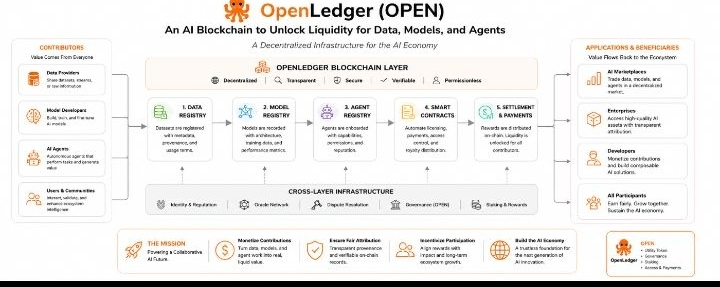
OpenLedger’s pitch is deceptively simple: data, models, and AI agents should behave like economic assets instead of disposable exhaust fumes floating around the internet. If an AI model learns from your dataset, contributes to an agent workflow, or generates downstream value, there should be a ledger tracking that movement the same way a neighborhood bar tabs every drink before closing time. Somebody owes somebody something.
Right now? That accounting barely exists.
The current AI economy feels oddly feudal. A handful of giant companies vacuum up datasets, train colossal models behind sealed walls, then rent intelligence back to everyone else through APIs. Developers provide labor. Users provide behavior. Data providers provide the raw fuel. The rewards pool upstream anyway.
OpenLedger is betting that this imbalance becomes a stubborn bottleneck as AI agents grow more autonomous and machine to machine commerce starts looking less theoretical and more operational. Because once autonomous systems begin negotiating, purchasing, generating content, or executing tasks independently, attribution suddenly matters. A lot.
Who trained the model?
Whose data sharpened the result?
Which agent actually created the value?
Without transparent attribution, the entire AI stack starts resembling a casino ledger after a flood.
That’s where the blockchain angle stops sounding like decoration and starts sounding functional. OpenLedger positions itself less like a speculative token project and more like a financial rail system for AI contribution tracking a way to meter participation, record provenance, and create liquidity around intelligence itself.
And yes, “liquidity for AI” sounds absurd the first time you hear it. So did streaming music royalties once. Then Spotify arrived and turned songs into measurable cash flow pipes.
Same instinct here. Different battlefield.
There’s also a broader market shift hiding underneath this narrative. Quietly, the center of gravity in crypto has been drifting away from pure consumer speculation toward infrastructure tied to computation, identity, and coordination. Less meme frenzy. More plumbing. Investors may still chase noise in the short term, but capital eventually hunts systems that solve ugly operational problems.
Ownership is an ugly operational problem.
Attribution is worse.
And AI agents? They’re about to multiply like raccoons behind a restaurant dumpster.
The interesting part isn’t whether OpenLedger becomes the dominant protocol. Most infrastructure projects don’t win cleanly. The interesting part is that projects like this are emerging at all. It signals a growing realization that the AI economy cannot scale indefinitely on vague handshakes, opaque data pipelines, and centralized trust silos.
Someone will build the accounting layer for machine intelligence.
The only real question is who gets there before the rest of the industry notices the meter is already running.
