
There is something odd about the way we talk about AI.
Most of the conversation is still about building. Building better models. Building faster agents. Building bigger systems. Building tools that can answer, plan, search, write, trade, organize, or automate.
That part makes sense. AI is still young in many ways, and people are trying to understand what can be made with it.
But after a while, another question starts to appear.
What happens after something is built?
A dataset may be created once, but it can remain useful many times. A model may be trained for one purpose, but it may serve many users in many different places. An agent may perform one narrow task well, but that task might be needed again and again by people who never meet the original builder.
This is where OpenLedger becomes interesting from a quieter angle.
It is not only about creating AI assets. It is about giving those assets a way to keep working after they leave the hands of the person who made them.
That may sound small, but it changes the way you look at ownership.
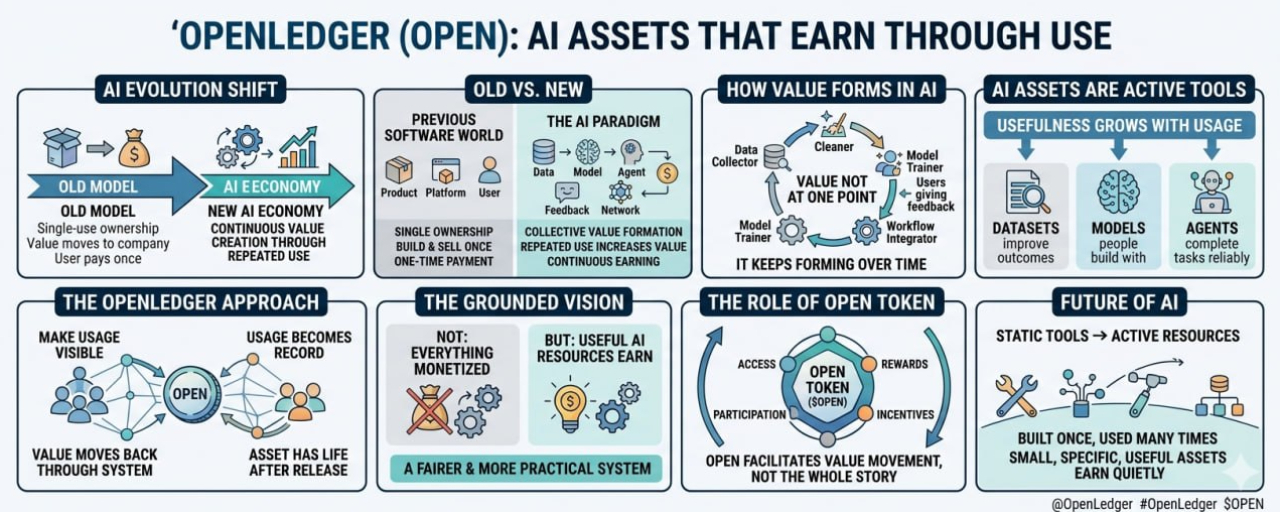
In the older software world, ownership was often simple. A company built a product. Users paid for access. The product lived inside one platform. The value moved mostly in one direction. From user to company.
AI does not always fit that shape.
A useful AI system can be made from many smaller parts. One person may collect the data. Another may clean it. Another may train a model. Another may build an agent on top of it. Someone else may connect that agent to a real workflow. And then, over time, users may produce feedback that makes the whole thing better.
The value is not created at one point.
It keeps forming.
That is where the idea of AI assets earning from usage starts to matter. Not because every dataset or model should become a financial product. That would be too much. But because some AI resources may have value that continues over time, and the current internet is not very good at handling that.
You can usually tell when a system was built for one-time ownership. It treats digital things like files. You upload them. You sell them. You license them. Maybe you get paid once. Maybe you get visibility. Maybe you do not.
But AI assets are different because their usefulness may grow through repeated use.
A model becomes more valuable when people build with it.
A dataset becomes more valuable when it improves real outcomes.
An agent becomes more valuable when it completes tasks reliably.
A contributor becomes more valuable when their work keeps helping other systems.
OpenLedger seems to be built around this slower idea of value. It asks what happens when data, models, and agents do not just sit still, but become active parts of an economy.
Not active in a dramatic way. More like tools that can be called, reused, measured, and rewarded.
That is an important distinction.
The real question is not whether an AI asset exists. Many things exist. The internet is full of models, datasets, scripts, bots, and unfinished experiments. The harder question is whether something gets used in a way that proves it has value.
Usage is a kind of truth.
Not a perfect truth, of course. Bad things can get used too. Popularity can be misleading. But repeated useful activity still tells us something. It tells us that a resource is not just theoretical. It is doing work somewhere.
OpenLedger’s approach seems to make that activity more visible. When an AI asset is used, that usage can become part of its record. When it creates value, the value can move back through the system. In that sense, the asset is not frozen after creation. It has a life after release.
That feels closer to how AI may actually develop.
The best AI resources may not always come from the biggest teams. Sometimes they may come from people who understand one narrow area very well. Someone with a good dataset for agriculture. Someone with a model trained on a specific language. Someone with an agent that handles a boring but necessary business task. Someone with knowledge that is too small for a large platform to care about, but useful enough for the right users.
Right now, a lot of that work has no natural path.
It can be shared, but sharing does not always create income. It can be sold, but selling once may not reflect long-term use. It can be hidden, but then it may never reach the people who need it.
OpenLedger offers another possible route: let the asset participate when it is used.
That does not remove the hard parts.
Quality still matters. Privacy still matters. Permission still matters. A system like this has to be careful about what kind of data enters the network and how it is used. It also has to make the experience simple enough that builders do not feel like they are managing a financial machine just to use an AI tool.
There is always a risk of making things too complex.
And with blockchain projects, that risk is familiar. Sometimes the token becomes louder than the product. Sometimes the market story moves faster than the actual use case. Sometimes people talk about ownership when the real problem is usefulness.
OpenLedger will have to avoid that trap.
The more grounded version of its idea is not “everything becomes monetized.” That feels too heavy. The better version is that useful AI resources should not disappear into the background once they start creating value.
That is a fairer and more practical thought.
OPEN, as part of the network, matters only to the extent that it helps this movement of value happen. Access, rewards, incentives, and participation all need some shared system. But the token is not the center of the story. The center is whether AI assets can keep earning because people keep finding them useful.
That is the part worth watching.
AI may slowly move from a world of static tools to a world of active resources. Things that are built once, but used many times. Things that improve, travel, connect, and generate value in places their creators may never see directly.
OpenLedger is trying to make room for that kind of future.
Not a future where every piece of data becomes precious. Not a future where every agent becomes important. Most will probably not. But some will. Some small, specific, useful things may keep working quietly in the background.
And maybe that is enough to change how we think about building AI in the first place.