
Look, the pitch sounds clean at first.
OpenLedger says artificial intelligence is becoming centralized inside giant corporations, data owners are not being compensated fairly, AI developers are trapped inside expensive cloud ecosystems, and blockchain can create a shared economic network where data, models, and AI agents interact without middlemen.
Neat story. Very Silicon Valley. Very crypto.
And to be fair, the underlying problem is real. AI is consolidating fast. A small group of companies now controls most of the serious compute infrastructure, advanced chips, training pipelines, and distribution networks. If you want to build something meaningful in AI today, chances are you’re renting infrastructure from a hyperscaler, paying API fees to another giant platform, and depending on systems you don’t actually control.
That part isn’t fiction.
The trouble starts when blockchain projects claim they can “fix” this by adding another economic layer on top of an already absurdly complicated technical stack.
Because that’s what OpenLedger really is. Another layer.
And layers sound elegant in whitepapers. They sound much less elegant when humans have to use them.
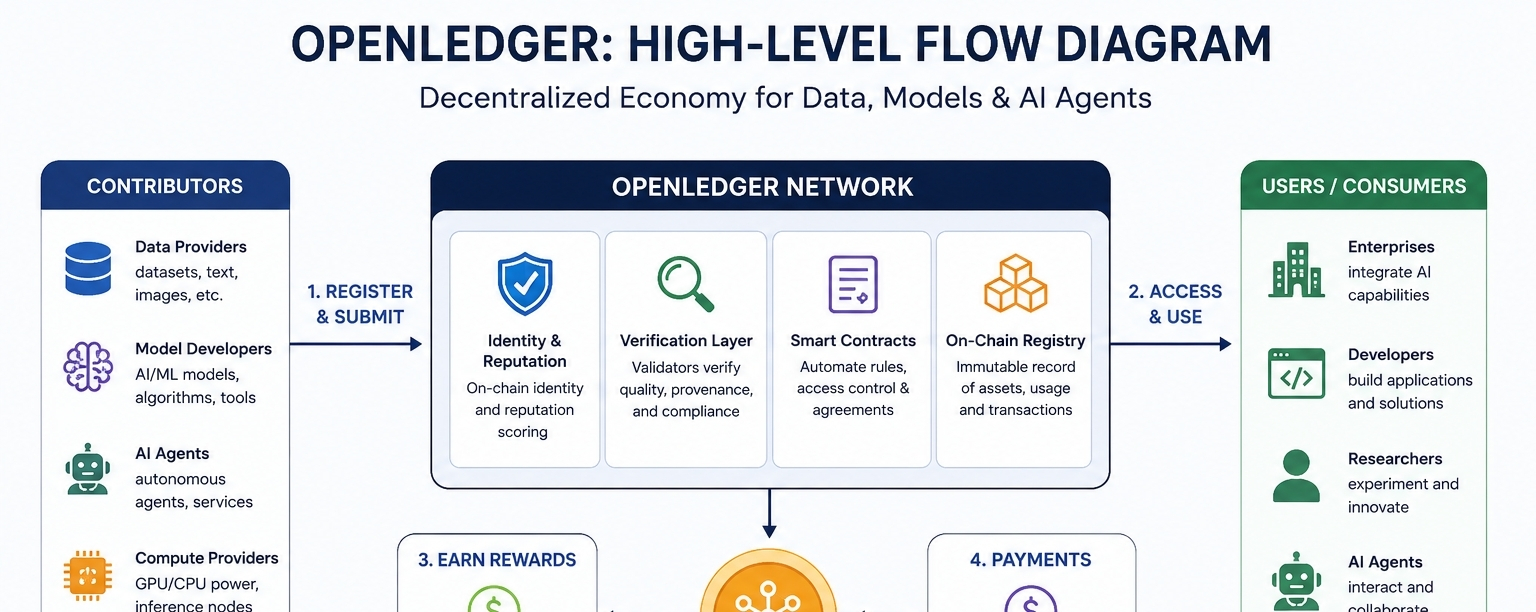
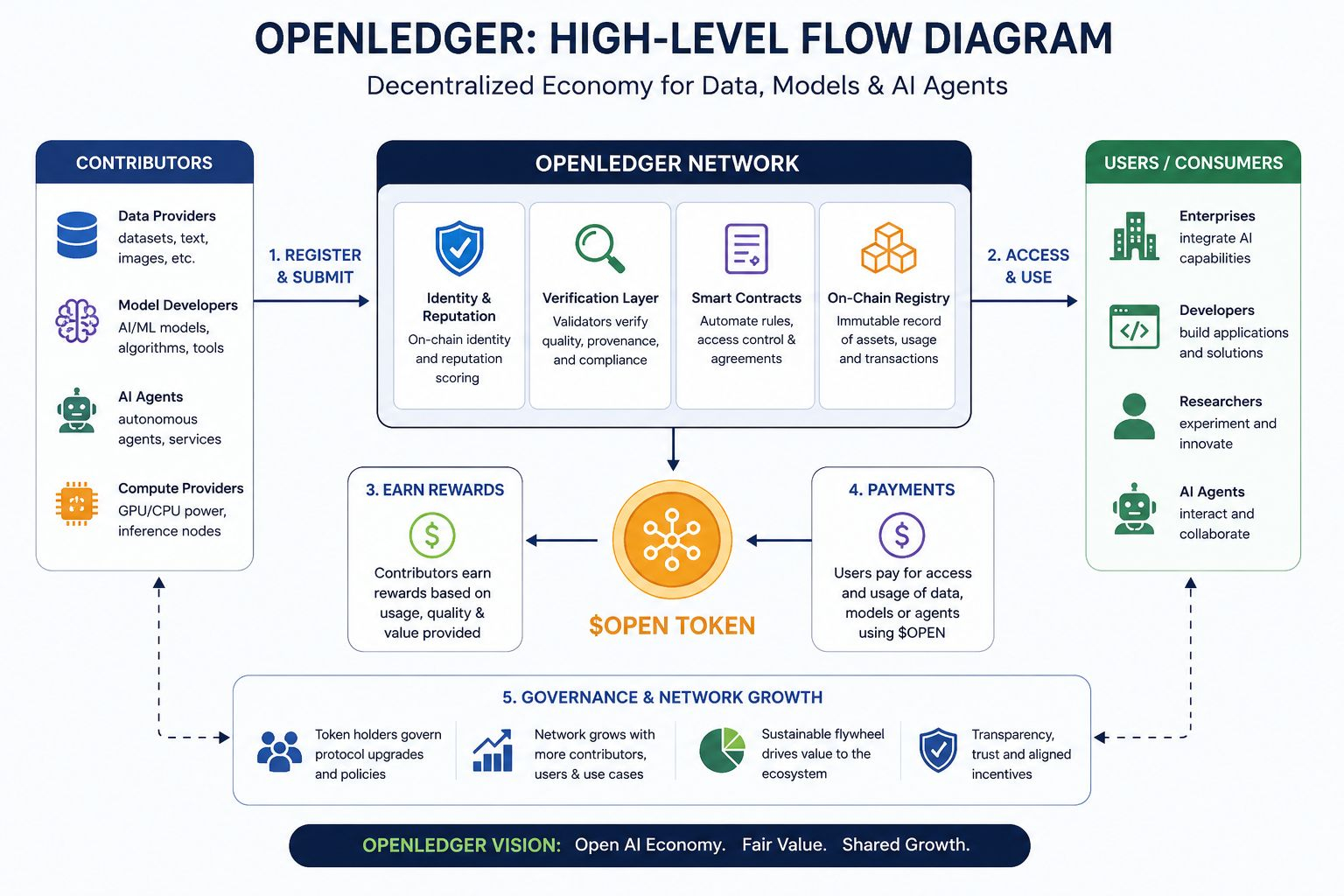
The core promise here is that AI resources — datasets, models, inference systems, autonomous agents — can become assets inside a decentralized marketplace. Contributors provide resources. Validators verify them. The blockchain tracks ownership and payments. Tokens coordinate incentives. Everyone participates in a distributed AI economy.
It sounds tidy. On paper, at least.
But when you peel back the marketing, the glue starts to melt.
Let’s start with the obvious problem nobody in these systems likes discussing openly: artificial intelligence is already computationally brutal. Training advanced models requires massive GPU clusters, industrial-scale electricity consumption, expensive networking hardware, and tightly optimized infrastructure environments. This is why companies like NVIDIA became so powerful so quickly. Scale matters. Efficiency matters. Centralization, whether people like it or not, often exists because physics and economics reward it.
Crypto systems move in the opposite direction. They distribute coordination across fragmented networks. That works reasonably well for ledger systems where redundancy is the point. It works much less cleanly for latency-sensitive AI workloads where efficiency determines viability.
So now you have two industries colliding.
One demands optimization.
The other introduces friction by design.
That tension sits underneath almost every “AI plus blockchain” project currently making the rounds.
And then there’s the data problem. This is where things get especially slippery.
OpenLedger talks about monetizing datasets and AI contributions through decentralized coordination. Fine. But let’s be honest about what the AI industry is already dealing with right now. Lawsuits. Copyright disputes. Scraping controversies. Synthetic data pollution. Privacy concerns. Regulatory pressure. Nobody fully agrees on who owns what anymore.
Now insert tokens into that environment.
The theory is that blockchain creates transparent provenance. The reality is more complicated. A blockchain can record that someone uploaded a dataset. It cannot magically verify that the dataset was legally obtained, ethically sourced, accurate, or even useful. Garbage data stamped onto a distributed ledger is still garbage data.
Actually, worse than that. It becomes economically incentivized garbage data.
I’ve seen this movie before. Every time networks reward contribution volume, somebody floods the system with low-quality material because the rewards structure encourages it. In crypto, people call this participation. In practice, it often becomes spam with venture capital attached.
And this is where the marketing starts getting selective with details.
The promotional narrative frames decentralization as liberation from centralized gatekeepers. But look carefully at who still controls the critical infrastructure. The compute resources remain concentrated. The high-end chips remain concentrated. The cloud hosting remains concentrated. The engineering talent remains concentrated. Even governance in many token ecosystems eventually concentrates into large holders, early investors, and insiders with oversized influence.
So the question becomes uncomfortable very quickly: is this actually decentralization, or just a different ownership wrapper around centralized dependencies?
Because if OpenLedger still relies heavily on major cloud providers and expensive compute operators underneath, then the blockchain layer may simply be functioning as an accounting system sitting on top of infrastructure owned by somebody else.
That’s not necessarily useless. But it’s not the revolution being advertised either.
Then you get to incentives. This is where crypto projects almost always reveal their real priorities.
Who gets rich if this works?
The token holders.
Not necessarily the users. Not necessarily the developers. Not necessarily the data contributors long term. The token itself becomes the gravity center because speculative value is what attracts liquidity, attention, listings, influencers, and venture funding.
That creates a structural contradiction.
Infrastructure systems want stability. Businesses want predictable costs. Enterprises do not want to budget around assets that behave like casino chips during market volatility. But token ecosystems depend heavily on speculation because speculation drives growth metrics and community momentum.
So which version wins?
The infrastructure layer or the speculative layer?
Crypto history suggests the speculative layer usually eats everything else alive.
And then there’s governance. Another favorite buzzword.
These projects often describe decentralized governance as if it automatically creates fairness. Sometimes it just creates paralysis. Distributed governance sounds noble until the system faces an actual crisis. Then suddenly nobody agrees on responsibility, decision-making slows to a crawl, and users discover there’s no real customer support department inside “the community.”
What happens when an AI agent inside the network produces harmful outputs? What happens when bad data contaminates a widely used model? What happens when validators manipulate verification systems for financial gain? What happens when regulators demand accountability?
Who exactly picks up the phone?
Because “the protocol” does not appear in court. Humans do.
And regulators are becoming less patient with these distinctions.
That’s another catch the marketing teams tend to glide past. Governments around the world are tightening scrutiny around both AI and crypto simultaneously. That is not ideal timing for projects trying to merge the two into one infrastructure stack. Europe is already moving aggressively on AI governance. The United States is increasingly hostile toward opaque crypto structures after years of exchange failures and fraud cases. Asia remains fragmented but highly controlled in critical sectors.
Open decentralized AI marketplaces sound exciting until they collide with legal systems designed around accountability, licensing, compliance, and identifiable operators.
Then the real-world friction starts.
Look, I understand why projects like OpenLedger attract attention. There is genuine frustration around the concentration of AI power inside a handful of giant firms. There is also legitimate interest in creating economic systems where contributors are compensated more directly for data, models, or machine intelligence.
But solving one layer of centralization by introducing tokenized coordination, distributed governance, cryptographic verification, staking mechanics, validator economies, and speculative financial infrastructure does not necessarily simplify anything.
Sometimes it just creates more moving parts.
And systems with too many moving parts tend to fail in very ordinary ways. Not dramatic collapse. Just exhaustion. Users lose interest. Developers drift away. Incentives stop aligning. Liquidity dries up. The infrastructure remains technically alive but economically hollow.
That’s the thing people forget during these hype cycles.
Technology does not win because it sounds philosophically elegant. It wins because it removes friction better than the alternatives. And right now, the centralized AI giants — for all their flaws — are still dramatically better at delivering speed, convenience, reliability, and integration than most decentralized competitors.
Which leaves one uncomfortable possibility sitting quietly underneath all the excitement.
Maybe the blockchain part isn’t solving the problem at all.
Maybe it’s just monetizing the frustration around it.
