
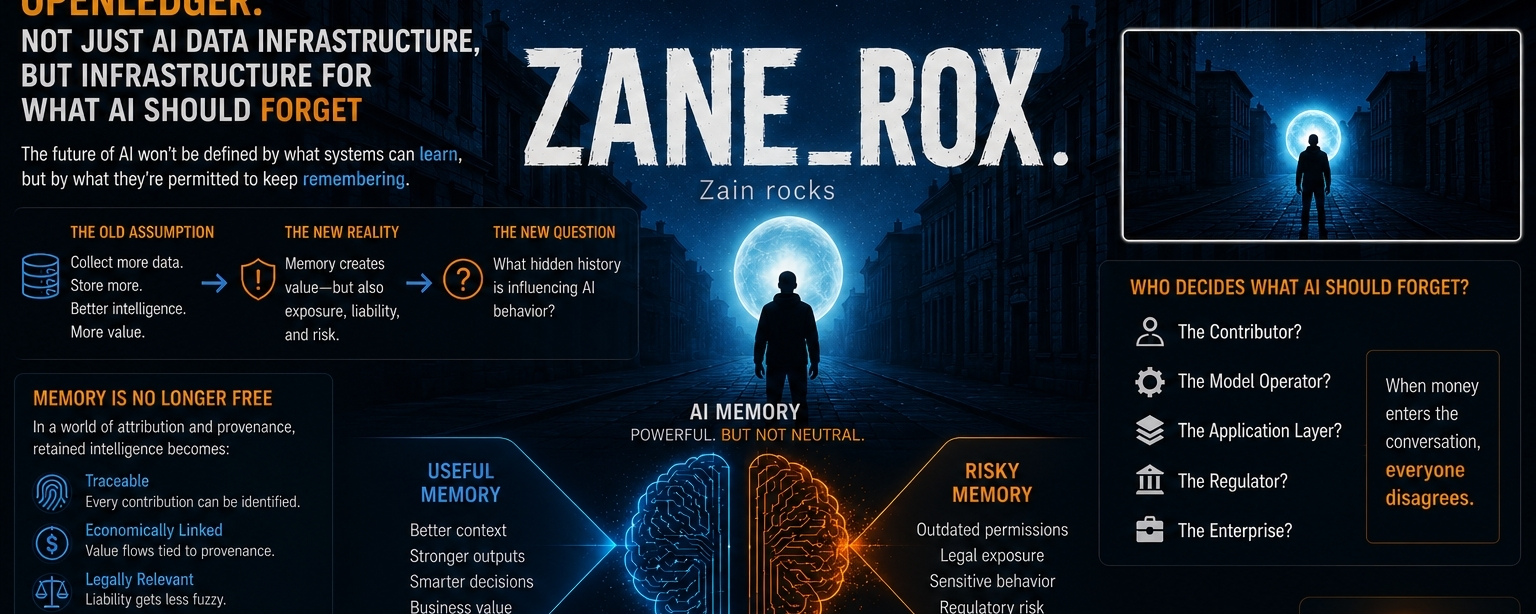
People still talk about AI as if the only thing that matters is intelligence.Smarter models. Faster outputs. Larger context windows. More personalized systems. More automation. More capability.
The entire market behaves like the future belongs to whichever company can help machines learn the most information in the shortest amount of time.But I think the conversation is starting to shift in a much stranger direction.
Because once AI begins operating inside real economic systems, memory stops behaving like a harmless advantage.It starts behaving like risk.That is why OpenLedger caught my attention in a different way than most AI infrastructure projects do.
Most people describe OpenLedger using familiar language. Decentralized AI data infrastructure. Attribution systems. Data contribution economy. Incentive coordination through $OPEN. Builders access data, contributors receive value, intelligence improves over time.Simple narrative.But the more I think about it, the less I believe the important part is about helping AI learn.
I think the deeper issue is about helping AI remember responsibly.And those are not the same thing.For years, the technology industry trained itself to believe retention was always positive. Every interaction became useful data. Every behavior pattern became potential optimization. Platforms accumulated information endlessly because future utility always justified present collection.
AI inherited that philosophy completely.The assumption underneath modern AI systems is straightforward:More memory usually creates better outcomes.More context improves prediction.More history improves personalization.
More behavioral understanding improves automation.But almost nobody stopped to ask what happens when machine memory becomes economically and legally dangerous.That changes the entire equation.
Human memory naturally fades. Institutional memory fades too. Old conversations disappear. Habits change. Context dissolves over time.Machine memory behaves differently.
AI systems absorb information into layers most users never see directly. Training data influences outputs. Behavioral patterns shape recommendation logic. Historical interactions affect automated decision-making. Information spreads through embeddings, retrieval systems, workflow automation, ranking structures, and adaptive model behavior.
Once intelligence internalizes something, removing it becomes far more complicated than simply deleting a file.That creates a structural tension the market still underestimates.
Teaching machines is scalable.Making machines forget precisely is not.And that distinction may become one of the defining infrastructure problems of the next decade.Because AI is no longer isolated experimentation.
It is moving into enterprise workflows, financial systems, healthcare operations, legal review, compliance structures, customer support, productivity software, autonomous agents, and eventually decision-making environments where mistakes carry real consequences.
At that point, the question changes completely.The market no longer asks:Can this AI system perform wellInstead it starts asking:What hidden information is shaping this system’s behaviorThat is a much more uncomfortable conversation.
And it is where OpenLedger becomes more interesting.Attribution systems sound simple on the surface. Data contributors are identified. Usage becomes trackable. Economic rewards become connected to provenance.
But provenance changes the economics of memory itself.Because once retained intelligence becomes attributable, memory stops being invisible infrastructure.
It becomes traceable.And once memory becomes traceable, people start assigning responsibility to it.That changes incentives dramatically.
Traditional AI systems largely treat retained knowledge as free value. Keep everything possible because future intelligence benefits outweigh storage costs.
But in a system where attribution matters, retained information may create ongoing obligations.Compensation expectations emerge.Ownership disputes emerge.Regulatory oversight emerges.
Liability becomes clearer.Economic accountability appears.Suddenly memory is no longer passive.It becomes active infrastructure carrying operational consequences.That is the part I think the broader AI market has not fully priced yet.
The industry still behaves as if intelligence itself is the scarce asset.I increasingly think responsible intelligence may become scarcer instead.Those are very different markets.
Imagine an enterprise AI assistant trained partly on sensitive internal communications. At first everything functions normally. Productivity improves. Employees rely on the system daily. The assistant learns organizational behavior, workflow patterns, customer relationships, negotiation habits, and operational preferences.
Then regulations change.Or data permissions shift.Or a client revokes access rights.Or legal exposure appears around historical interactions.Deleting raw files is easy.But what happens to intelligence shaped by those interactions?
Should the AI still benefit from behavioral insights generated using information it no longer has permission to retain?
Who decides thatThe enterpriseThe customerThe contributorThe regulatorThe infrastructure providerNobody has a clean answer.And that uncertainty may eventually become one of the largest hidden markets in artificial intelligence.
Because the real challenge is not simply storing intelligence.The challenge is governing memory after intelligence already formed around it.That becomes even more complicated when autonomous agents enter the picture.
AI agents are being designed to build persistent behavioral understanding over time. They learn user preferences, financial tendencies, communication styles, negotiation behavior, transaction patterns, and strategic habits.
That memory becomes commercially valuable.It also becomes extremely dangerous.Because useful memory and problematic memory often look identical until a crisis appears.
The systems generating the highest personalization may simultaneously generate the highest future liability.
That contradiction matters more than people realize.Crypto communities actually understand this dynamic better than most industries do.
Blockchains once treated permanence as universally positive. Immutability became almost ideological. The assumption was simple: permanent systems create trust.
Then reality complicated the narrative.Privacy concerns emerged.Regulatory pressure increased.Identity issues appeared.Data permanence stopped sounding entirely beneficial.
Suddenly the industry discovered something uncomfortable:Permanent memory creates permanent exposure.AI may now be walking into a similar contradiction.Except AI memory is even harder to isolate than blockchain records are.A blockchain transaction exists in a visible location.
AI influence diffuses across systems invisibly.A single interaction can shape future recommendations, automated decisions, output probabilities, behavioral ranking, or strategic prioritization in ways nobody fully tracks afterward.That makes attribution simultaneously powerful and dangerous.
Because once attribution becomes economically meaningful, organizations may eventually realize something uncomfortable:Retaining intelligence is not always worth retaining the risk attached to it.
That realization could reshape the economics of AI infrastructure completely.Forgetting may eventually become as valuable as learning.
And if forgetting becomes valuable, then infrastructure managing permissions, provenance, attribution rights, compensation logic, and memory governance may become one of the most important layers in AI.
That is where OpenLedger potentially becomes more than a standard crypto-AI project.The project may not simply be building data rails.It may be participating in the creation of economic systems for negotiated machine memory.That sounds abstract now.
But most structural shifts sound abstract before markets fully recognize them.The internet originally looked like a faster publishing system before it transformed commerce.Social media originally looked like communication infrastructure before it transformed political influence.
Blockchains originally looked like alternative payment systems before they evolved into broader coordination layers.AI memory governance may follow a similar path.
At first it appears niche.Then suddenly every enterprise realizes the issue affects them directly.Because once AI systems become operational infrastructure, memory management stops being theoretical.
It becomes financial.Legal.Strategic.And political.Of course, none of this guarantees OpenLedger succeeds.There are serious challenges.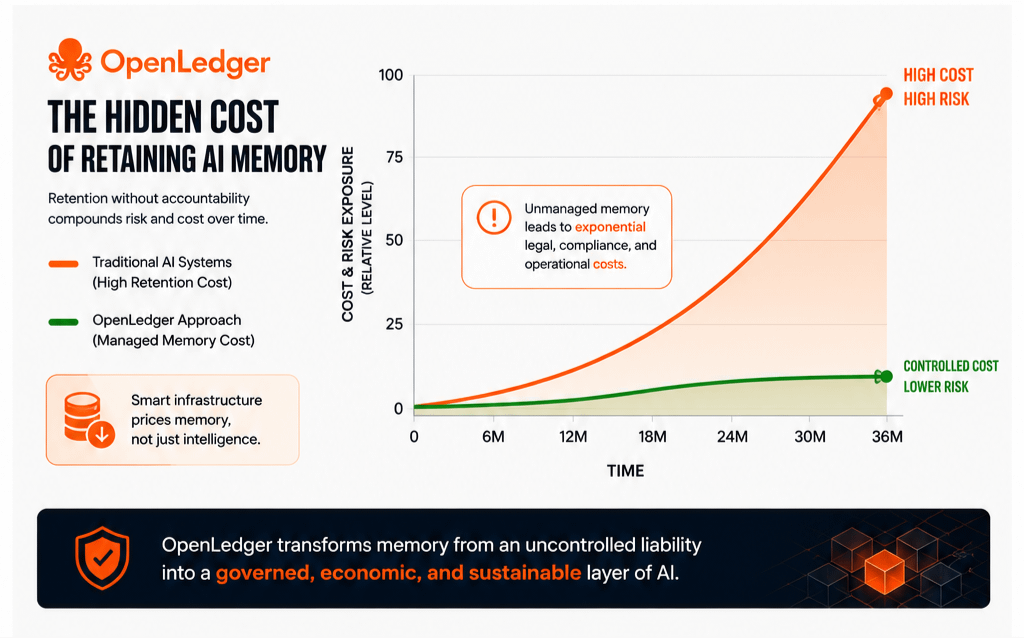
Attribution systems can become operationally heavy. Compensation layers can create friction. Enterprises often prefer efficiency over transparency. Private infrastructure frequently wins because simplicity scales faster than philosophical purity.
Machine unlearning itself also remains technically difficult.The broader AI industry still struggles to define what meaningful forgetting even looks like in practice.
Removing visible data is one thing.Removing influence is something else entirely.And if systems cannot guarantee meaningful memory control, regulatory pressure could intensify rapidly over the next few years.
That creates another interesting tension.The more powerful AI becomes, the more dangerous unmanaged memory becomes alongside it.Which means intelligence growth may indirectly increase demand for accountability infrastructure.
That is not how most investors currently frame the market.Most people still chase performance narratives.Faster models.Cheaper inference.
Larger datasets.Smarter agents.But long-term infrastructure winners are often determined by constraint management, not pure expansion.And AI’s biggest future constraint may not be intelligence capacity.It may be memory responsibility.
That is why OpenLedger feels more important than its surface-level narrative suggests.The project may absolutely remain a specialized AI attribution network.But it may also end up sitting near one of the defining economic questions of the AI era:
Who controls what intelligence is allowed to rememberHow long can it remember itWho gets compensated while memory stays activeWho carries liability when memory creates harm
And who has authority to demand forgetting?Those questions do not have stable answers yet.Which is exactly why they matter.