
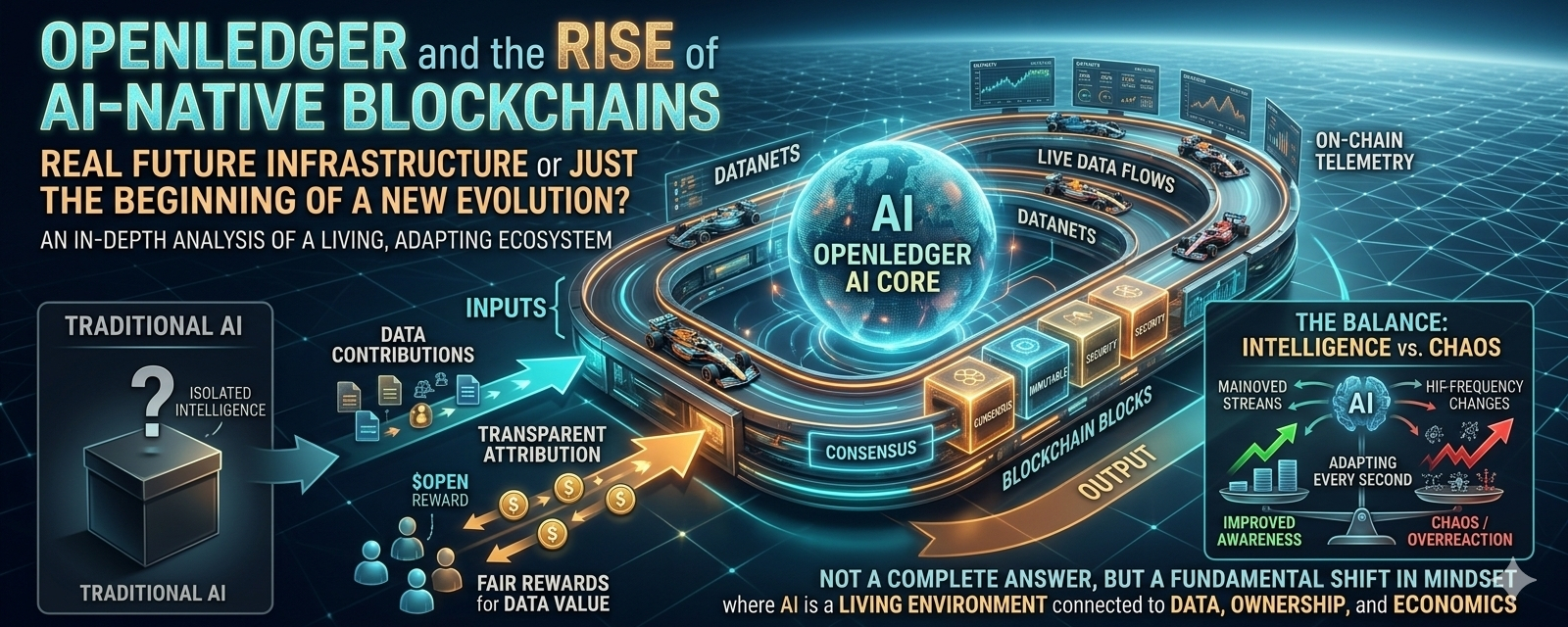
There’s something about the phrase “AI-native blockchain” that keeps pulling me back into thought. Maybe because the more I hear it, the more I wonder what it actually means beneath the surface. Is this truly a new layer of technology being built from the ground up, or are we simply watching old blockchain ideas being reshaped with AI terminology? That question stayed in my head while looking deeper into @OpenLedger, because unlike many projects that only attach AI as a feature, this one seems to position AI as the center of the entire ecosystem itself. Not an extra tool. Not a side component. But the mechanism that keeps everything alive and moving.
What makes the idea interesting is how they compare the system to a Formula 1 racing environment. At first, it sounds dramatic, maybe even exaggerated. But after thinking about it longer, the comparison actually fits. In Formula 1, nothing remains stable for more than a few seconds. Weather shifts, tires lose grip, track conditions change, opponents react instantly, and teams continuously make decisions while the race is still happening. OpenLedger appears to imagine AI in the same way — not static intelligence waiting for commands, but a constantly adapting system that keeps analyzing live conditions every moment. Their concept around Datanets and on-chain telemetry gives the feeling of a network that never truly “sleeps.” It keeps reading signals, processing behavior, and recalculating decisions in real time.
And honestly, that changes the way I think about AI itself. Traditional AI often feels isolated. You ask something, it responds, and the process disappears behind a wall nobody can fully see. But here the idea is different. The AI is meant to exist inside an environment that is continuously evolving with incoming information. The more I think about that, the more complex it becomes. Because while real-time intelligence sounds powerful, it also introduces another problem — too much information can create noise. Systems that react too quickly sometimes lose stability. Adapting every second may improve awareness, but it can also increase the chance of overreaction. That balance between intelligence and chaos is probably one of the biggest hidden challenges behind this entire vision.
Still, one part of OpenLedger stands out more than anything else to me: attribution. This is where the project feels different from typical AI conversations. Most discussions focus only on outputs — faster models, better answers, stronger performance. But OpenLedger keeps bringing attention back to inputs. Who contributed the data? Which information influenced the model? How much value did that contribution actually create? These questions matter far more than people realize because they touch the core issue of the emerging AI economy. If data is becoming the fuel behind intelligent systems, then ownership of that fuel becomes extremely important. And for the first time, a project seems to be trying to make those invisible contributions traceable and economically connected through $OPEN rewards.
At the same time, I can’t ignore the uncertainty around it. Can every contribution really be measured fairly? Can influence inside a learning system ever be fully captured without losing context? Some forms of value are obvious, while others quietly shape outcomes without ever being visible. That dilemma probably won’t disappear easily. But maybe the significance of OpenLedger is not about solving every problem immediately. Maybe it’s about changing the direction of the conversation itself. Instead of treating AI like a closed black box, the project seems to push toward an environment where intelligence, data, ownership, and economics all move together in real time.
That’s why I don’t see OpenLedger as something that can simply be dismissed as hype, but I also wouldn’t call it a complete answer yet. It feels more like the beginning of a transition. A shift in mindset where AI is no longer viewed as a fixed tool that waits for instructions, but as a living environment connected to data flows, attribution systems, and economic incentives. Whether this becomes the foundation of future infrastructure or simply the first stage of a larger evolution is still impossible to know. But one thing feels increasingly clear — if real-time intelligence, transparent attribution, and data ownership truly start merging together, then the way we understand AI today may slowly begin to change forever.