I’ve been looking at OpenLedger in a way that feels a bit uneasy, like standing too close to a machine you don’t fully understand yet, watching it run anyway.
It trades like most new AI-linked tokens do at first. Sharp moves, sudden pauses, liquidity that feels present one moment and thinner the next. The OPEN token sits in that familiar early zone where price can stretch into attention faster than anything inside the system can prove itself. Market cap expectations get built almost immediately, sometimes before anyone can clearly say what sustained usage would even look like. Circulating supply dynamics start to matter in a psychological way too, because limited float plus narrative heat tends to create a kind of artificial clarity — as if movement itself is proof of direction.
But movement isn’t the same thing as function.
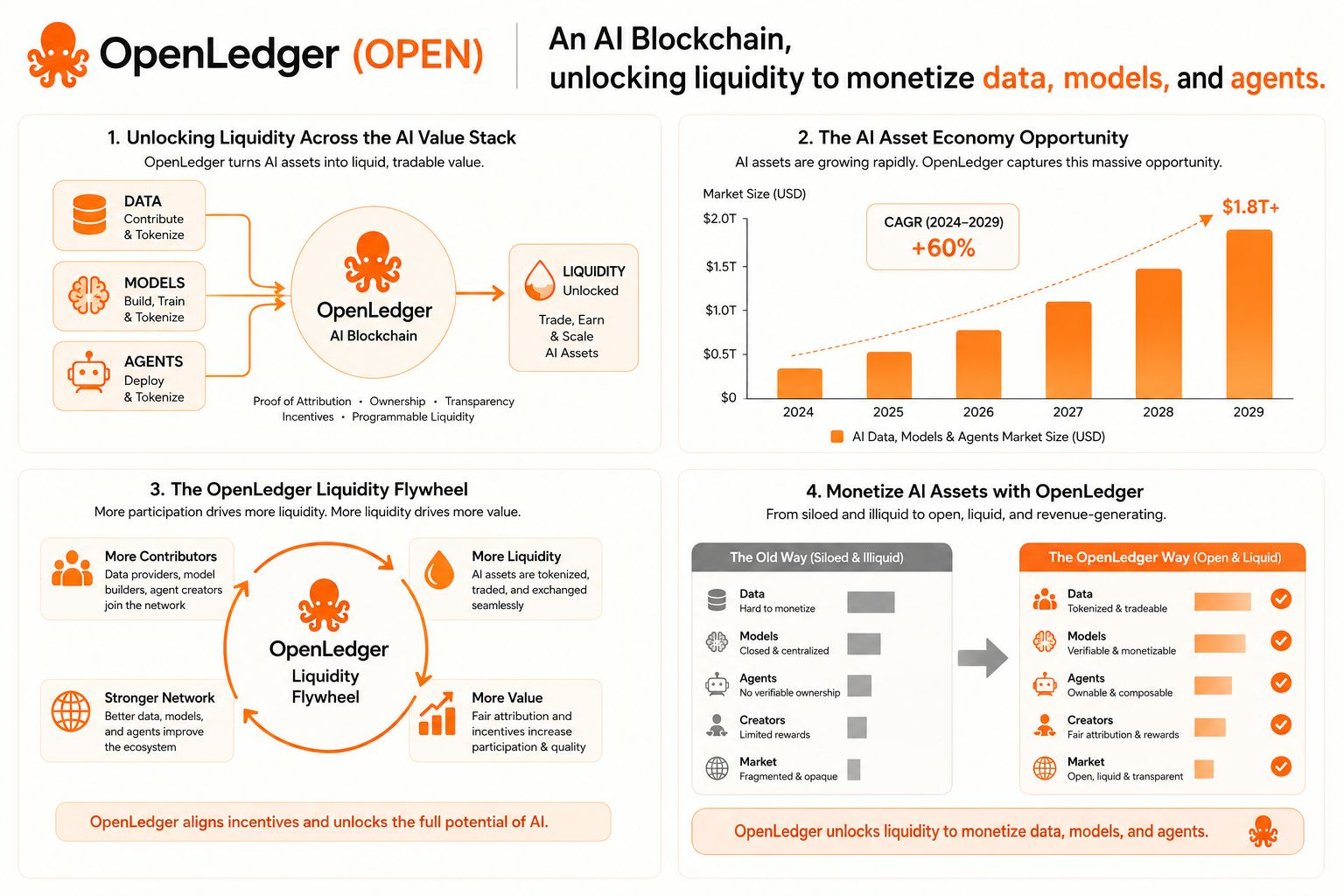
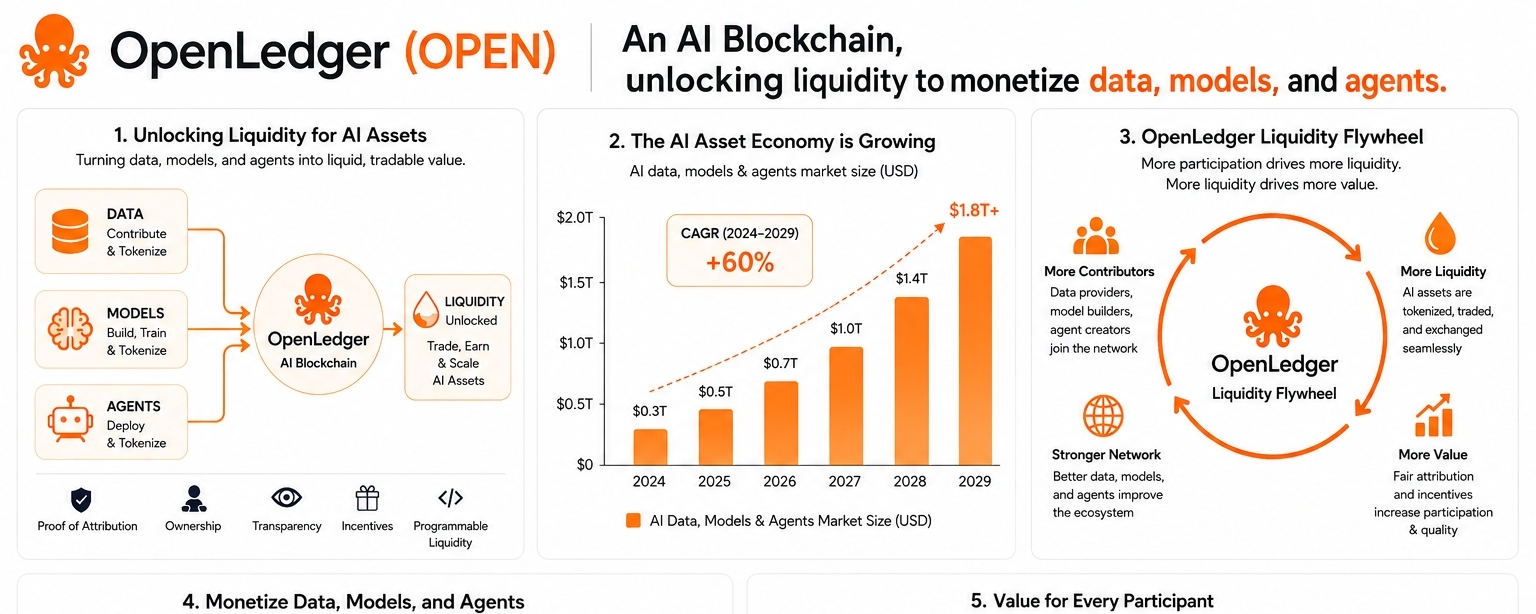
What OpenLedger is trying to point toward, at least in its framing, is something more structural than most AI-token projects admit openly. Not just compute markets or model hosting, but the idea that data, models, and agent outputs can be tracked as economic units — things that leave behind receipts, attribution trails, and payment logic that doesn’t disappear inside a closed platform.
On paper, that sounds like infrastructure. In practice, it’s closer to trying to rebuild parts of the digital economy that big platforms normally keep sealed off.
And that’s where the tension begins.
Because AI already produces value in a way that is strangely invisible. A dataset improves a model, a model improves a product, a product improves a company’s revenue — but the path between those steps is rarely transparent outside the organization that owns it. OpenLedger’s direction, as I understand it, is to make that path more observable, and ideally, compensable. If someone’s data or computation contributes to a useful output, the system tries to make that contribution legible.
That idea carries weight. It also carries friction.
Crypto systems tend to struggle exactly at the point where they try to measure real-world usefulness without central authority. The moment you introduce rewards, people optimize around rewards. The moment you define “useful,” people start producing things that look useful under the metric rather than actually being useful in practice. This is where early optimism often starts to blur.
So when I watch OpenLedger, I don’t really watch the pitch. I watch whether anything inside the system behaves like it would if the incentives were working even without hype.
Does anyone keep building when rewards fade.
Does activity look natural or repetitive, almost mechanical.
Do participants stay for utility, or rotate in and out like they’re passing through a temporary opportunity.
These things are hard to fake consistently, even in crypto.
The market right now is still treating OPEN like a typical early AI narrative asset. Price discovery is fast, sometimes disconnected from visible usage. That’s not unusual — most of these systems go through a phase where attention leads and function follows, if function arrives at all. The problem is that the gap between those two can stay open for a long time, and in that gap, valuations often start to behave like assumptions that haven’t been tested yet.
What makes OpenLedger interesting, at least to me, is not that it claims to build an AI economy layer, but that it’s entering a space where that kind of layer might eventually be needed. If AI systems keep expanding into finance, logistics, content, and automated decision-making, then whoever defines attribution and coordination underneath those systems ends up sitting in a structurally important position.
But that “if” is doing a lot of work.
Because building decentralized coordination for AI is not just a scaling problem. It’s a trust problem, a measurement problem, and a behavioral problem all at once. You need participants who don’t just generate activity, but generate activity that can be trusted, verified, and sustained without constant external pressure. That’s much harder than it sounds when incentives are involved.
I keep coming back to that.
Not because I doubt the direction entirely, but because I’ve seen how quickly early infrastructure can look convincing while it’s still mostly powered by momentum and attention cycles.
So I stay with the quieter signals.
Whether usage deepens instead of just spreads.
Whether developers treat it as infrastructure rather than experimentation.
Whether the system starts to feel necessary instead of optional.
And most importantly, whether anything inside it continues to function when the market stops caring about it for a while.
That last part is usually where the truth shows up, slowly and without ceremony.
If OpenLedger survives that phase, it will be because something real formed underneath the token — not because the narrative held, but because the system became difficult to ignore.
And if it doesn’t, the chart will probably still move for a while, as these things often do, even after the underlying question has already been answered in practice.
I’m still watching, but not for the same reasons the market is moving right now.