
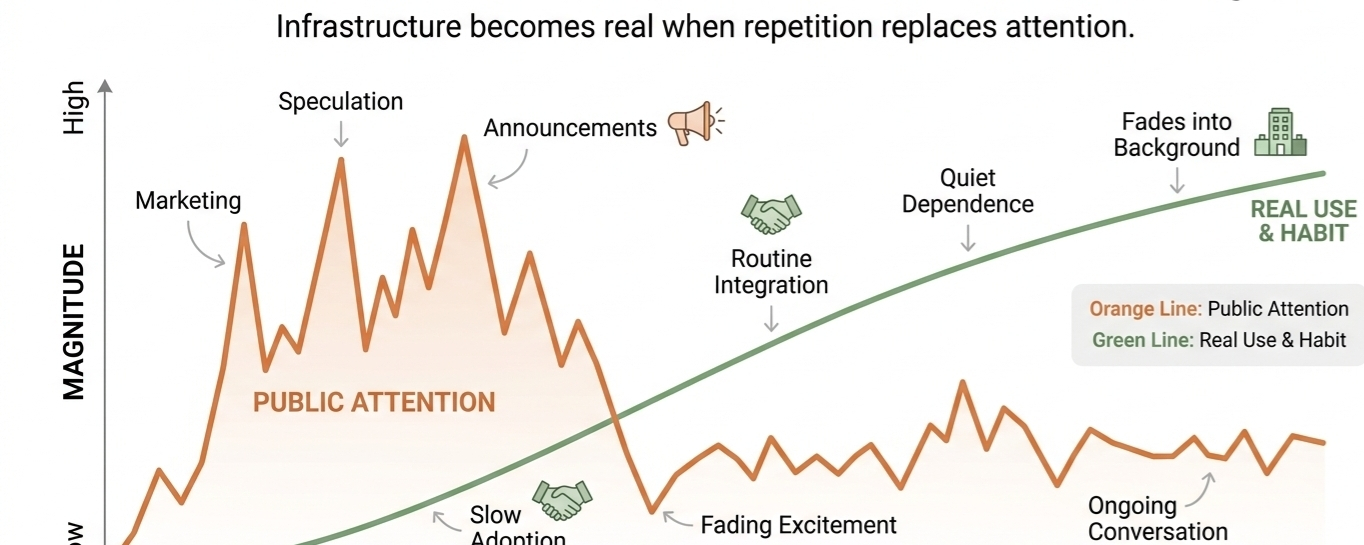
I’m watching the way people return to the word infrastructure lately, and it feels strangely familiar. I’ve seen this kind of confidence before, where an industry starts speaking about the future as if it has already arrived. At first the conversations feel thoughtful and open, but over time the language becomes heavier, more certain, almost rehearsed. Eventually, everyone repeats the same ideas so often that the ideas begin to sound true simply because they survive repetition.
That’s part of what I keep noticing around AI and blockchain right now.
OpenLedger entered my attention quietly. Not through aggressive marketing or oversized promises, but through the growing number of conversations around AI ownership, data contribution, and the invisible systems sitting underneath new technologies. Most projects in this space try hard to sound revolutionary. OpenLedger feels more like something waiting in the background, assuming that if AI keeps expanding, the deeper question will eventually become who controls the structure beneath it.
I think that difference is what stayed with me.
For a long time, crypto convinced itself that building the network was enough. If the architecture looked advanced and the vision sounded large, people assumed real adoption would naturally follow. But real infrastructure does not become important because it exists. It becomes important because people slowly stop noticing it. Electricity matters because daily life quietly depends on it. Roads matter because people build routines around them. The strongest systems usually disappear into ordinary behavior.
Crypto still struggles with that reality.
So many networks generate attention before they generate dependence. There’s excitement, speculation, activity for a while, and then suddenly the movement fades faster than expected. What looked permanent starts feeling temporary. I’ve watched this happen enough times that I’ve become more interested in behavior than announcements.
That uncertainty is what makes OpenLedger interesting to observe.
The project is built around the idea that AI models, datasets, and contributors should interact through a more transparent system where attribution and participation can actually be tracked. On paper, the idea makes sense. AI is expanding quickly, but the structure around ownership still feels unclear. Data moves everywhere, people contribute in invisible ways, and value often accumulates in places most users never see.
OpenLedger seems to be responding to that imbalance.
But I keep returning to the same thought: will people truly change their habits because a system offers better attribution, or will convenience continue to dominate everything else?
That question feels bigger than one project. It feels tied to the direction of technology itself.
Over the last few years, AI stopped feeling like an experimental corner of the internet and started becoming part of economic planning. Countries are investing in compute power the way earlier generations invested in industrial infrastructure. Companies are reorganizing around automation and data systems before fully understanding what the long-term social effects might even look like. There’s a sense that everyone is preparing for something massive, even if nobody can clearly describe the final shape yet.
Inside that atmosphere, projects like OpenLedger are trying to position themselves early, before the structure becomes fixed. I understand the logic behind that. If AI eventually becomes embedded into education, logistics, research, healthcare, communication, and everyday business operations, then the systems coordinating data and contribution may end up mattering more than the applications currently receiving attention.
Still, anticipation can create its own illusion.
Crypto has always been good at predicting importance before usage exists. Sometimes that foresight becomes meaningful. Other times it creates entire ecosystems built around future demand that never fully arrives. I think that’s why I’ve become cautious around narratives that sound complete before real human behavior has formed around them.
Because in the end, usage is quieter than marketing.
Real adoption does not usually announce itself dramatically. People simply return to something again and again until it becomes part of their routine. They stop explaining it. They stop debating it. The system fades into the background because it has already integrated into ordinary life.
That may be the hardest challenge for projects like OpenLedger. Not building the technology itself, but crossing the invisible distance between interest and habit. Between being discussed and being depended on.
And maybe that is what I keep realizing now. Infrastructure only becomes real when repetition replaces attention. Not when people talk about it constantly, but when they keep using it long after the conversation loses its excitement. #OpenLedger $OPEN @OpenLedger
