
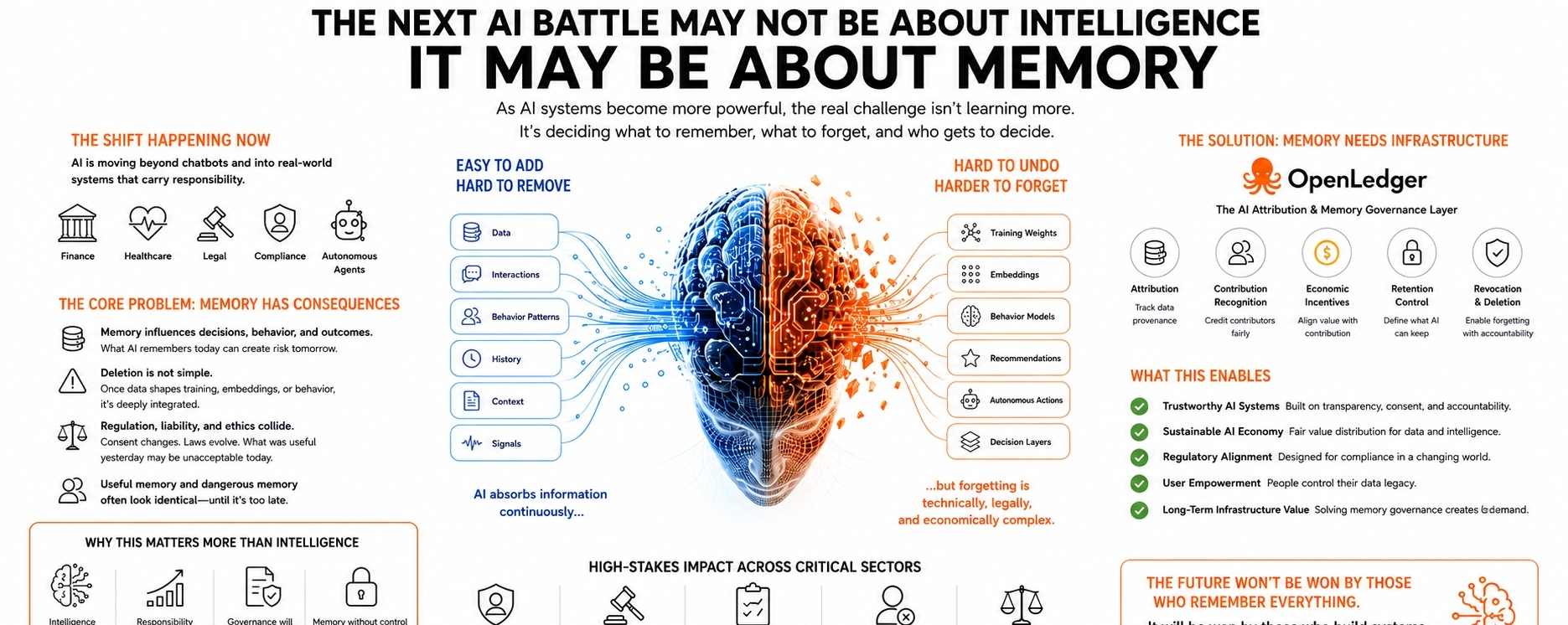
The Next AI Battle May Not Be About Intelligence
It May Be About Memory
There is a pattern I keep noticing across nearly every major technology cycle.
Markets become obsessed with accumulation long before they think seriously about retention.
The conversation is always about gathering more: more users, more data, more context, more history, more behavioral signals, more intelligence.
Very few people stop to ask the harder question:
What should these systems actually be allowed to keep?
For years, the assumption behind modern digital infrastructure was simple: if storage is cheap and information might become useful later, preserving it is rational.
That assumption shaped almost the entire internet economy.
Social platforms stored endless behavioral histories because future monetization opportunities were impossible to predict. Financial apps archived years of customer interactions because compliance and analytics benefited from long-term records. Recommendation engines improved by remembering everything possible about human behavior.
Then AI accelerated the pattern dramatically.
Suddenly every company wanted larger datasets, broader context windows, deeper personalization, longer memory layers, and systems capable of carrying forward enormous amounts of historical information.
The underlying belief was straightforward:
more memory creates smarter systems.
And technically, that is true.
But something changes once intelligence stops being a passive analytical tool and starts becoming an operational actor inside real economic systems.
At that point, memory stops being a harmless asset.
It becomes liability.
It becomes governance.
It becomes power.
And eventually, it becomes conflict.
That shift is partly why OpenLedger caught my attention.
Not because it fits the popular crypto narrative people repeat online.
But because it accidentally points toward a much larger problem the AI industry still seems uncomfortable discussing openly.
Everyone Thinks AI’s Biggest Problem Is Learning
I Think the Bigger Problem Might Be Forgetting
Most people currently describe OpenLedger as an AI data marketplace.
Contributors provide datasets. Developers consume them. Models improve. Attribution gets tracked. The token coordinates incentives.
Clean. Simple. Easy to understand.
It fits perfectly into the familiar crypto infrastructure template: tokenized coordination for valuable digital resources.
But I think that framing misses the more important layer entirely.
Because the truly difficult challenge emerging in AI is not simply helping systems absorb information.
It is helping them stop carrying information once they already have.
That sounds abstract until you think carefully about how modern AI systems actually work.
People outside technical circles still imagine deletion in fairly traditional software terms.
Delete the file. Remove the database record. Erase the server copy.
Done.
But machine intelligence does not function like a folder on a laptop.
Once information influences training weights, embeddings, retrieval systems, fine-tuning behavior, recommendation logic, autonomous agents, or decision-support layers, the information becomes diffused throughout the system.
It spreads.
The knowledge becomes structurally integrated into behavior itself.
And that is where the problem begins.
Because removing information from intelligent systems is often far harder than introducing it.
That is exactly why the entire field of machine unlearning exists.
And honestly, machine unlearning has always felt philosophically revealing to me.
Not because the research lacks sophistication.
But because the existence of the field quietly admits something the industry does not love saying out loud:
teaching machines is easier than making them forget precisely.
That distinction becomes extremely important once AI systems start interacting with areas where mistakes carry real-world consequences.
AI Is Moving Beyond Chatbots
And Into Systems That Carry Responsibility
Two years ago, most AI discussions revolved around novelty.
Could models generate images? Write essays? Summarize articles? Answer questions?
Interesting problems. But relatively low-stakes problems.
Now the trajectory looks very different.
AI is increasingly moving into operational environments: financial analysis, healthcare workflows, legal review, identity systems, customer support, compliance monitoring, enterprise coordination, autonomous agents, payment infrastructure, risk evaluation.
And once AI begins influencing real economic activity, the central question changes completely.
The issue is no longer:
> “How intelligent is this system?”
Instead, the question becomes:
> “What information is still shaping this system’s decisions — and should it still be?”
That is a far more dangerous question.
Because memory inside intelligent systems does not remain passive.
It influences outputs. Recommendations. Judgments. Risk scores. Behavioral assumptions. Autonomous actions.
In other words:
memory becomes operational.
And operational memory creates exposure.
The AI Industry Still Treats Memory Like a Free Resource
That Assumption May Break
Right now, most AI systems operate under a fairly simple economic logic:
retaining context is usually beneficial.
More memory improves personalization. More historical awareness improves continuity. More data improves performance.
So companies keep everything possible.
But OpenLedger introduces an interesting complication.
Attribution.
And attribution changes economics.
The moment contributors can be identified, tracked, compensated, challenged, or connected to downstream value creation, retained memory stops being free infrastructure.
Memory starts carrying cost.
And once memory carries cost, forgetting becomes economically rational.
That is the part I think the market is massively underestimating.
Because people still analyze AI systems primarily through the lens of capability expansion.
Bigger models. Smarter outputs. More autonomous behavior. Larger context windows.
But infrastructure markets often change direction once hidden costs become visible.
And attribution makes hidden costs visible.
The Moment Memory Becomes Traceable, Everything Changes
Imagine an enterprise AI assistant trained partly on sensitive internal customer interactions.
At first, that seems efficient.
The model becomes more personalized. More context-aware. More accurate.
But now imagine several months pass.
A customer changes data permissions.
New regulations emerge.
Internal legal teams decide historical interactions create compliance risk.
Or perhaps a company realizes certain retained behavioral patterns expose them to future lawsuits.
Suddenly the issue is no longer simply deleting records from storage.
The real question becomes:
> Should intelligence shaped by those interactions still remain active inside the system itself?
That question becomes brutally complicated.
Because intelligence is not modular.
You cannot always isolate which exact behavioral improvements came from which exact data contributions once systems become sufficiently interconnected.
And that creates a tension the AI industry has not fully solved:
useful memory and dangerous memory often look identical until something goes wrong.
Healthcare and Finance Make This Problem Much More Serious
The implications become even heavier in sectors where historical context directly affects human outcomes.
Take healthcare.
An AI system trained on patient interaction histories may improve treatment coordination dramatically.
But what happens when retention rules change? What happens if consent gets revoked? What happens if certain historical patterns create future liability?
Now consider financial advisory systems.
Long-term behavioral memory may improve fraud detection, investment recommendations, or risk management.
But those same memory structures could also introduce surveillance concerns, bias amplification, or regulatory exposure.
The exact information that makes systems smarter can also make them more dangerous.
That contradiction is not temporary.
It is structural.
And it becomes even more important once autonomous agents enter the picture.
Because agents do not merely retrieve information.
They build behavioral models over time.
They remember counterparties. Transaction habits. Communication styles. Patterns of trust. Decision histories.
That memory becomes strategically valuable.
It also becomes legally and ethically volatile.
Crypto Already Experienced a Version of This Crisis
Which is why I think crypto people may understand this transition faster than most traditional tech observers.
Crypto spent years glorifying permanence.
Immutable ledgers. Permanent records. Unchangeable history.
At first, that sounded revolutionary.
Then reality arrived.
Privacy concerns emerged. Regulatory pressure increased. Human behavior collided with permanent transparency.
And suddenly the industry discovered something uncomfortable:
systems that remember forever are not automatically pro-human.
In some situations, permanence becomes hostile.
AI may now be approaching its own version of that realization.
The industry currently treats infinite retention as a mostly positive feature.
But once intelligent systems begin affecting careers, credit decisions, healthcare access, legal outcomes, or autonomous operations, society may become far less comfortable with unrestricted machine memory.
And OpenLedger sits surprisingly close to this pressure point.
Because attribution systems make memory legible.
And once memory becomes legible, memory becomes challengeable.
Attribution Creates Accountability
Accountability Creates Conflict
The moment provenance becomes visible, entirely new questions emerge.
Who owns contribution rights?
Who deserves compensation when intelligence generated value using historical data?
Who carries responsibility if retained information causes harm?
Who decides when memory should expire?
Who has authority over revocation?
The contributor? The enterprise? The model operator? Governments? Regulators? Courts? Users?
Those groups will not agree.
Especially once money enters the equation.
And this is where OpenLedger becomes more interesting than most people realize.
Because beneath the surface, attribution infrastructure is not just coordinating data.
It is coordinating responsibility.
That is a much harder market.
The Technical Problem Is Difficult
The Economic Problem May Be Even Harder
Even if OpenLedger succeeds technically, the incentive structure remains complicated.
Crypto systems often look elegant in theory.
Then operational reality arrives.
The difficult question every infrastructure project eventually faces is simple:
> what creates sustainable organic demand?
Speculation can drive temporary attention. Narratives can create cycles. But durable systems require recurring necessity.
If $OPEN becomes tied to attribution management, contributor compensation, data access coordination, memory rights, or retention governance, then perhaps a meaningful economic loop emerges.
But there is another possibility too.
Complexity itself becomes friction.
Because enterprises often prioritize simplicity over ideological purity.
If attribution systems become too expensive, too legally complicated, or too operationally difficult, many companies may simply choose private closed systems instead.
That is a real risk.
And honestly, I think the governance layer may become harder than the engineering layer.
Because machine forgetting is not purely technical.
It is political.
The AI Economy May Be Mispricing What Becomes Scarce
Right now the market still behaves as though intelligence itself is the scarce resource.
That assumption drives almost everything: larger models, faster models, smarter agents, better reasoning, more context, more capability.
But intelligence is scaling rapidly.
Open-source models improve continuously. Computation becomes cheaper. Optimization advances accelerate.
The scarcity may shift elsewhere.
And I increasingly suspect responsibility will become scarcer than intelligence.
The ability to govern memory responsibly. The ability to prove attribution. The ability to negotiate retention rights. The ability to manage deletion. The ability to handle liability.
Those capabilities may eventually matter more than marginal improvements in raw intelligence itself.
If that happens, entirely different infrastructure layers become valuable.
Not just systems that help AI learn more.
But systems that determine:
what AI should remember,
how long it should remember it,
who benefits from retained memory,
who controls revocation,
and what obligations exist while memory remains active.
That is not the narrative most people currently associate with OpenLedger.
But it may be the more important one.
The Most Important AI Infrastructure May Not Be About Intelligence At All
Maybe OpenLedger ultimately becomes exactly what most people currently describe:
a tokenized AI contribution network with attribution rails.
That alone could still matter.
But the larger possibility feels more significant.
It could evolve into infrastructure for negotiating machine memory itself.
Not merely data exchange.
Not merely model optimization.
But the economic and political architecture surrounding what intelligent systems are permitted to carry forward across time.
And honestly, that market feels inevitable.
Because every technological era eventually collides with the consequences of what it preserves.
The internet collided with permanence. Social media collided with behavioral surveillance. Crypto collided with immutable transparency.
AI may soon collide with inherited memory.
And when that collision fully arrives, the most valuable systems may not be the ones that help machines remember everything.
They may be the systems that help society decide what deserves to be forgotten.