

Everyone keeps talking about how AI will change the future,
but almost nobody talks about the infrastructure required to make AI trustworthy in the first place.
That’s why I’ve been paying attention to @OpenLedger lately.
At first, I assumed it was just another project trying to combine AI and blockchain because those are the two hottest buzzwords in tech right now.
But after looking deeper into what they’ve actually been building, the direction feels far more serious than the usual hype cycle.
Most AI systems today operate like black boxes.
You see the output.
You see the prediction.
You see the generated result.
But you rarely know:
Where the data came from.
Who contributed it.
Whether the information was licensed.
Or why the AI made a certain decision.
That becomes a massive problem once AI starts handling finance, research, trading, content, healthcare, and automated decision-making at scale.
OpenLedger seems focused on solving that exact layer.
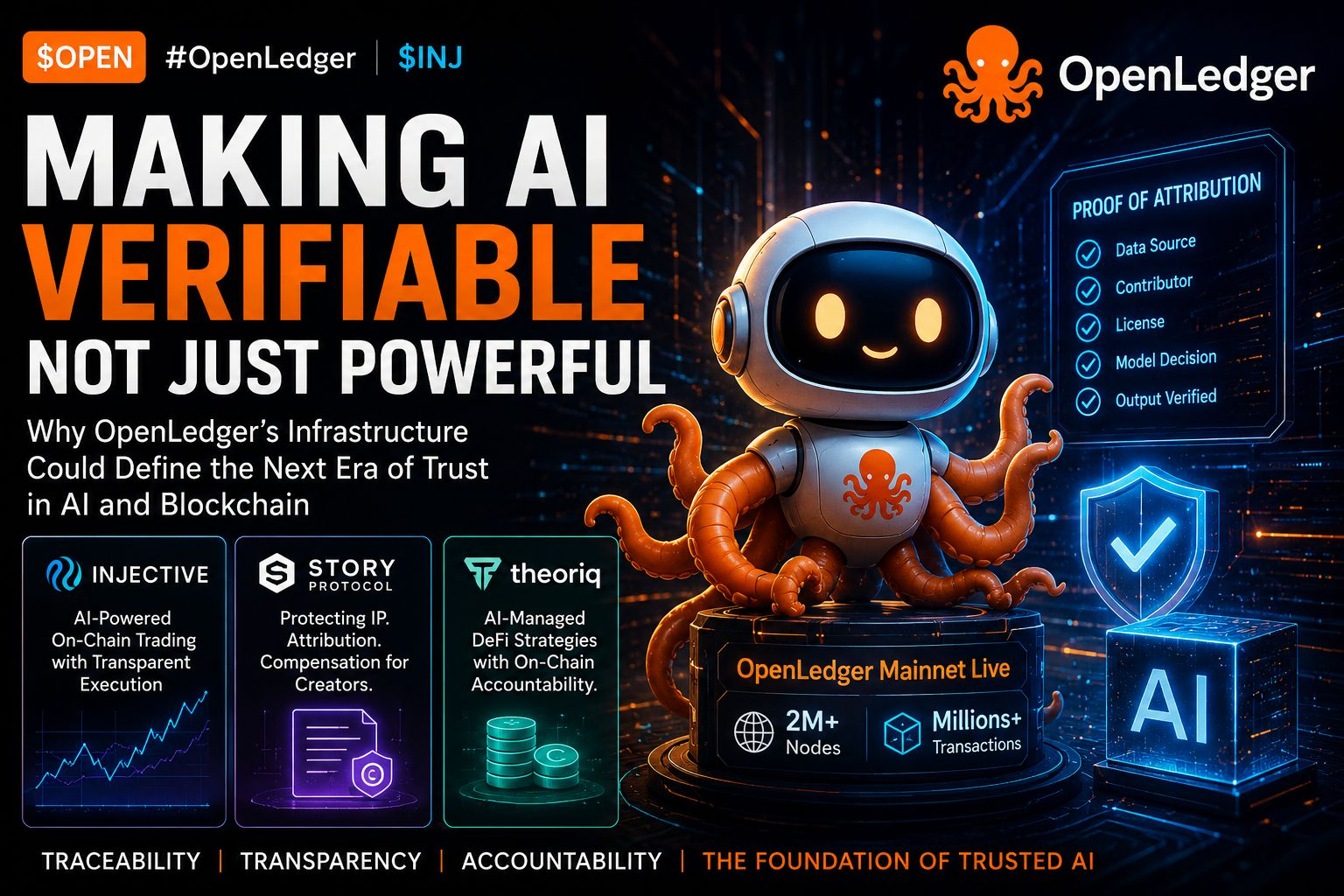
 Their “Proof of Attribution” model introduces something the AI industry desperately lacks right now: traceability.
Instead of treating intelligence like magic, they’re building systems where data contributions, model behavior, and AI-generated outcomes can actually be tracked and verified.
That may sound boring compared to flashy demos, but infrastructure usually matters more than marketing in the long run.
What also caught my attention is the kind of partnerships they’ve been forming.
The collaboration with Injective opened the door for AI-powered on-chain trading systems with transparent execution trails.
Their integration with Story Protocol attacked another growing issue inside AI: intellectual property rights.
AI companies are increasingly facing criticism for training models on unlicensed data.
OpenLedger’s approach creates a framework where creators can potentially receive attribution and compensation instead of being invisible sources feeding massive models for free.
Then there’s the DeFi side.
Through partnerships like Theoriq and ERC-4626 vault integrations, they’re experimenting with AI-managed financial strategies that remain auditable on-chain.
That’s important because automation without accountability eventually becomes dangerous.
The interesting part is that they’re not only talking about ideas anymore.
Mainnet is already live.
Millions of nodes have reportedly registered.
Millions of transactions have already been processed.
 And developers are actively building models on top of the network.
Whether the token pumps or dumps tomorrow honestly matters less to me than whether the infrastructure survives long term.
Crypto is full of projects selling narratives.
Very few spend years solving foundational problems nobody else wants to touch.
I’m not saying OpenLedger becomes the next giant. Nobody knows how this market plays out.
But I do think they’re working on one of the more realistic and necessary ideas inside the AI x crypto space right now:
Making artificial intelligence verifiable instead of blindly trusted.
That alone makes the project worth watching.
