
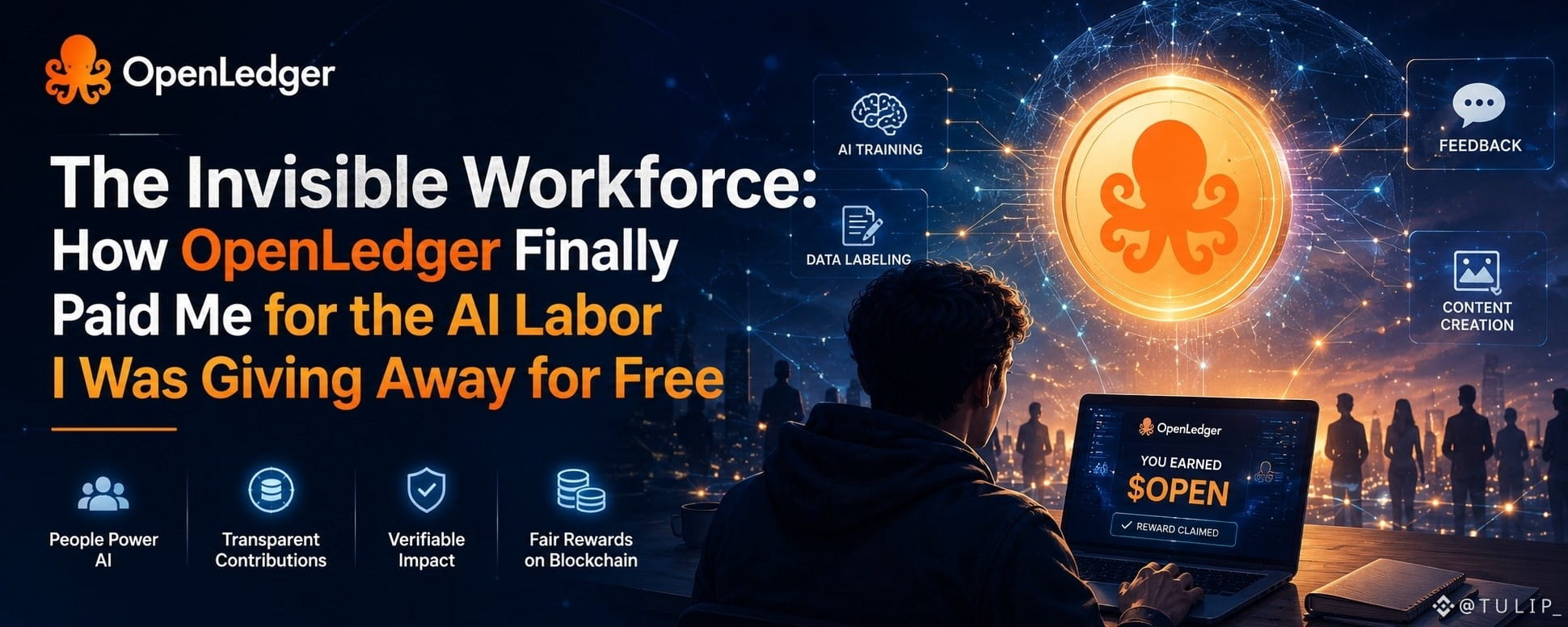

Look, I’m gonna keep it a hundred with you. For the longest time, I watched the AI revolution happen around me, not with me. I’d burn hours labeling datasets, testing half-baked beta models, writing detailed feedback, tweaking prompts until my eyes glazed over, curating training data, and basically doing all the invisible grunt work that makes these shiny chatbots sound halfway intelligent. And what did I get in return? A generic “thanks for your feedback” popup and maybe some imaginary karma points that I couldn’t spend, trade, or even brag about. The billions in value being created? That went straight into the pockets of the same handful of centralized platforms, while people like me got ghosted completely.
It honestly started feeling like a party I wasn’t invited to, but I was still expected to cater it. You pour in your data, your time, your expertise, your human judgment—the exact thing AI desperately needs so it doesn’t sound like a broken parrot regurgitating nonsense—and in exchange you get… absolutely nothing. No equity. No attribution. No check. Just the quiet, hollow satisfaction of knowing you made someone else’s product better, for free, while they monetized it. That vibe gets old fast. Real fast.
Then I stumbled across OpenLedger, and it was one of those rare moments where something actually clicks in your brain. I wasn’t out here hunting for another crypto project to blindly ape into. I was just genuinely tired of being a volunteer in an economy that prints money off my contributions without cutting me in. What hooked me was this concept they call Proof of Attribution. Sure, it sounds technical on paper, but the core idea is stupidly simple and brutally fair: if your work genuinely improves an AI model, you get paid based on how much it improved it. No middleman swiping the lion’s share. No corporate committee sitting in a glass tower deciding your time is worth exactly zero. Just a direct, transparent line between the value you create and the reward you actually receive.
So I decided to put my money where my mouth was and test it. I started contributing data to one of the open models running on OpenLedger’s pipeline. I wasn’t doing anything fancy or PhD-level—just cleaning up messy training pairs, flagging bad outputs that made no sense, refining edge cases in reasoning tasks, and doing the kind of nitty-gritty detail work I’d done for free a hundred times before on other platforms. But this time, the protocol was actually tracking the real impact of my contributions. When the model’s performance bumped up in the specific areas I’d worked on, the attribution algorithm registered that improvement, and rewards flowed straight back to my wallet. It wasn’t lottery-ticket, quit-your-job overnight money, but seeing any economic return for work I would normally do unpaid felt like a heavy door opening that I didn’t even know was locked.
Here’s what genuinely hit different: the transparency. On centralized platforms, you’re basically throwing your contributions into a black hole. You have zero idea if your data was actually used, if it helped the model improve, or if it just got buried in some server farm to be repackaged and resold later without your name anywhere near it. With OpenLedger, the attribution is verifiable on-chain. You can actually trace how your specific input influenced the model’s output quality over time. That changes the entire psychology of the work. You’re not a disposable cog in a machine anymore; you’re a verified participant with actual skin in the game, and there’s proof.
And the barrier to entry? Basically zero. That’s honestly what I love most about it. You don’t need to be a Stanford PhD researcher or a startup founder with millions in VC backing. You can be a regular person with a laptop, decent judgment, and some spare time. Label some images. Evaluate some model responses. Fine-tune a local dataset. The protocol meets you exactly where you are and pays you based on the real-world impact of your work, not your credentials or your network. That’s a massive, refreshing shift from the elitist gatekeeping we’ve all normalized in AI development.
The bigger picture really started to sink in after a few weeks of participating. Right now, AI is being built like industrial agriculture—massive centralized factories sucking up resources and labor from everywhere, controlled by a tiny handful of giants, while the actual contributors doing the labor are fragmented, anonymous, and quietly exploited. OpenLedger is proposing something much closer to a farmers’ market: distributed, transparent, community-driven, and—crucially—where the people doing the actual work get to eat what they grow. Proof of Attribution is the engine that makes that sustainable. It transforms the AI supply chain from a one-way extraction model into a genuine circular economy where contribution and compensation are actually linked.
I’m not here to sell you a fantasy or tell you it’s perfect, and I’m definitely not saying you’re gonna retire next Tuesday because you labeled fifty images over the weekend. What I am telling you, from direct personal experience, is that for the first time in years of doing this work, I feel like my contributions to AI are actually mine. They’re tracked, they’re valued, and they’re compensated fairly. That dignity matters more than people think. It changes how you show up. When you know you’ll be rewarded fairly for quality work, you naturally put in better effort, which makes the models better, which creates more value for the entire ecosystem. It’s a real flywheel, but for once it actually starts spinning from the contributor outward, instead of from the corporation downward.
If you’ve been sitting on the sidelines watching the AI boom explode, feeling like there’s no seat at the table for regular people like us, trust me—I felt that exact same thing. I was there. But this is that seat. You don’t need permission. You don’t need to apply to some centralized platform and hope they deem you worthy of crumbs. You just show up, contribute your skills and time, the protocol attributes the value honestly, and you earn what you’re actually owed.
We’re early. The infrastructure is still maturing, the models are still improving, and the ecosystem is finding its rhythm. But the direction feels inevitable. The future of AI isn’t going to be built by another walled garden charging admission to the very people who laid the bricks. It’s going to be built by open, decentralized networks that recognize and reward every single hand that touches the work.
I’m all in on that future. You should be too.
