i’ve seen far too many projects label themselves as “AI infrastructure” lately. they drop sleek dashboards, promise intelligent agents, and talk endlessly about autonomy and machine economies. yet when you actually use them, you’re still copying api keys, managing deployments, monitoring nodes, switching wallets, and opening multiple tabs just to keep everything from breaking in the background.
the gap between the marketing and the real user experience is massive.
that’s the strange contradiction haunting most of AI crypto right now. everyone talks about autonomous agents and decentralized intelligence, but the day to day reality for users is still heavily manual. the complexity hasn’t disappeared, it’s simply been pushed onto the people who are supposed to benefit from the automation.
the deeper issue is operational friction. most current AI systems are technically functional but incredibly fragile underneath. users end up maintaining the infrastructure instead of using the product naturally. agents might sound smart in demos, but deployment, orchestration, scaling, monitoring, and reliability still require constant human intervention. in practice, humans are still the real operators behind the so called “autonomous” systems.
this is exactly where OctoClaw stands out as something worth paying attention to (d).
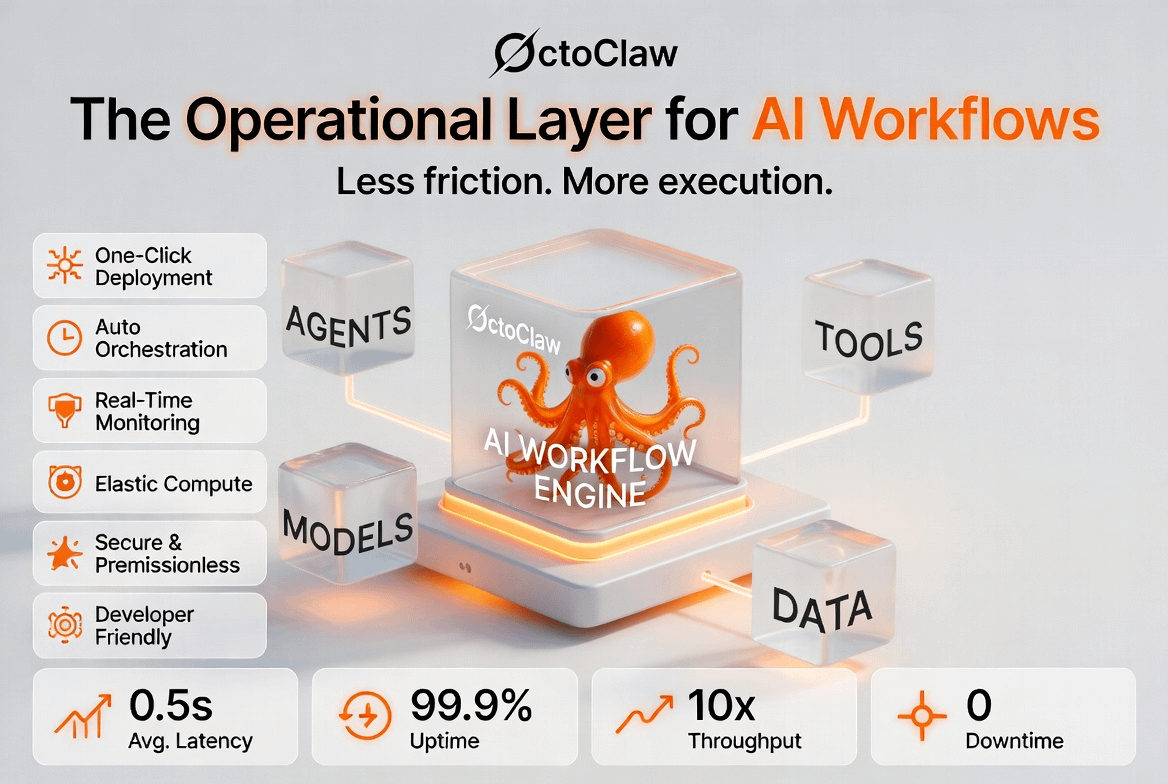
instead of adding another layer of hype, #OpenLedger designed OctoClaw to attack the operational friction head on. through its cloud config, you can deploy an intelligent agent in minutes, no more wrestling with local servers, docker, ports, or constant maintenance. the agent runs in a secure, always on cloud environment while staying deeply integrated with OpenLedger’s AI native l2. every action is verifiable on chain via proof of attribution, and it connects seamlessly with the rest of the stack (datanets for data, model factory for training, evm bridge for liquidity, and erc 4626 vaults for yield).
the experience feels refreshingly practical. you set your strategy and rules once, and the agent handles research, analysis, execution, and optimization without you needing to babysit the backend. it reduces the manual overhead that makes most AI tools exhausting in real life. for the first time, the promise of automation starts to feel closer to reality rather than marketing copy.
because of this focused approach to reducing friction, @OpenLedger is positioning itself differently in the market. while most projects chase the next viral AI narrative or flashy agent demo, OctoClaw is building reliable infrastructure that actually makes autonomous workflows usable at scale. it turns fragmented, high maintenance AI experiments into something closer to stable, production grade tools that normal users and developers can rely on daily.
for the broader crypto community, this matters more than another round of hype. crypto has always been excellent at creating new assets and narratives, but terrible at reducing real operational pain. if OpenLedger can deliver on simplifying AI workflows through OctoClaw, it could help shift the entire sector from “looks automated” to “actually automated.” that would be a quiet but significant step toward making decentralized AI practical instead of performative.
of course, this is still early. infrastructure only proves itself under sustained real world usage, not in whitepapers or polished demos. the real test will be whether these workflows remain stable at scale, whether developers keep building on top of it once the initial excitement fades, and whether the abstraction genuinely removes friction or just hides it behind a cleaner interface.
still, in a market flooded with overpromised autonomy, OctoClaw feels like one of the few projects addressing the boring but critical problem: making the damn thing actually easier to use.
and in crypto, solving the boring problems is often what separates infrastructure that lasts from narratives that disappear after one cycle.