
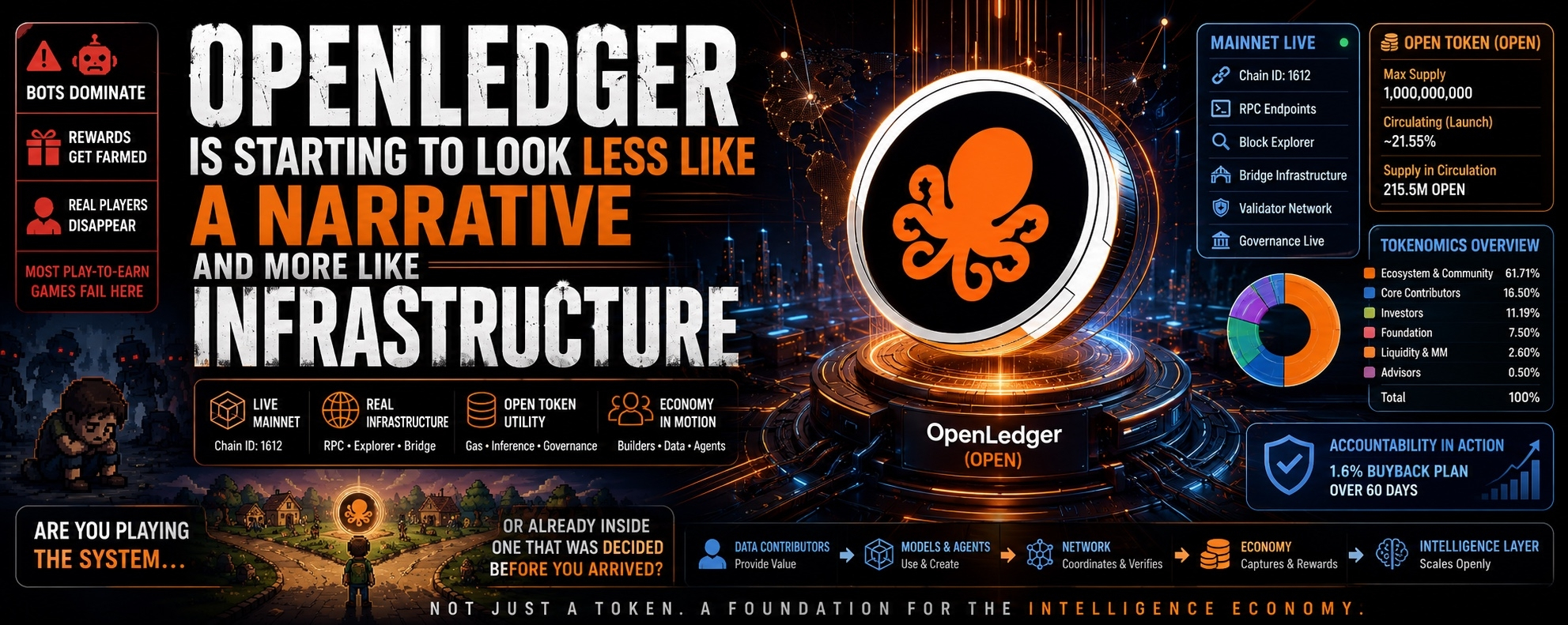
For a long time, @OpenLedger looked like another AI-adjacent crypto project benefiting from market psychology more than operational reality. The AI sector became saturated so quickly that almost every protocol with a machine-learning angle began describing itself as infrastructure for agents, data liquidity, or decentralized intelligence. That repetition made it difficult to separate durable architecture from narrative packaging. But the launch of OpenLedger’s mainnet changes the conversation in a meaningful way. A live chain with its own RPC endpoints, explorer, bridge infrastructure, native OPEN token, and Chain ID 1612 does not automatically prove adoption, yet it does establish something more important: executable infrastructure. The project can now be evaluated through actual settlement behavior, validator coordination, governance execution, and economic activity rather than theoretical positioning alone. That transition matters because infrastructure becomes measurable the moment real users interact with it under live market conditions.
The role of OPEN inside the network is where the economic structure becomes more interesting. Gas fees are often described simplistically as transaction costs, but within OpenLedger they also function as the pricing mechanism for model registration, inference execution, validator participation, and governance interactions. In effect, the token becomes the settlement unit for machine-coordinated economic activity. If meaningful AI workflows begin operating through the network, demand for OPEN could eventually become tied to utility rather than pure speculation. At the same time, that design introduces an equally important risk. Crypto ecosystems frequently generate artificial velocity where incentives recycle activity without creating durable usage. A network can appear active while much of the volume remains internally subsidized. That is why adoption metrics alone will not be enough to judge OpenLedger. The quality of economic participation — not simply transaction count — will determine whether the infrastructure develops genuine long-term gravity.
The tokenomics structure reinforces both the opportunity and the caution surrounding the project. OPEN carries a fixed maximum supply of 1 billion tokens, with approximately 21.55% circulating at launch. That creates immediate market liquidity while still leaving substantial future unlock exposure. Token supply dynamics matter because infrastructure valuation cannot be separated from vesting schedules, liquidity depth, treasury management, and long-term demand generation. The initial release of 215.5 million OPEN included allocations toward liquidity provisioning and community incentives, which should help bootstrap early network activity. However, crypto markets have repeatedly shown that rewards-driven ecosystems can attract speculative farming long before they attract sustainable usage. Builders may arrive because the infrastructure is useful, or because emissions temporarily make participation profitable. Those outcomes often look identical during early growth phases, which is why long-term retention becomes more important than launch momentum.
One of the more revealing aspects of OpenLedger’s structure is the scale of its community and ecosystem allocation. Roughly 61.71% dedicated toward ecosystem expansion appears generous on the surface, but allocations of that size also shape behavioral incentives across the network. Treasury deployment determines which contributors get rewarded, which activities become economically prioritized, and whether participation reflects meaningful contribution or optimized extraction behavior. In decentralized systems, token distribution is never neutral. It becomes a mechanism for directing attention, liquidity, governance influence, and network culture simultaneously. That is partly why OpenLedger’s decision to implement a 1.6% buyback plan over 60 days after allocation complications stood out as a meaningful signal. Not because buybacks alone solve structural problems, but because they demonstrate operational accountability under live market pressure. Real infrastructure eventually faces difficult decisions involving liquidity management, spread control, trust preservation, and treasury discipline. Those pressures are impossible to hide behind polished branding once a network becomes operational.
The broader significance of #OpenLedger extends beyond token performance or short-term speculation. The project reflects a growing realization that intelligence itself may become an economic layer of the internet. Modern AI systems are built on massive amounts of human-generated data, creativity, and behavioral contribution, yet most of the resulting value remains concentrated within centralized corporate structures. OpenLedger attempts to redesign that relationship by creating an environment where datasets, models, autonomous agents, and contributors can interact inside open economic systems rather than closed institutional silos. That shift introduces a different vision for digital infrastructure — one where machine intelligence becomes programmable, attributable, and economically participatory. Whether OpenLedger ultimately succeeds remains uncertain, especially in a market dominated by centralized AI incumbents with enormous distribution advantages. But the project is now asking a more important question than most speculative AI tokens ever reach: can intelligence become part of an open settlement economy without disconnecting the humans who helped create it? That question feels substantially more durable than narrative momentum alone.
