
I keep thinking about how strange the AI industry feels right now.
A few years ago, everyone was talking about models who had the smartest AI, the biggest dataset, the fastest training cluster. Now the conversation is slowly changing. People are starting to ask a different question: “Who actually owns the value being created?”
That sounds simple at first, but the deeper you go, the messier it becomes.
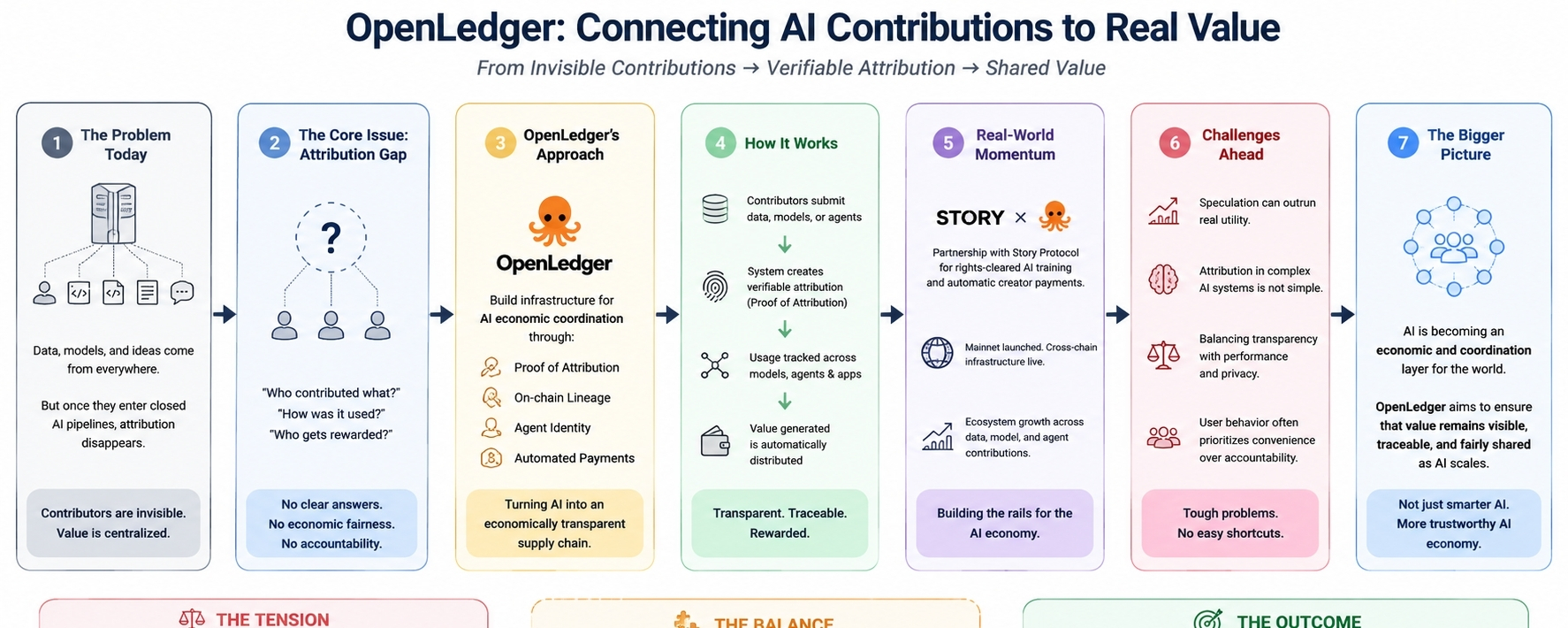
I was reading about OpenLedger recently, and what caught my attention wasn’t the “AI blockchain” label. Honestly, almost every project in crypto seems to attach AI somewhere in the description now. What interested me more was the problem they’re trying to sit in the middle of: the gap between contribution and reward.
And that gap is everywhere.
Think about how modern AI works today. A creator uploads research. Developers publish open-source code. Communities generate conversations, images, feedback, datasets. Then large AI systems absorb all of it into training pipelines. Months later, billion-dollar products emerge but most contributors never really know where their input went or whether it mattered at all.
It reminds me of social media in the early days.
People thought they were just posting photos or thoughts online. Years later, platforms became trillion-dollar ecosystems powered by user-generated behavior. The users created enormous value, but the ownership structure stayed heavily centralized.
AI feels similar, except the stakes are higher because now the raw material isn’t just attention. It’s intelligence itself.
That’s where OpenLedger becomes interesting to me. The project seems less focused on “replacing” centralized AI and more focused on creating economic memory around AI systems. In simple terms: if your data, model, or AI agent creates value, can the system actually track that contribution and reward it transparently?
That sounds technical, but the real issue is trust.
Not marketing trust. Operational trust.
Because systems behave very differently when they’re under pressure.
For example, everybody loves openness until money becomes serious. Then incentives start bending. Companies become protective. Data sources become blurry. Attribution disappears. Suddenly the “open ecosystem” becomes much more closed than people expected.
We’ve already seen hints of this across the AI industry over the last year. Lawsuits around copyrighted training data. Publishers challenging AI scraping practices. Creators asking why their work powers systems they never agreed to support. Even regulators are starting to push for better transparency around AI origins and accountability.
That’s why OpenLedger’s recent focus on Proof of Attribution and AI lineage tracking feels timely. Not because it magically solves everything, but because it acknowledges something many projects avoid saying directly: verification is easy in theory and painfully hard in real-world execution.
And execution is where systems usually break.
A blockchain can verify transactions beautifully. But AI systems are probabilistic. Outputs come from billions of weighted relationships inside neural networks. Proving that one specific dataset meaningfully shaped an output is much harder than tracking a token transfer.
That tension is important.
Some people assume decentralized AI automatically creates fairness. I don’t think reality works that neatly. Decentralized systems can become fragmented, slow, or economically chaotic if incentives aren’t aligned properly. Meanwhile centralized systems often execute faster because decisions are simpler.
So the real challenge isn’t choosing one side.
It’s figuring out how to combine openness with coordination.
That’s probably the deeper layer I see in OpenLedger’s approach. They’re trying to create infrastructure where AI contributions become economically traceable without slowing everything down to the point nobody wants to use it.
And honestly, that balancing act is harder than most people realize.
I think about autonomous AI agents a lot here. Everyone talks about agents as if they’re just smart assistants, but economically they’re something bigger. Agents will eventually negotiate, transact, generate content, manage workflows, maybe even operate businesses. Once that happens, attribution becomes incredibly important.
If an agent makes money using your dataset, who gets paid?
If a model generates something harmful, who carries responsibility?
If thousands of contributors shape an AI system over time, how do you preserve fairness without creating unbearable complexity?
Most AI conversations skip these questions because capability demos are more exciting. But long-term infrastructure is usually built around boring problems nobody notices until systems scale.
The internet itself worked that way. Payments worked that way. Cloud infrastructure worked that way.
Reliability becomes visible only after failure.
That’s also why I’m cautious about projects in this space, including OpenLedger. Narrative momentum can move much faster than actual infrastructure maturity. Crypto especially has a habit of rewarding vision before reliability is fully tested.
But sometimes that speculation hides a legitimate structural shift underneath.
And I think the structural shift here is that AI is slowly evolving from a software industry into a coordination industry.
The hardest part may not be building intelligence anymore. It may be organizing incentives around intelligence in a way people can trust over long periods of time.
That’s a very different challenge.
Because trust isn’t created by slogans or decentralization alone. Trust forms when systems continue functioning during stress when markets get volatile, when incentives conflict, when scale increases, when regulation arrives, when mistakes happen.
Anybody can design a system for ideal conditions.
The real test is what survives contact with reality.
Maybe that’s why I keep returning to projects like OpenLedger. Not because they have all the answers, but because they seem to be asking a more honest question than most of the industry:
As AI becomes more autonomous and economically powerful, how do we stop the value underneath it from becoming invisible again?
I don’t think we fully understand the answer yet. But I suspect the systems that matter most over the next decade won’t simply be the smartest ones.
They’ll be the ones people can still trust when complexity becomes too large for any single person to fully see.
