A while ago I started noticing something uncomfortable about the way people talk about artificial intelligence. Whenever a model becomes successful, the conversation usually narrows around the company behind it, the founders, the valuation, the infrastructure. But the deeper I looked, the harder it became to ignore how many invisible hands are buried underneath every “intelligent” system we use.
Someone cleaned the data.
Someone labeled edge cases for hours.
Someone tested outputs nobody else wanted to examine.
Researchers shared ideas openly.
Communities refined models through constant interaction.
Developers built tools on top of imperfect foundations.
And then somehow all of that work dissolves into a single branded product.
That part stayed with me.
AI systems are often described as if they emerged from pure computation, but they are really layered accumulations of human contribution. Thousands of small inputs become compressed into something that later appears seamless and centralized. The strange thing is that once intelligence absorbs those contributions, the memory of where they came from begins to disappear.
I think this is one of the least discussed problems in AI right now.
Not scaling.
Not inference costs.
Not even regulation.
Memory.
Or more specifically: attribution.
Because intelligence without memory creates imbalance....
The current structure of AI rewards ownership far more than participation. The people closest to the final model capture most of the visibility and economic value, while contributors further down the chain slowly become anonymous. Data providers become invisible. Testers disappear. Smaller researchers get absorbed into larger ecosystems without much acknowledgment beyond a citation buried somewhere nobody reads.
Maybe that was always inevitable. Large systems simplify history. They compress complexity into cleaner narratives. But AI feels different because contribution itself is becoming the raw material of the industry.
The more capable these systems become, the more valuable human input becomes too.
And contributors are starting to realize that.
You can already feel a quiet cultural tension forming between centralized AI companies and the people feeding these systems. Not always openly. Sometimes it shows up as frustration over scraped content. Sometimes through debates around ownership, compensation, or dataset provenance. Sometimes it appears in smaller ways, like creators questioning why their work strengthens systems that never remember them afterward.
I don’t think people only want payment.
I think they want recognition that their contribution mattered.
That’s a different thing entirely.
This is where blockchain starts becoming interesting to me again, although probably not in the way most crypto narratives frame it. The important part is not speculation or branding everything as decentralized. It is the possibility of creating persistent memory around collaboration.
A transparent record layer.
Something that can track contribution instead of erasing it.
When people hear “AI + blockchain,” the conversation usually drifts toward tokens very quickly. But the more meaningful question may be simpler: how do future AI systems remember who helped create them?
Because if AI becomes deeply collaborative, provenance stops being optional.
You need systems capable of tracing where information came from, who improved what, which datasets influenced outcomes, and how intelligence evolved across time. Not just for fairness, but for accountability. Trust becomes difficult when the creation process is hidden behind centralized walls.
And honestly, transparency changes behavior naturally.
People act differently when contribution histories are visible.
Communities become more careful.
Collaboration becomes easier to verify.
Credit becomes harder to monopolize.
That does not magically solve exploitation or imbalance. But it changes the structure of memory itself.
That’s one reason @OpenLedger caught my attention recently.
Not because it presents itself as another “AI crypto” project. We already have enough of those. What feels more interesting is the underlying direction it seems to explore: the idea that collaborative AI systems should be able to remember contribution instead of absorbing it into silence.
There’s something subtle there that I think many people are overlooking.
OpenLedger appears less focused on replacing AI companies and more focused on building infrastructure around attribution, provenance, and transparent participation. almost like an attempt to give AI systems a historical layer they currently lack.
And maybe that layer becomes essential later.
Because the future of AI probably cannot depend entirely on blind trust in centralized actors. The systems are becoming too influential, too integrated into decision-making, too economically important. If contributors cannot trace how value moves through these ecosystems, resentment eventually builds underneath the surface.
History usually matters more than people expect.
Especially in systems built from collective intelligence.
The strange irony is that modern AI has extraordinary computational memory while still failing at social memory. Models can retain patterns across unimaginable scales, yet the humans who shaped those patterns often disappear from the story almost immediately.
That imbalance feels unstable to me.
Maybe the next stage of AI is not only about making systems more intelligent..
Maybe it is about making them more accountable to the networks of people who helped create that intelligence in the first place.
Because in the end, intelligence alone is not enough.
A system also needs the ability to remember.
#OpenLedger $OPEN

Articolo
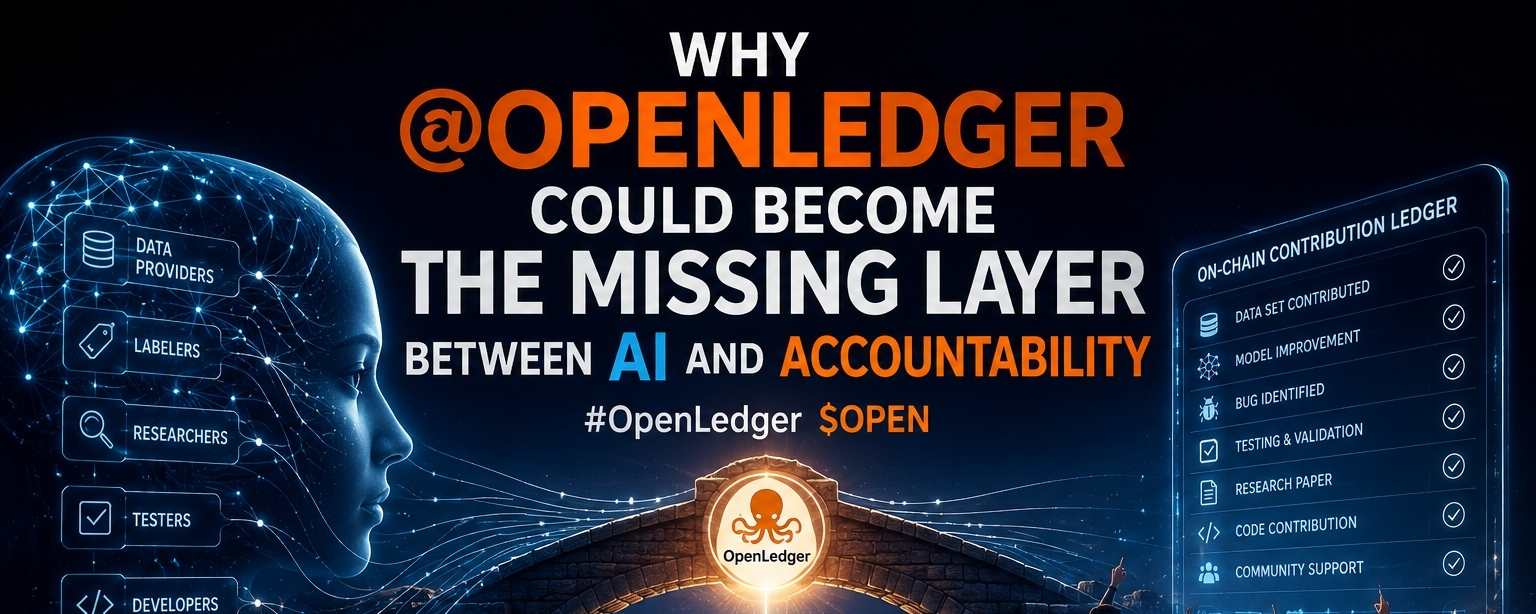
Why @OpenLedger Could Become the Missing Layer Between AI and Accountability
Disclaimer: Include opinioni di terze parti. Non è una consulenza finanziaria. Può includere contenuti sponsorizzati. Consulta i T&C.