Most crypto tokens start to feel the same after a while. They launch with big promises, a lot of energy, and a story that sounds stronger than the actual product. For a short time, that can be enough. People get excited, prices move, and the community believes something important is being built. But excitement fades fast when a token doesn’t really do much in everyday use. That’s why OPEN Token should be judged in a very simple way: does it have a real place in the system, or does it just sit around as part of the branding?
From my point of view, that’s the whole question. A token only becomes meaningful when people need it for something they can’t easily avoid. If OPEN Token is part of real activity, then it has a chance to matter long term. If it’s only there to sound innovative, then it will always be fighting for attention. The difference between those two things is huge. One creates lasting value. The other creates temporary noise.
Gas is usually the first sign that a token has real usefulness. When a token is needed to pay for transactions, it becomes part of the network’s daily life. That matters because people don’t just hold it for hope or hype anymore. They need it to do something. I think that’s one of the strongest forms of utility a token can have. It gives the token a basic reason to exist. Every time someone uses the network, the token comes into play. That kind of demand is much stronger than the kind built on speculation alone.
Still, gas by itself doesn’t solve everything. A lot of projects can point to transaction fees and say that they have utility, but fees only matter when there’s enough actual usage behind them. If the network is quiet, the gas feature doesn’t create much economic strength. It just sounds good in theory. So I’d say the real test for OPEN Token is not whether gas exists, but whether people are using the system often enough for that gas demand to become meaningful. If they are, that’s a good sign. If they’re not, then the utility is only surface-level.
Inference is where things become more interesting. If OPEN Token is tied to inference in a real way, then it’s connected to something far more valuable than simple transaction flow. Inference is about computation turning into results. It’s the part where people get answers, predictions, automation, or outputs that actually help them. That’s a much stronger position than just being a token with a good story. If the token is part of how inference is accessed or paid for, then it starts to sit inside a real demand cycle.
That’s why inference could be one of the most important parts of OPEN Token’s entire structure. People don’t use inference because it sounds futuristic. They use it because it gives them something useful. That kind of utility can grow naturally if the product is good and the service is actually needed. The more people use it, the more the token should matter. That’s a much better setup than a token that only moves because traders are talking about it.
At the same time, I’ve learned to be careful whenever a project leans too hard on the word AI. A lot of tokens borrow that word without really connecting it to anything practical. They use it like decoration. They make it sound like the token is part of a smart future, but when you look closely, there’s not much there. That’s why the key question for OPEN Token is whether inference is actually built into the way the product works. If the token is truly needed for access or use, that’s real utility. If it’s only loosely attached to the idea, then the token is weaker than it sounds.
Governance is another area where people often give too much credit too quickly. A token with governance sounds important. It suggests decentralization, community power, and shared control. But in reality, governance often matters less than people think. In many projects, the votes don’t change much. A few large holders may have most of the influence. Sometimes the decisions are already heading in one direction, and the vote just makes it look official. So when I look at governance, I don’t ask whether it exists. I ask whether it truly affects anything.
If OPEN Token gives holders real influence over treasury decisions, protocol changes, incentive design, or network direction, then governance has real value. It gives people a reason to stay involved beyond price. It makes them feel connected to the future of the ecosystem. That can be powerful. But if the governance system is mostly for show, then it becomes a weak feature. It may look good in a presentation, but it won’t create much lasting strength on its own.
Staking is a little different, because it can actually help a token if it’s designed well. On the positive side, staking encourages people to hold for longer, reduces quick selling, and gives users a reason to stay committed. That can strengthen the token’s overall structure. It can also make people feel like they’re supporting something bigger than a short-term trade. In that sense, staking can be a healthy sign.
But staking can also go wrong very easily. If the rewards are too high, then people stop staking because they believe in the project and start staking because they want the yield. That changes everything. The token then begins to depend on constant rewards to keep people involved. Once the incentives slow down, the excitement often drops too. That’s why I think staking only helps when it’s handled carefully. It should reward commitment, not create a habit of chasing emissions.
Rewards work in a similar way. They can be useful at the beginning of a project because they help attract users, create activity, and give people a reason to try the network. That early support can matter. But rewards should never become the whole reason the system works. If people are only there for the incentive, then the project hasn’t really built loyalty. It’s just rented attention for a while.
That’s what makes reward design so important. If OPEN Token uses rewards to build habits that continue after the incentives become smaller, then that’s a healthy sign. If the rewards are only creating short bursts of activity that disappear later, then the system is fragile. I think the best reward models are the ones that quietly help people settle into real use. The bad ones are the ones that make the project look busy without actually building much underneath.
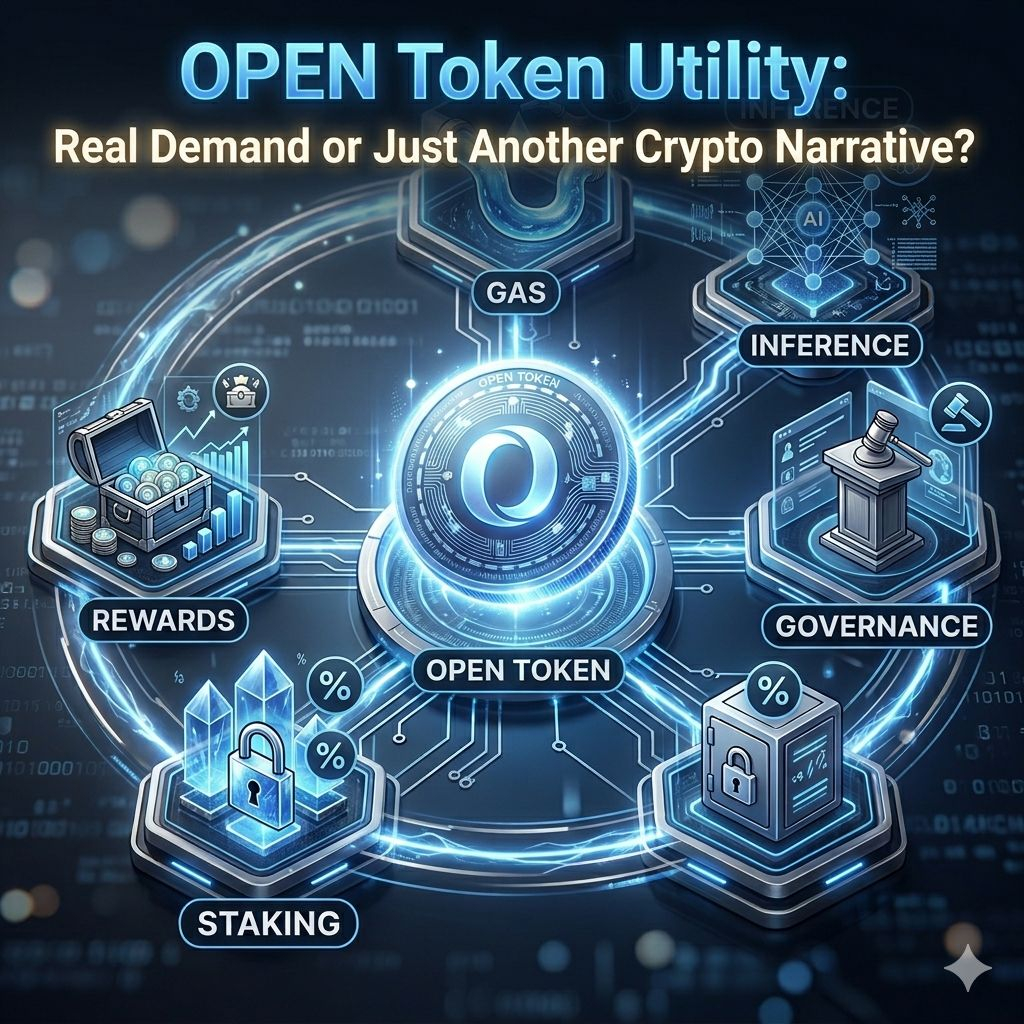
What matters most is how all these pieces fit together. Gas, inference, governance, staking, and rewards shouldn’t be treated as separate selling points. They should work like parts of the same machine. Gas should create regular demand. Inference should create practical use. Governance should give people a reason to stay engaged. Staking should encourage patience. Rewards should help the system grow without becoming a long-term crutch. When those pieces support each other, the token begins to feel real.
If they don’t connect well, then the whole thing weakens. Gas may not be used enough. Inference may not drive enough demand. Governance may not carry much weight. Staking may be too inflationary. Rewards may create temporary hype and then fade away. I’ve seen enough token models to know that a project can look serious on the outside while still being shaky underneath. A long list of utilities doesn’t automatically make a strong token. The real question is whether those utilities actually matter in the lives of users.
That’s why my honest view is that OPEN Token should be judged by necessity, not by narrative. Does anyone actually need it? Do users rely on it? Does the system work better because the token exists? Those are the questions that matter. A token can have a good website, a lot of community energy, and a confident message, but if it doesn’t have a clear job, it won’t hold people’s attention for long.
The market has become more skeptical about this, and honestly, that’s a good thing. People are less willing now to accept token language at face value. They want proof. They want to know what the token does, who uses it, and why it’s not easily replaced. That’s the right attitude. Projects should be forced to earn trust. OPEN Token should be no exception. If its utility is real, it will stand up to that kind of pressure. If it’s mostly a story, the cracks will eventually show.
So when I step back and look at OPEN Token, I see something that could be meaningful, but only if it actually becomes part of how the network works. Gas gives it a basic economic role. Inference could give it real functional demand. Governance could make it more participatory. Staking could create discipline. Rewards could help with early growth. But all of that only matters if the system feels natural and necessary. That’s what gives a token staying power.
To me, that’s the most human way to look at it. Not through hype, not through slogans, not through fancy language, but through simple reality. Do people need it? Do they use it? Does it make the system better? If the answer is yes, then OPEN Token has a strong case. If the answer is no, then it’s just another token trying to look more important than it really is.
At the end of the day, that’s what separates a serious token from a short-lived one. Serious tokens become part of behavior. They get used because they’re needed. They don’t depend entirely on attention, and they don’t survive only because people are talking about them. If OPEN Token can reach that point, then it has a future worth taking seriously. If it can’t, then no amount of polished utility language will change the outcome.