
I kept rereading the same line in OpenLedger’s description: monetizing data, models, and agents.
At first, it sounds straightforward. AI contributors create value, the network helps coordinate that value, and liquidity makes participation economically meaningful. That is the clean version most people will probably focus on.
But after sitting with it longer, I started thinking about something else.
Systems that turn activity into liquid economic assets rarely stay neutral for long.
They begin shaping the behavior of the people inside them.
That possibility feels much more important than the usual “AI + blockchain” framing around OpenLedger.
Because once data, models, and agents become economically active objects, builders may stop thinking only about performance. They may start thinking about visibility, continuity, and market presence at the same time.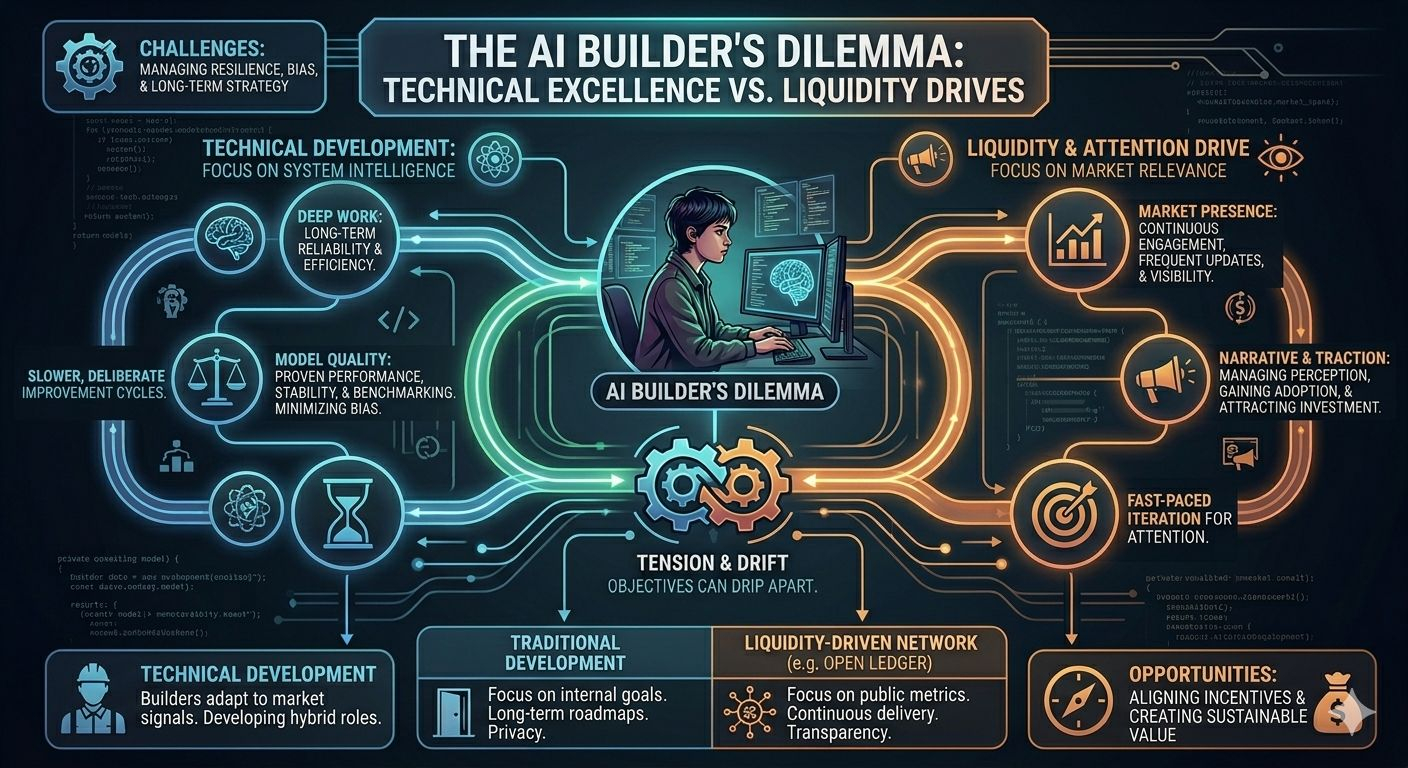
That changes the psychology of development itself.
The strange part is that this pressure does not appear immediately. On the surface, OpenLedger simply looks like infrastructure helping AI participants monetize their contributions more efficiently. Data can carry value. Models can carry value. Agents can carry value. Attribution becomes economically meaningful instead of invisible.
Reasonable idea.
But economic systems have a habit of quietly training participant behavior over time.
And markets usually reward what stays visible.
That is the part I cannot stop thinking about.
A builder creating AI tools inside a liquidity-driven environment may eventually face two separate objectives at once. One objective is improving the actual intelligence of the system. The second is keeping that system economically relevant inside the network long enough for value to continue flowing around it.
Those objectives can overlap.
They can also slowly drift apart.
A technically strong model that becomes inactive or ignored may lose economic gravity faster than a more visible system with stronger circulation around it. An agent that constantly attracts interaction may become more economically important than a quieter tool producing better outputs behind the scenes.
That does not automatically mean the worse system wins.
But it does mean attention starts affecting survival.
And crypto markets already understand this dynamic better than most industries do. Visibility compounds. Narratives persist. Continuous engagement often matters more than raw technical quality for longer than people expect.
If OpenLedger succeeds in building real liquidity around AI assets, some of that same market behavior could start leaking into AI development itself.
I think smaller builders would feel this pressure first.
Large companies already have distribution, infrastructure, and user pipelines. They can survive periods of low attention because their ecosystems are already established.
Independent contributors usually cannot.
Inside an economically active attribution network, smaller builders may feel pressure to constantly maintain momentum around their models, datasets, or agents simply because inactivity could weaken monetization opportunities over time.
That creates a very different operating environment from traditional software development.
Normally, developers can disappear for months, improve something privately, then return when the product is ready. But in systems where liquidity and attribution remain connected to ongoing participation, disappearing carries economic cost.
Even temporary silence can become strategically dangerous.
That changes creative incentives in ways people may not fully appreciate yet.
Builders may prioritize frequent visibility over slower improvement cycles. They may optimize for systems that maintain interaction rather than systems that quietly become more reliable. Public engagement starts mattering operationally, not just socially.
The network does not need to force this behavior directly.
The incentive structure can produce it naturally.
That is usually how economic pressure works. Nobody announces the behavioral shift while it is happening. Participants simply adapt to whatever keeps them economically alive.
And I think OpenLedger sits close to that transition point.
The project description sounds simple enough: an AI blockchain coordinating value around data, models, and agents. But underneath that simplicity is a more complicated question about what happens when intelligence itself becomes economically liquid.
Because liquidity does not just reward usefulness.
It rewards sustained market presence.
Those are related ideas, but they are not identical.
I also think this creates a subtle long-term tension for AI builders themselves. The more economically connected their systems become, the harder it may become to separate technical development from market maintenance.
At some point, the builder is no longer just improving intelligence.
They are managing economic attention around intelligence.
That can slowly distort priorities without anybody noticing immediately.
And the uncomfortable part is that the distortion may initially look like success. Higher activity. More circulation. More participation. More visible ecosystems.
But visibility-driven environments often become exhausting for the people producing the underlying work.
Especially smaller participants.
That is why I do not think OpenLedger is only an infrastructure story.
It may also become a behavioral story about what happens when AI builders operate inside systems where relevance needs to remain continuously active to preserve economic momentum.
Maybe that pressure becomes manageable.
Maybe stronger attribution systems genuinely create healthier incentives for contributors.
But markets rarely reward silence for very long.
And once intelligence becomes tied to liquid economic networks, staying economically visible may quietly become part of the job itself.