
 I’ve been thinking a lot about how strange the AI economy is becoming.
Not the technology itself.
The ownership behind it.
Because the more advanced AI gets, the more invisible the contributors seem to become.
A model produces an answer in seconds.
An agent completes a task.
An AI system generates value almost instantly.
But underneath that output sits an enormous hidden structure.
Data from millions of people.
Feedback loops.
Model refinements.
Context collected across countless interactions.
And somehow, most of the value keeps flowing toward the top of the stack.
That part has been bothering me lately.
Not because companies building AI shouldn’t benefit from their work. Of course they should.
But because modern AI systems are starting to feel less like isolated products…
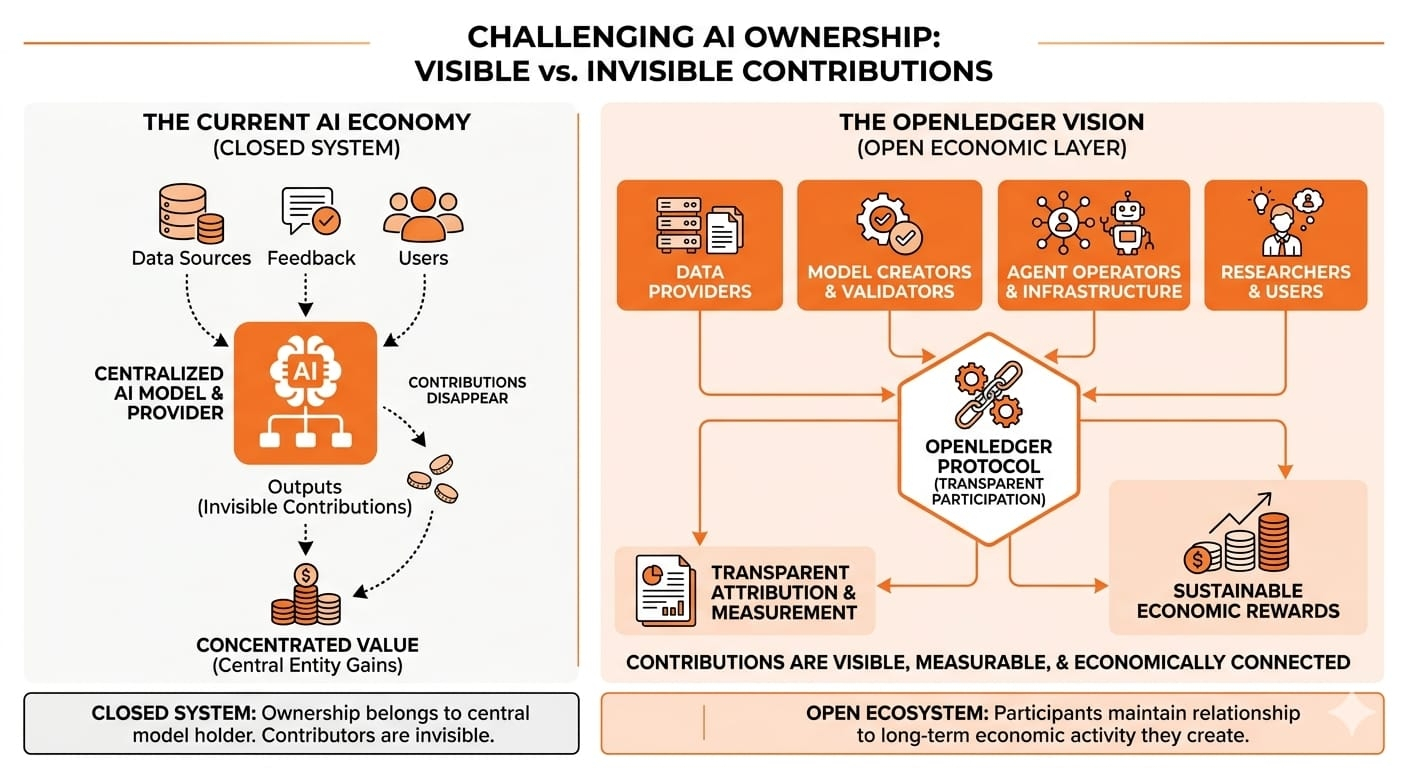
and more like economies built on invisible participation.
That changes the conversation completely.
I think people still underestimate how much AI depends on contribution layers most users never see.
A model is not just code.
It is shaped by data providers, validators, infrastructure operators, researchers, and users constantly feeding signals back into the system. Even interaction itself becomes part of the refinement loop.
The strange thing is that these contributions often disappear once the output is produced.
The AI answer becomes visible.
The ecosystem that made the answer possible does not.
That’s where OpenLedger started feeling interesting to me.
Not because it’s simply combining AI and blockchain. That narrative exists everywhere now.
What caught my attention is the deeper idea underneath it:
What happens if AI contributions stop disappearing into centralized systems?
What if the people and systems shaping AI could exist inside a structure where their participation remains visible, measurable, and economically connected to the value being created?
That question feels much bigger than most people realize.
Because once AI becomes an economy instead of just a tool, ownership starts mattering differently.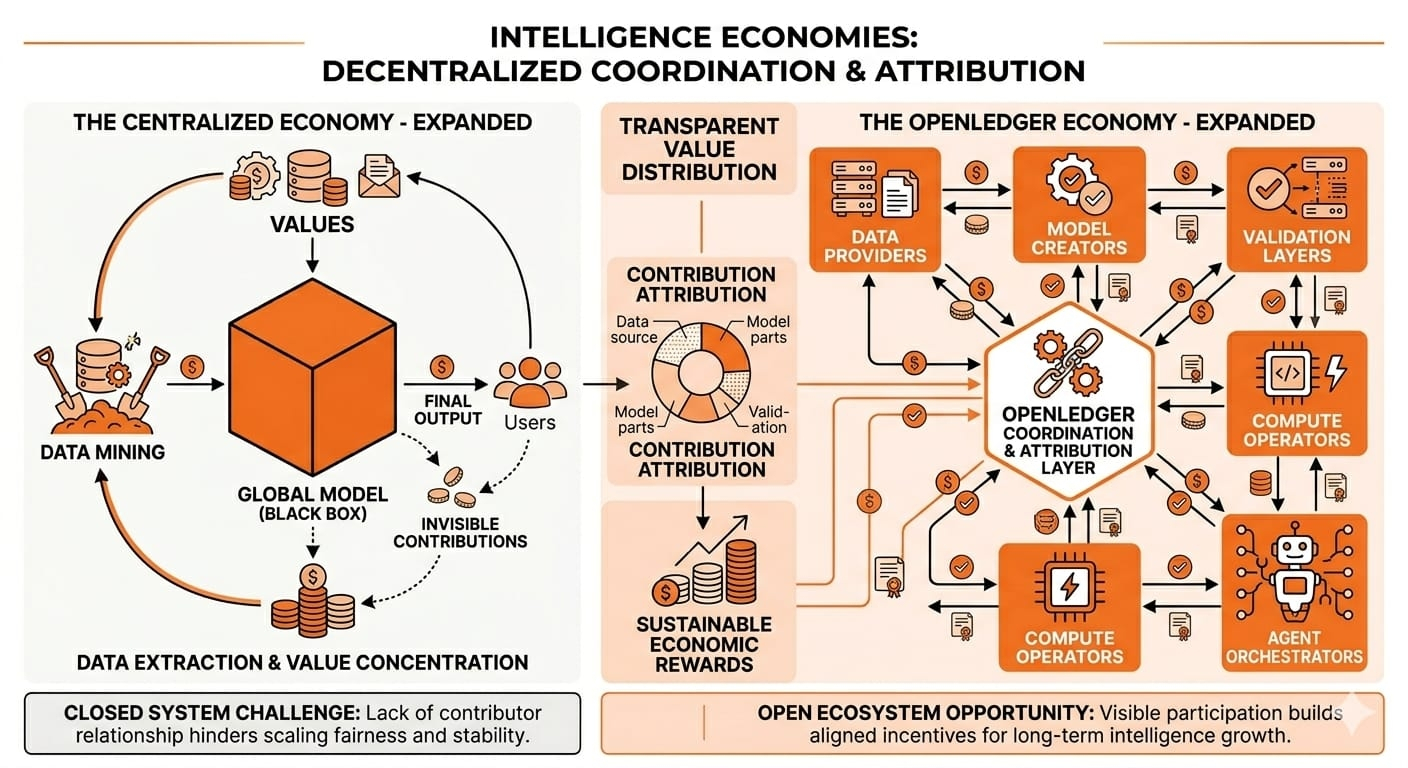
Right now, most AI systems operate like closed environments.
Data enters.
Models improve.
Value gets extracted.
But contributors rarely maintain any meaningful relationship to the long-term economic activity their participation helped create.
OpenLedger seems to challenge that structure directly.
The project introduces a direction where AI systems can become more transparent in how contributions are tracked and connected to value creation. Data, models, and agents stop behaving like isolated components owned entirely by centralized entities.
Instead, they begin behaving more like participants inside an open economic layer.
That changes the psychology of AI completely.
Because once contributions become visible, they also become attributable.
And attribution changes incentives.
People contribute differently when they know their participation doesn’t simply vanish into a black box.
I think this is one of the hidden tensions inside the current AI landscape.
Everyone talks about smarter models.
Very few people talk about the infrastructure required to make AI economies sustainable over long periods of time.
If AI systems continue absorbing value from contributors without creating structures for participation and ownership, eventually the imbalance becomes difficult to ignore.
Open ecosystems emerge precisely because centralized accumulation eventually creates pressure around fairness, transparency, and incentives.
Blockchain systems understood this dynamic early.
Networks scale more effectively when participants have reasons to remain aligned with the system’s growth.
OpenLedger appears to apply that logic directly to AI infrastructure.
Instead of treating AI as something produced only by a central model provider, it explores an environment where many different contributors can exist within the same economic system.
That includes data providers.
Model creators.
Agent operators.
Validation layers.
Each part contributes to the broader intelligence economy.
And importantly, each part can remain economically visible instead of disappearing behind the final output.
That visibility matters more than it seems.
Because the future AI market probably won’t revolve around just one model answering questions.
It will revolve around networks of models, agents, datasets, and applications interacting continuously.
At that point, the real challenge becomes coordination.
Who contributed what?
How is value distributed?
Which systems are creating meaningful intelligence versus simply extracting from existing ecosystems?
Without transparent infrastructure, those questions become harder to answer over time.
OpenLedger feels like an attempt to build that missing layer before the AI economy becomes too large to reorganize cleanly.
And honestly, I think that timing matters.
Most infrastructure shifts look unnecessary in the beginning because the old system still appears functional.
But pressure accumulates quietly.
The internet eventually needed open protocols.
Digital economies eventually needed decentralized coordination.
AI may eventually need transparent contribution layers for the exact same reason.
Not because openness sounds idealistic.
But because large-scale intelligence systems become unstable when too many contributors remain economically invisible.
That’s the part I keep coming back to.
OpenLedger isn’t just exploring how AI can become more decentralized.
It’s exploring whether the people and systems shaping intelligence can remain connected to the value they help create.
And if AI truly becomes one of the largest economic layers humanity has ever built…
that question may become far more important than the models themselves.
#openledger #OpenLedger #USCourtDeniesKalshiPolymarketPause #CryptoMarketCapNears2.6T #KevinWarshLeadsFederalReserve